
NEWS
The Nvidia Board Prepares to Oust a CEO It Never Replaced
Nvidia’s board can fire Jensen Huang by majority vote, but 33 years with no named successor leave only a stopgap CFO.

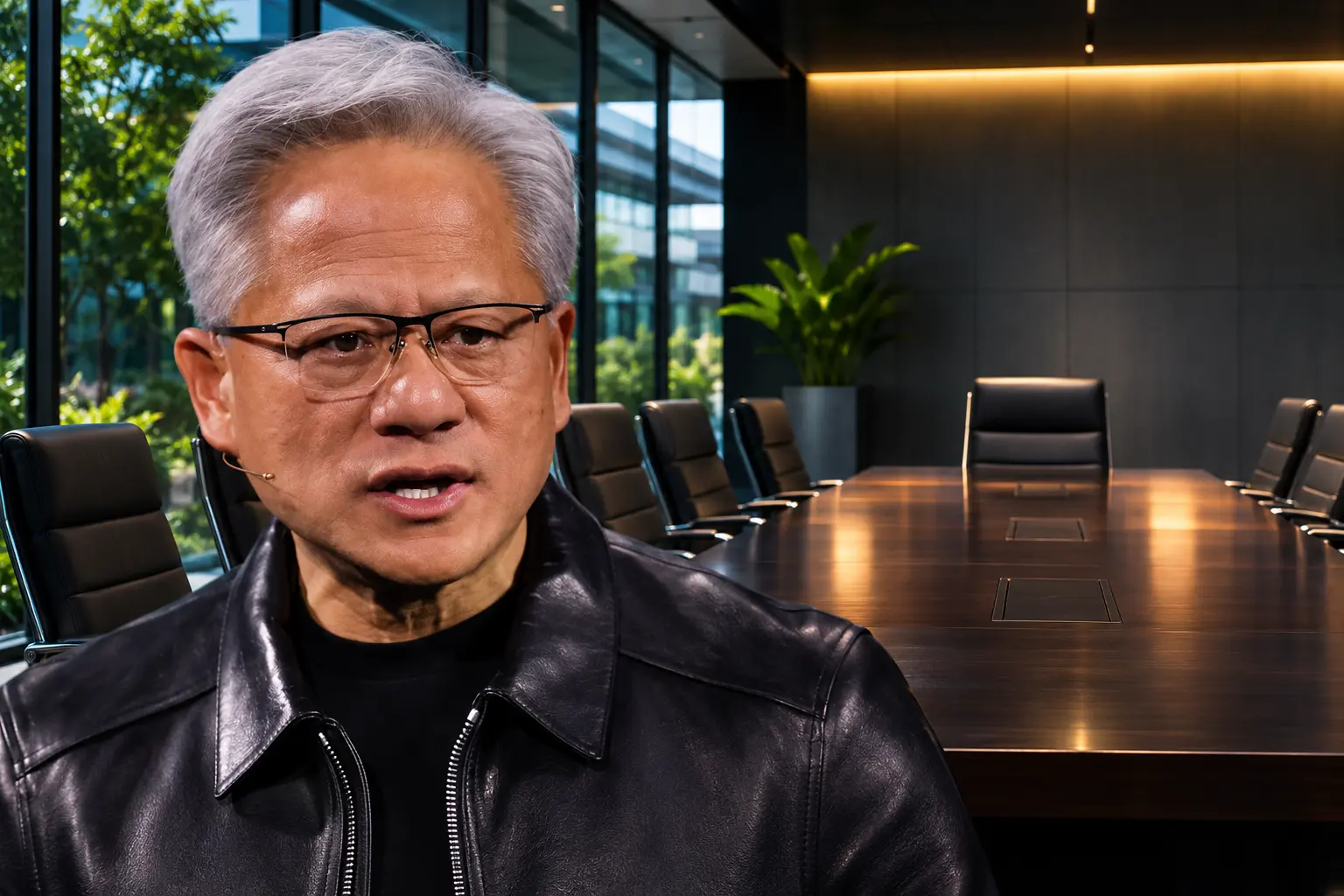
Nvidia’s board met late Wednesday to decide whether to remove Jensen Huang, the only chief executive the chipmaker has had since 1993, after reports of two extramarital affairs. Shares fell about 8% after hours. If those losses hold, the roughly $4 trillion company has shed about $600 billion in market value since the board opened its probe on November 8.
On Sunday that same board said Huang would keep the job without interruption. By Wednesday night, people familiar with the matter said directors were preparing to take it away, and they still had no named successor waiting in the next room.
Sunday’s Vote of Confidence Lasted Three Days
Huang, 63, wrote to staff on November 8 that he had been unfaithful to his wife. He did not name the other person. He said he would cooperate with a board review of national-security reporting around the relationship, and he asked that his family be given privacy.
The board spoke the same day. It said it was opening an independent probe after reporting that the founder and CEO had been the target of a foreign intelligence effort. A committee of independent directors, with outside counsel, would run it. The directors said they had no reason to believe secrets were compromised, that U.S. national and economic security came first, and that they still had confidence in Huang and his leadership team. A company spokesman added that Huang was committed to leading Nvidia as CEO without interruption.
That line did not survive the week.
THE FOUR DAYS THAT BROKE THE SCRIPT
- November 8, 2026: Huang emails staff an apology. The board opens a probe and says it still has confidence in him.
- November 9, 2026: China, through Foreign Ministry spokesman Guo Jiakun, calls the spy narrative a groundless accusation, slander, and a smear.
- November 10, 2026: Independent directors retain Joon H. Kim and Wachtell, Lipton, Rosen & Katz to run the inquiry announced on Sunday.
- November 11, 2026: A second relationship, with a vice president who reports to Huang, becomes public. The board meets late to decide his job.
Under Nvidia’s bylaws, directors can remove Huang with or without cause by a majority vote. Nvidia has 11 directors and treats all but Huang as independent, so six votes would be enough. Nvidia did not comment on the session. By Thursday, November 12, it had not announced a decision.
The Two Relationships the Board Cannot Ignore
The first file is Alice Huang, also known as Huang Le, a Chinese executive tied to Megaspeed International, a Singapore cloud firm that Nvidia has listed as a partner. U.S. officials concluded she was an intelligence asset for Beijing who built a close relationship with the Nvidia chief, according to people briefed on that assessment. The two are not related. Jensen Huang’s November 8 note admitted unfaithfulness without naming her.
Megaspeed has been under U.S. scrutiny over suspected diversion of restricted Nvidia chips toward China. Nvidia’s general counsel, Tim Teter, called the Commerce Department in 2025 about a Singapore detention of Alice Huang. Singapore’s inquiry into alleged chip diversion later closed with no adverse action against Megaspeed, the company has said. Alice Huang has not been reached for comment in recent reporting.
The second file landed on Wednesday. Five people who had worked at Nvidia said Huang had a relationship with Kimberly Powell, vice president of healthcare, one of the executives who reports to him. Powell, 48, joined in 2008 and was named to the healthcare post in 2017. Nvidia and Powell did not immediately comment.
I was unfaithful to my wife. My actions hurt her and our children. There is no excuse for what I did. I am deeply sorry.
Leading NVIDIA is the privilege of my life. My responsibility is to serve you and be worthy of your trust. I have fallen short of that responsibility. I am fully committed to NVIDIA and will work to earn back your confidence.
Jensen Huang, email to Nvidia employees, November 8, 2026
A private-life defense is easy to write if the only fact is an affair. It is harder if one relationship sits inside a live intelligence file and the other is with a subordinate on a 60-person reporting line. Nvidia’s own code, people around the company note, already tells staff to avoid conflicts, including personal ones. The board does not need a guilty verdict on espionage to have a problem. It needs to decide whether the CEO still meets the standard it would apply to anyone else in that building.
WHAT WE KNOW
- The admission: Huang told the company on November 8 that he was unfaithful to his wife and would cooperate with the board’s review.
- The first file: U.S. officials have described Alice Huang, a Megaspeed executive in Singapore, as a Chinese intelligence asset close to the Nvidia chief. China rejects that claim.
- The second file: People who worked at Nvidia say he also had a relationship with Kimberly Powell, a vice president who reports to him.
- The lawyers: Independent directors hired Kim and Wachtell on November 10 to run the inquiry.
WHAT IS UNCONFIRMED
- The vote: People familiar with the board said it was preparing to remove Huang. Nvidia has not said it did so.
- The secrets: The board’s own November 8 letter said it had no reason to believe national security or company secrets were compromised, and the probe is not finished.
- The heir: Some directors have discussed Colette Kress as an interim chief. No appointment has been announced.
Gil Luria, head of technology research at D.A. Davidson, put the bind in one line: if Huang broke the law or company policy, the board is likely to act as soon as it has proof, and an immediate removal would still be hard because there is no succession plan in place.
Nvidia Has 11 Directors and No Named Heir
Huang has said he does not subscribe to succession planning in the usual way and would rather grow a new crop of executives. The company has no board chair. Stephen Neal, the lead independent director and a former chief executive of the law firm Cooley, which helped set Nvidia up in 1993, holds the closest thing to that job. Public filings talk about leadership development and do not lay out an emergency CEO plan.
He runs the place through an oval desk in Santa Clara and a stack of “top five things” emails, with more than 60 people reporting to him, no president, and no chief operating officer. Both of his adult children work at the company. He owns about 3.6% of the stock. Co-founder Chris Malachowsky is still a senior technology executive. The machine is deep. The org chart still points at one chair.
HOW THE BOARD CAN ACT
- The vote: Eleven directors, ten of them independent, can remove the CEO with or without cause by majority, which means six votes.
- The chair: There is none. Neal, as lead independent director, is the named counterweight.
- The counsel: Kim, a Wachtell partner who served as acting U.S. attorney in Manhattan in 2017 and 2018 and oversaw more than 220 assistant U.S. attorneys, is running the outside inquiry.
- The tenure: Several directors, including Tench Coxe and Mark Stevens, have been in the room since the 1993 founding. Suzanne Nora Johnson joined when the board expanded to 11 on July 13, 2026.
- The gap: No director is a former national-security official, and Huang is the only current or former S&P 500 CEO at the table.
Kim’s hire is the tell that the Sunday letter was not the last word. His practice is internal investigations, white-collar defense, and crisis work, including economic espionage and workplace-misconduct files. The board announced him in a one-sentence note and said nothing about timing, scope, or early findings.
David Yoffie, a professor at Harvard Business School, said the directors have almost no good options, because Jensen is Nvidia, and a forced exit with no successors is a terrible outcome. Bernstein’s note to clients used the same identity: Nvidia is not an ordinary company, and Jensen is not an ordinary CEO; he is Nvidia. Shaun Maguire, a partner at Sequoia Capital, an early investor, wrote that Jensen is irreplaceable for America’s AI leadership.
Those lines are why the board looked slow on Sunday. They are also why a Wednesday ouster, if it comes, would be a governance act the company spent 33 years refusing to rehearse. Nvidia employs more than 40,000 people. Lots of them can run a function. None of them has been named as the next Huang.
Who Would Run Nvidia If Huang Leaves?
The board has been working with an outside firm to identify candidates and has discussed naming a temporary chief while that search runs, according to a person familiar with the process. Some directors favor Colette Kress, the chief financial officer since September 2013, as that stopgap. Kress is 59. She came from Cisco and Microsoft, has sat on every earnings call beside Huang through the shift from gaming cards to AI chips, and is the executive investors already know by name.
Josh Gilbert, lead analyst at eToro, called her the obvious choice to steady the ship for that reason. The objection writes itself in the other direction. A finance chief can hold the microphone. She cannot, on her own, own the product roadmap that made the stock a proxy for the entire AI build-out.
THE NAMES IN THE SUCCESSION ARGUMENT
| Name | Current job | Why the name is in play |
|---|---|---|
| Colette Kress | EVP and CFO, in the job since September 2013 | Some directors favor her as interim CEO; she is the voice on earnings calls |
| Ian Buck | VP, hyperscale AI products; joined in 2004 | Helped create CUDA; runs the hardware and software sold to the big clouds |
| Johny Srouji | Apple hardware chief | An outside name in the search talk; was on Intel’s CEO list in 2019 |
| Unnamed search firm | External mandate | Board is using an outside firm for a permanent chief and may install a temporary one first |
Buck joined after a Stanford Ph.D. and has testified to Congress on AI. Prediction-market odds on Polymarket, which on November 12 showed an 83% chance Huang would resign or be removed by year end, leaned toward Buck among successor names. He is the technical continuity argument. Kress is the market-calming argument. Srouji is the outsider argument. None of them is a published plan.
Other names in the parlor game, from Arm’s Rene Haas to 32-year Nvidia veteran Jeff Fisher to Huang’s children, are just that: parlor game. The useful fact is narrower. If the board wants the stock to stop finding a new floor, it needs a name in the same release as any exit. A blank box on the org chart is the extra loss.
Lawmakers Want Huang in a Hearing Room
Directors briefed the White House on the planned meeting, a senior administration official said. Lawmakers had already sent Huang a letter asking him to testify about the Alice Huang relationship, citing significant national-security concerns. A proposed investor class action filed in San Jose federal court on November 10 seeks to cover buyers of the stock between October 9 and November 8, the window from Nvidia’s earlier denial of Megaspeed-China claims through the day the board opened its probe. Reuters, describing the legal map, also noted an FBI inquiry and calls for congressional hearings.
Baird analysts Tristan Gerra and Tyler Bomba, writing after the board’s spy-file announcement, said Huang might need to step down as the top executive. They argued a new CEO is needed to put in internal safeguards that match U.S. limits on China’s access to American AI chips, and to rebuild trust inside and outside the company. They cut the stock to Neutral and cut their price target 60% to $200. That is an analyst’s policy argument, not a board finding. It is also the first time in this cycle a house that covers the name has said out loud that the founder is the problem, not just the scandal around him.
The other side of the argument is just as plain, and it does not need a letterhead. There is no clear replacement. A departure would be a net loss for shareholders and for the AI build that still runs on Nvidia’s stack. CoreWeave, a cloud firm that uses Nvidia chips and counts Nvidia as an investor, fell more than 4% after hours on the same tape, a reminder that this is not a closed-loop Santa Clara story.
The louder public split is cruder than that. One camp says a CEO who still delivers should not lose the job over his private life. The other camp is looking at a direct report and a live intelligence file and asking what rule would be left if this one is waived. The second camp has the better facts. The first camp has the better fear, which is a non-technical interim running a company whose edge is still a software platform named CUDA and a man who answers 60 inboxes.
Earnings Are Due Before the Probe Can Finish
Investors are due to hear Nvidia’s quarter on November 17, five days after the Wednesday meeting. Kim’s inquiry will not be finished by then. The class-action clock is already running. The White House has been briefed. China has called the spy story a smear. Alice Huang’s whereabouts have been reported as Beijing. Powell has not spoken. Huang has not named either woman in a public letter.
The board that spent 33 years making him irreplaceable now has the votes to fire him, a law firm to investigate him, and a CFO some directors would park in the job while a search firm looks for someone who can do the part Kress cannot. That is not a succession plan. It is the bill for not having one, arriving in the same week as the proof they waited for.
On Thursday morning the company still had one CEO, one unfinished probe, and no public successor. The bylaws say six directors can change the first of those facts whenever they choose.
Disclaimer: This article is news reporting and analysis for general information only. It is not investment advice, a recommendation to buy or sell Nvidia or any other security, or a prediction of the board’s vote, the probe’s findings, or future returns. Readers who are considering any trade, holding, or legal step tied to these events should consult a licensed financial adviser and, where needed, employment or securities counsel who can review their own facts. Share prices, market-value figures, prediction-market odds, and Huang’s status reflect the statements and market prints cited here as of November 12, 2026, and can change as the board, the courts, and the company speak.

Record Diesel Lifts UK Inflation Before Food Prices Follow

Nvidia Stops China H200 Sales as Cloud Licenses Close

Wake Forest Joins the Field; Texas Tech Stays Out

Supreme Court Lets Restored Research Grants Keep Flowing

FAA Ground Stop Began on a Network It Does Not Own

Rolex Made Drake the Daytona It Fights Jewelers Over

Treasury’s First Iran Bank Shot Lands on an Ally

Instinct’s $2.5 Billion Raise Still Binds the User as Agent

City’s £125m Enzo Deal Caps a £327m Midfield Rebuild

Meta’s Teen Settlement Leaves Chat Off the Clock
-
 ENTERTAINMENT3 months ago
Rolex Made Drake the Daytona It Fights Jewelers Over
-
 BUSINESS3 months ago
Treasury’s First Iran Bank Shot Lands on an Ally
-
 NEWS3 months ago
Instinct’s $2.5 Billion Raise Still Binds the User as Agent
-
 NEWS3 months ago
City’s £125m Enzo Deal Caps a £327m Midfield Rebuild
-

 ENTERTAINMENT3 months ago
Ricky Gervais Wants Alley Cats to Run Until He Dies
-
 NEWS3 months ago
Meta’s Teen Settlement Leaves Chat Off the Clock
-

 NEWS3 months ago
CSIRTs Inherit Europe’s Missing security.txt Before Article 14
-

 BUSINESS3 months ago
Berkshire Anchors Alphabet’s Record Raise With a $10 Billion Check