
NEWS
Turkey’s Electrification COP Opens With Coal Still in Charge
COP31 opened in Antalya selling a 35% electricity goal by 2035, while coal still supplies 34% of Turkey’s power and the pledge skips a clean-power rule.

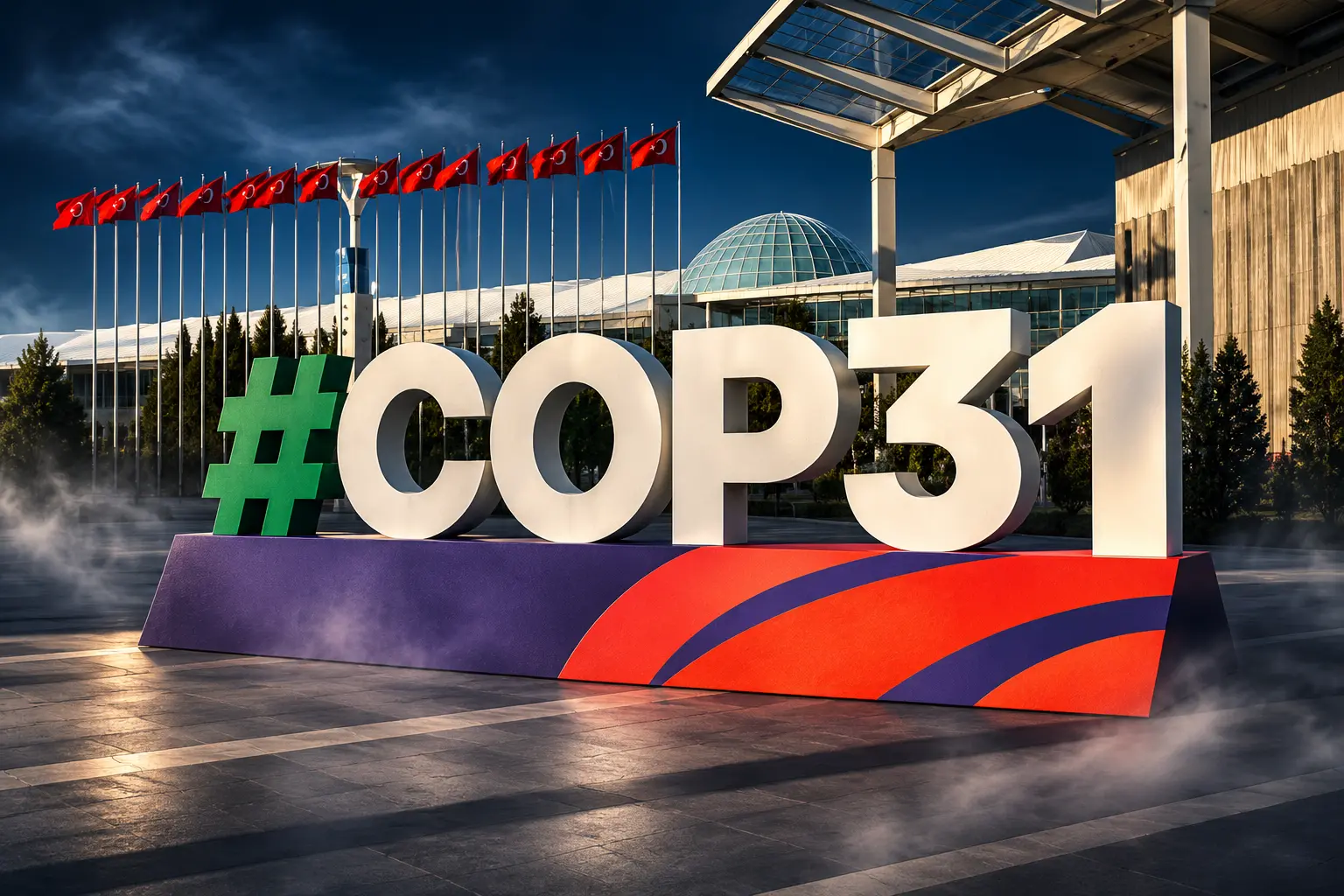
COP31 opened in Antalya on November 9 with its host already selling an age of electricity, and with coal still the largest source of power on the Turkish grid. More than 100,000 people are expected at the two-week UN climate summit, which runs from November 9 to 20 at a sprawling expo centre on the Mediterranean.
Murat Kurum, Turkey’s environment minister and COP31 president, called the meeting an “Implementation COP.” The flagship offer is a voluntary 35-by-35 Global Electrification Pledge. It does not require the new electricity to be clean.
The Implementation COP Started an Hour and a Half Late
The opening ceremony began an hour and a half late, with no public explanation. Negotiators had been locked in talks late on November 8 over demands from developing countries to put climate finance on the official agenda. Jasper Inventor, head of Greenpeace’s COP31 delegation, said it had “already been a difficult start for COP31.”
Kurum and Chris Bowen, Australia’s climate and energy minister and president of negotiations, clasped hands above their heads to applause. The split job settled a fight over who would host after COP30 in Belém. Turkey runs the venue and the Action Agenda. Australia chairs the formal talks.
Kurum told delegates that conflict, debt, food insecurity and a hotter climate now pile onto one another, and that “each crisis makes the others worse.” He added, “A drought in one part of the world is felt at the dinner table in another.” The World Meteorological Organization’s State of the Climate Update 2026, released as the summit opened, found that the past 12 years have each been the warmest on record, and that the past four years are the top four.
UN Climate Change Executive Secretary Simon Stiell said this year’s “fossil fuel cost chaos has delivered a global shockwave, hitting households hard and spreading inflation like a cancer.” He said global renewables saved $265 billion in the first half of 2026. The presidency warned that a strong El Niño could push 50 million more people into acute hunger, and it dedicated November 9 to food, agriculture and health.
UN Secretary-General António Guterres, in a statement as talks opened, said the world had “entered a new age of climate extremes” and urged leaders to “get serious by cutting emissions faster, accelerating a just transition from fossil fuels and delivering the finance and protection vulnerable countries need.” He is due to address the leaders’ segment on November 11.
Clean Power Stays Optional in the Flagship Pledge
On November 10, Energy and Transport Day, the presidency pressed countries and firms to raise electricity’s share to 35% of global final energy consumption by 2035, from around 23% now. Bowen put the same jump in plainer terms, saying the world needs to move electricity “from a fifth to a third of global energy consumption.”
The age of electricity is taking shape
Murat Kurum, COP31 president, Antalya presidency briefing, November 10, 2026
He said COP31 would be remembered as the moment “we flicked the switch.” The presidency said 180 companies with $1.69 trillion in revenues had backed faster electrification, and that a utilities group had raised its annual investment commitment to $156 billion. A new electrification finance coalition is co-chaired by the World Bank and the African Development Bank. IRENA, the International Renewable Energy Agency, says grid investment must reach a cumulative $10 trillion by 2035 if the goal is to be real.
The pledge is built on IEA and IRENA pathways that keep 1.5C “within reach.” The legal text still leaves a hole. Participants commit to lift electricity’s share to 35% globally by 2035, “supported by diverse and sustainable energy sources,” and they do so while “recognising different national circumstances and pathways.” Clean power, storage and modern grids are listed as enablers. They are not the target.
WHAT THE PLEDGE BINDS, AND WHAT IT DOES NOT
- The metric: Electricity’s share of final energy, not the carbon intensity of each kilowatt-hour.
- The date: 2035, with IEA and IRENA 1.5C pathways cited as the analytical base.
- The force: A voluntary Action Agenda instrument, unless parties later write it into a negotiated decision.
- The gap: No requirement that the extra electricity come from wind, solar, hydro or nuclear rather than coal or gas.
That gap is the argument hiding inside the branding. After COP28 in Dubai in 2023, countries agreed to transition away from fossil fuels in energy systems. COP30 in Belém produced a deal that did not mention fossil fuels in the formal text, and Brazil issued a voluntary road map instead. Electrification lets Antalya talk about delivery without reopening that word. Emel Turker Alpay, an energy campaigner with Greenpeace Turkey, said electrification “should end the dependency on fossil fuels,” and that the 35-by-35 target “did not specify electricity should be generated by clean energy.”
The European Union has already asked for “clean” electrification, which would put oil, gas and coal back on the table inside Turkey’s own proposal. Reports around the venue on November 10 said Ankara wanted the goal written into the formal outcome, not left as a side pledge. The presidency did not confirm that step in its public briefing.
Raising electricity’s share of global final energy consumption to 35% by 2035 is the ambition behind the 35 by 35 Global Electrification Pledge.
At the COP31 Presidency Press Briefing, #COP31 President Murat Kurum outlined the initiative, which brings political will and… pic.twitter.com/EimzmQJiMw
— COP31 Türkiye (@turkiyecop31) November 10, 2026
Coal Still Supplies a Third of Turkey’s Power
The host’s grid is the test of the pitch. Ember’s Türkiye Electricity Review 2026 found that in 2025 coal remained the largest power source at 34%, with about two-thirds of that coal power supplied by imports. Wind and solar together set a record at 22% of generation, a different 22% from the country’s electrification rate. No new coal plant has been commissioned since 2022, and Ember said none is under construction. Coal output still barely moved, from 122 TWh in 2024 to 121 TWh in 2025. A purchase guarantee for domestic coal plants that starts in 2026 may lift those plants’ running hours and set a new coal record.
TURKEY’S 2025 POWER MIX
| Source | Share of generation | Note |
|---|---|---|
| Coal | 34% | Largest source; about two-thirds imported |
| Wind and solar | 22% | Record share; solar about 11% |
| Wind and solar additions | 6.5 GW in 2025 | Short of the 8 GW a year Ember says the 2035 build needs |
| Battery project pipeline | 33 GW | Tied to new wind and solar plants |
Ufuk Alparslan, Ember’s regional lead for Turkey and the Caucasus, wrote that drought has cut output at the Atatürk, Karakaya and Keban dams by 29% over the past decade against 1996 to 2005, pushing an average $1.8 billion a year in extra fossil gas imports. Wind and solar have helped limit that bill. They have not knocked coal off the top of the stack.
A second Ember paper, published as COP31 opened, found that electricity met 22% of final energy demand in Turkey in 2024, while fossil fuels still supplied 70%, a share unchanged since 1990. Existing kit could already electrify 100% of energy use in buildings, 96% of transport and 58% of industry. If today’s trends hold, Ember puts the national electrification rate at 24.4% in 2035, about 11 points short of 35%. The rate rose only 1.3 points in the 11 years to 2024, so hitting 35% would take progress about 10 times as fast.
WHAT 35% WOULD TAKE IN TURKEY
- Cars: 19 million electric cars on the road by 2035, about 1.7 million new ones a year.
- Vans and trucks: 6.5 million electric commercial vehicles.
- Homes: Heat pumps in 20 million homes.
- Factories: About 12 GW of electric heat in industry.
Bahadır Sercan Gümüş, the Ember analyst who wrote that paper, is blunt that building more power plants is not enough. Heat pumps, electric cars and electric industrial heat have to move together, with the grids to match. Kurum is asking the rest of the world to do in nine years what his own energy system has not done in eleven.
Adaptation Finance Lost Its Standalone Slot
The first fight was not about plugs. It was about money. Developing countries, including the African Group, wanted a standalone Climate Finance Work Programme, a track on tripling adaptation finance, and a look at climate-related trade measures. The work programme landed on the agenda. Tripling adaptation finance did not get its own item, and the trade debate was dropped.
Kurum reminded the hall of the Baku climate finance goal: at least $300 billion a year for developing countries by 2035, and a call to scale finance from all sources to at least $1.3 trillion a year. “Now our promises must be backed by capital. That capital must fund investment. And that investment must deliver results,” he said. European officials had already signalled there would be no appetite for extra funding pledges in Antalya.
THE MONEY ALREADY ON THE TABLE
- Public floor: $300 billion a year by 2035, agreed in Baku for developing countries.
- All-sources call: at least $1.3 trillion a year by 2035.
- Renewables dividend: $265 billion saved by global renewables in the first half of 2026, per Stiell.
COP30 in Belém had already been sold as a delivery summit, and it left a pledge to triple adaptation finance by 2035 without a firm baseline, a cash figure or a payer list. One reading of an older $40 billion goal would put the new mark near $120 billion a year. Antalya is now arguing about a work programme rather than a cheque. Poorer countries wanted the tripling in lights. They got a heading they can fight under, and a reminder that the last COP’s “implementation” label did not move the cash.
UNEP Puts Peak Warming at 1.7C to 1.8C
The science sitting behind the slogans is uglier than the branding. UNEP’s Emissions Gap Report 2026, The Point of Return, published on October 21, says global temperature rise is now set to exceed 1.5C above pre-industrial levels. The “lowest possible” overshoot path limits peak warming around mid-century to 1.7C to 1.8C and brings the world back to 1.5C by 2100 with about a 50% chance. Getting on that path would mean the world has to cut emissions 45% by 2035 from 2025 levels, after an 18% cut by 2030 and a 69% cut by 2040.
Full delivery of current national climate plans would cut emissions only 5% to 8% by 2030 and 11% to 15% by 2035. UNEP puts current policies on a 2.8C path this century, all national plans on 2.6C, and plans plus net-zero pledges on 2.1C. Those numbers are worse than a year earlier, the report says, because the United States left the Paris Agreement and because historical emissions were revised. New national plans filed since last year’s report barely moved the projection.
THE CUTS UNEP SAYS 1.5C NOW REQUIRES
| Path | By 2030 vs 2025 | By 2035 vs 2025 | Century outlook |
|---|---|---|---|
| Lowest overshoot | 18% down | 45% down | Peak 1.7C to 1.8C, then back toward 1.5C by 2100 |
| All national plans | 5% to 8% down | 11% to 15% down | 2.6C |
| Current policies | – | – | 2.8C |
On that lowest-overshoot path, coal’s share of total energy supply would need to fall at least 55% by 2035 against 2025, and electricity from coal would need to fall at least 75% by 2035 and be effectively gone globally by 2040. Every five years of carbon dioxide emissions at current levels pushes peak warming up by about 0.1C. The same path assumes about 320 gigatonnes of carbon dioxide removed and stored this century, a volume UNEP itself calls uncertain.
Guterres, in a message on the report, said, “Overshoot is not surrender.” Inger Andersen, UNEP’s executive director, said every extra fraction of a degree, and every extra year above 1.5C, raises the toll from floods, heat and fire. Kurum still told the opening that 1.5C “remains our guide” and that Antalya would “be frank about what the science tells us.” Frank, in UNEP’s tables, means the 1.5C line is now a return path, not a ceiling the world has kept.
Washington Sent Lawmakers, Not Negotiators
The United States has no official delegation in Antalya, for the second year running. A White House official said the summit “rejects reality by failing to acknowledge that extremist climate policies are destroying countries around the world.” President Donald Trump pulled the United States out of the Paris Agreement again, with effect from January 27, 2026. Washington’s notice of withdrawal from the parent climate convention was filed on February 27, 2026, and that exit takes effect on February 27, 2027. Antalya is the last COP at which the United States still holds a convention seat, and that seat is empty.
A 19-member congressional delegation is travelling anyway, led through the Sustainable Energy and Environment Coalition Institute. Representative Sean Casten, an Illinois Democrat, said the group would play an “important diplomatic function” after Democrats took both the House and the Senate in the November 3 midterm elections. “America has spoken,” he said, while noting that the delegation would “not, of course, be in the majority” in Antalya. State and city officials are also coming. None of them can vote in the negotiations.
UNEP’s own temperature math already prices that absence in. The report says the worse 2.6C and 2.8C outlooks partly reflect the US withdrawal. Casten’s group can tell other capitals that American voters moved. It cannot put the federal government back in the room before 2027.
Wednesday’s Leaders Summit Inherits an Unfinished Agenda
Heads of government convene on November 11 and 12, later in the fortnight than the usual opening-days ritual. Brazil’s President Luiz Inácio Lula da Silva is due among them, after a re-election that climate campaigners treated as a win. The agenda they inherit is already stripped of a standalone adaptation-finance item, already carrying a finance work programme, and already wrapped around a 35% electricity goal that can be met with dirty power.
Kurum said delay carries “one of the heaviest costs in climate action.” Bowen said COP31 must “turn climate ambition into real-world outcomes.” Both men are selling delivery. The opening ran late because the cash fight from Belém walked into the room. The host still burns more coal than wind and solar combined. The pledge that is supposed to flick the switch does not say what kind of power is on the other side of it. Leaders will spend two days in Antalya trying to look like they closed that gap. The text they have so far leaves it open.

Nvidia Stops China H200 Sales as Cloud Licenses Close

Skydance Bets on a Marvel Producer to Run DC Studios

Turkey’s Electrification COP Opens With Coal Still in Charge

The 24-Team CFP Trades Title Saturday for Campus Dates

Tesla Bets the Cybertruck Line on Texas Cybercab Output

Rolex Made Drake the Daytona It Fights Jewelers Over

Treasury’s First Iran Bank Shot Lands on an Ally

Instinct’s $2.5 Billion Raise Still Binds the User as Agent

City’s £125m Enzo Deal Caps a £327m Midfield Rebuild

Meta’s Teen Settlement Leaves Chat Off the Clock
-
 ENTERTAINMENT3 months ago
Rolex Made Drake the Daytona It Fights Jewelers Over
-
 BUSINESS3 months ago
Treasury’s First Iran Bank Shot Lands on an Ally
-
 NEWS3 months ago
Instinct’s $2.5 Billion Raise Still Binds the User as Agent
-
 NEWS3 months ago
City’s £125m Enzo Deal Caps a £327m Midfield Rebuild
-

 ENTERTAINMENT3 months ago
Ricky Gervais Wants Alley Cats to Run Until He Dies
-
 NEWS3 months ago
Meta’s Teen Settlement Leaves Chat Off the Clock
-

 NEWS3 months ago
CSIRTs Inherit Europe’s Missing security.txt Before Article 14
-

 BUSINESS3 months ago
Berkshire Anchors Alphabet’s Record Raise With a $10 Billion Check