
NEWS
Utah Leaves a Mink Bird Flu Outbreak Unculled
Utah has not culled a mink farm with dairy-strain H5N1, has not tested a worker with a red eye, and the same cattle virus just killed a Yakima dairy worker.

A cattle-adapted bird flu confirmed on a Utah mink farm on Aug. 17 has not been culled, and state officials still are not watching the workers. The virus is H5N1 genotype B3.13, the same family that has moved through U.S. dairy herds since 2024. On Nov. 1 a Yakima County dairy worker died after catching that cattle strain, a separate spillover that shows what the lineage can already do in a person.
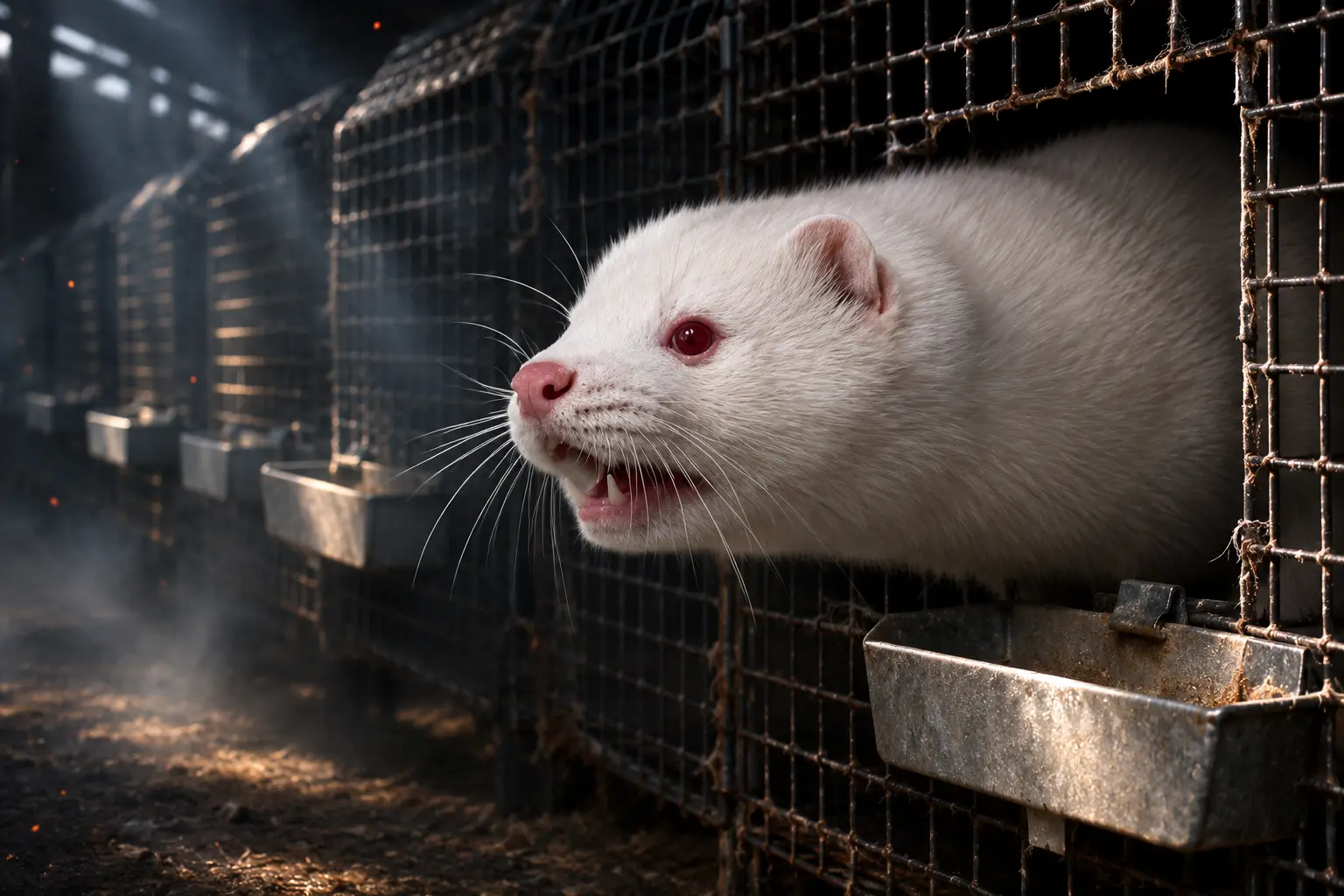
The farm is C&T Fenn Farms, about an hour south of Salt Lake City, where Chad Fenn raises thousands of mink for pelts. Utah’s state veterinarian, Amanda Price, never ordered the animals killed. A 2025 deal between the agriculture and health departments had already taken active worker checks off the table. Flu researchers call that mix a bet on luck.
The Dairy Strain Reached Mink in Utah
USDA’s National Veterinary Services Laboratories confirmed the virus by PCR on Aug. 17 from samples taken Aug. 7, the first documented H5N1 outbreak on a mink farm in the Americas. NIH, Pirbright and CNRS researchers posted a preliminary analysis on Oct. 22 of ten mink genomes collected on Aug. 7. All ten sit inside the 2026 B3.13 cattle clade. The closest published relatives were Texas dairy cattle sampled on May 28.
The ten sequences form a single farm cluster, which points to one introduction. The estimated median start is July 4, with a range from June 21 to July 15, meaning the virus likely spread for weeks before anyone sampled it. How it jumped from cattle to mink is still open. Fenn said the mink are routinely fed raw organs of livestock, including cows. Federal mink-farm advice talks about wild birds and raw poultry. It does not mention beef.
THE MUTATIONS IN THE AUGUST SAMPLES
- Cattle polymerase: The mink virus already carried PB2-M631L, a change from dairy B3.13 that helps flu copy itself in mammals, so it did not need to pick that up on the farm.
- Spain echo: All ten mink samples had PB1-K388R, rare in birds, absent from the cattle relatives, and previously seen in Spain’s 2022 mink outbreak.
- No human-nose flip: The hemagglutinin protein, which docks the virus onto cells, showed no amino-acid changes from nearby Idaho and Utah cattle. Canonical PB2 mammalian sweeps at 627K and 701N were absent.
- Closed window: Every public mink genome is from that one August day. Later farm samples have not been posted.
Temple University biologist Sergei Pond, reading the same trees, argues that two years of cow-to-cow spread have not pushed the main B3.13 trunk toward the receptor that sits in a human nose and throat. Selection in udders, bird guts and farm wildlife still rewards the bird-type docking sugar. The mink outbreak stacked polymerase and M2 changes instead, including PB2-Q13R, PB1-K388R, PA-I129T and M2-G58D/S64F. That does not make the farm safe. It means a side spill into a person, or a mix with seasonal flu, would not have to start from a bird virus.
Mink airways carry a high share of the same cell receptors found in a human upper throat. They also catch human seasonal flu. Two flu viruses in one cell can swap large stretches of code, which is how every modern flu pandemic began. Jennifer Nuzzo, who directs the Pandemic Center at Brown University, said the most likely pandemic path is a reassortment. September brought one of the earliest U.S. flu-season starts on record, against a typical November takeoff.
Spain Cleared Its Mink Farm in 30 Days
When clade 2.3.4.4b H5N1 hit a Galicia mink farm in October 2022, Spain announced a full cull two weeks after the virus was identified. Killing began on Oct. 18 and finished on Nov. 17. About 50,000 animals were removed. Twelve workers, already in contact with the animals, were swabbed on Oct. 13 and 14 while they still had no symptoms. All tested negative.
Finland moved even faster on the legal side. After H5N1 turned up on Ostrobothnia fur farms in mid-July 2023, the agriculture ministry amended national rules on July 18 so animal-health officials could order restrictions and culls. By late August the food authority had issued cull orders covering 120,000 foxes and mink. Finnish health officials tested contacts and became the first to offer fur-farm workers a pre-emptive H5 shot.
HOW THREE OUTBREAKS WERE HANDLED
| Place and year | Animals | What officials did | Workers |
|---|---|---|---|
| Galicia, Spain, 2022 | About 50,000 mink on one farm | Full cull, Oct. 18 to Nov. 17 | 12 workers tested, all negative |
| Ostrobothnia, Finland, 2023 | Foxes, mink and raccoon dogs on 27 farms | Law changed July 18; 120,000 foxes and mink ordered killed by late August | Contact testing; H5 shots offered to fur workers |
| Utah, United States, 2026 | Thousands of mink on C&T Fenn Farms | Verbal hold on movements; no cull; state veterinarian did not visit | No active monitoring; a worker with a red eye was not tested |
Tom Peacock, an avian influenza researcher at the Pirbright Institute and a co-author of the Utah genome note, told investigators the pattern abroad is not subtle.
Every other country that I’m aware of that has had H5N1 in fur farms, depopulation has happened pretty quickly. The fact that the first instinct wasn’t just to depopulate and figure stuff out later is very concerning to me.
Tom Peacock, avian influenza researcher, the Pirbright Institute
Price said she knew Finland and Spain had killed their fur animals. She also said she did not look much further into why. A fur-trade representative had warned her that a cull would kill the business and, in time, the industry, because farms spend decades breeding unique genetic lines. USDA officials told her they do not regulate mink and have no approved mink vaccine. Congress, a USDA spokesperson said, would have to fund a mink depopulation program. The poultry cull program has cost well over $1 billion since 2022.
“There’s just not a lot of options out there other than kind of sitting and waiting and seeing what happens,” Price said. She added that USDA staff did not make her feel bird flu in mink was riskier than infections in ducks or cows.
Utah’s 2025 Bargain Ended Worker Checks
Utah used to call farm workers during bird flu outbreaks. It stopped after agriculture staff said farmers were annoyed. Pamela Gomez Pinedo, a respiratory disease epidemiologist in the state health department, said active monitoring made farms not want to work with health officials, and that her team then had a pretty difficult time getting details from agriculture.
A 2025 agreement let the Utah Department of Agriculture and Food share outbreak information only if health officials did not track workers’ health. Pinedo told a CDC epidemiologist the state would do active monitoring only if there was evidence of human-to-human spread. Price framed the policy as letting farmers decide whether to call, rather than forcing contact. “If we started seeing people actively dying from this, obviously that would change how we respond to this,” she said.
That is the reverse of how this farm was handled in 2020, when COVID-19 tore through Utah mink sheds, including Fenn’s. State officials invited federal researchers. Wildlife staff set traps around infected farms and repeatedly caught escaped mink carrying barn-origin COVID. Mink and workers were tested often enough to follow the virus as it moved and changed. Other countries using the same playbook found people infected by mink, then person-to-person spread. USDA later said it was more involved then because COVID had significant potential to move both ways. There is no matching effort on this H5N1 outbreak.
THE UTAH OUTBREAK CLOCK
- July 4, 2026: Estimated median start of the mink-farm cluster, weeks before anyone sampled the animals.
- Aug. 7, 2026: State and federal labs collect the only mink genomes later posted in public databases.
- Aug. 17, 2026: USDA confirms H5N1 in captive American mink, the first such farm outbreak in the Americas.
- Aug. 28, 2026: Ten whole-genome sequences appear on NCBI’s Sequence Read Archive.
- Oct. 22, 2026: Researchers post the B3.13 and PB1-K388R analysis; the farm outbreak is still listed as ongoing.
- Nov. 1, 2026: A Yakima County resident dies after catching the related cattle strain on a dairy, not the mink farm.
State messages obtained under Utah’s public records law show officials declined to declare an emergency because doing so “may alert animal rights groups.” Willy Lanier, a public health veterinarian in the health department, told colleagues to keep the mink outbreak under closer hold than poultry or dairy cases. When a reporter later asked the Utah County Health Department about a possible bird flu outbreak, the spokesperson said that would be news to her.
Price has not set foot on the property. She said she became very comfortable, from Google Maps, calls with Fenn and talks with the farm’s vet, that the virus would not leave. Short of a quarantine, she gave a verbal hold: no mink, manure or carcasses off the farm. She said there had been no additional Utah cases linked to it. Erin Sorrell, a senior scholar at the Johns Hopkins Center for Health Security, said that claim does not hold without looking. “If you’re not looking for something, you won’t find it.”
What a Red Eye Is Supposed to Trigger
CDC guidance is not ambiguous. People exposed to H5N1-infected birds, cattle or other animals, including people who wore protective gear, should be watched for respiratory illness and red, irritated eyes from the first day of contact through 10 days after the last exposure. For workers with unprotected contact, the agency wants active monitoring after unprotected exposures: health departments call or text, which requires a list of names. Most exposed dairy workers fall in that bucket. Self-monitoring is for people who used gear correctly and had no breach, often poultry cull crews.
A red eye is not a side note. It shows up in over 90 percent of U.S. human H5N1 cases and is often the only symptom. CDC testing rules say that if a person has conjunctivitis, with or without a cough, collectors should take both a conjunctival swab and a nose or throat swab. Last Saturday before the investigation published, a reporter found two Fenn farm workers. One had a visibly red eye.
After the farm was contacted, Fenn called the Utah County Health Department. He said the redness had cleared by Monday and that the worker got dust in his eye. The department did not recommend a test unless a cough or sore throat appeared. “They’re not going to do anything,” Fenn said. “They said they don’t see that there’s a need.”
CDC’S WATCH-AND-TEST BAR
- Who is watched: Anyone exposed to infected animals or their environments, including people who wore recommended gear.
- How long: From day 0 of exposure through 10 days after the last contact.
- What counts as a symptom: Fever, cough, sore throat, shortness of breath, eye tearing or redness, headache, body aches, runny nose, diarrhea or vomiting.
- What a red eye requires: A conjunctival swab plus a nasopharyngeal or combined nasal-throat swab, not a wait-and-see for a cough.
Mink work is close, wet and physical. A Spanish-speaking minkero on a nearby farm showed bite and scratch scars and said the animals are fierce, that they bite and claw. Fenn said his crew wears masks and can wear glasses. He does not. “Me? I don’t wear it at all. Never have, never will, because I’ve been doing it for 40 years.” When the outbreak started he asked state officials if people could catch it. “Right off the bat, the state people we reported to, they said you don’t need to worry too much.”
Peacock’s personal threshold is higher. “I would want a full on hazmat suit if I were on that farm. Or, preferably, I’d rather not to be on that farm.” Gail Hansen, a former Kansas state public health veterinarian, put the geographic risk in one line: “Utah doesn’t want to be the epicenter of the next human flu outbreak, right?”
A Yakima Dairy Worker Died on Nov. 1
The mink farm has not been tied to a confirmed human infection. The cattle strain it carries has. The Yakima Health District said a county resident with underlying health conditions was hospitalized after exposure at a dairy with infected cows and died on Sunday, Nov. 1. CDC confirmed H5N1. Two other Yakima residents tested positive after dairy exposure in the prior three weeks; neither was hospitalized. County health officer Dr. Dave Atteberry said the risk to the general public remains low.
USDA’s Animal and Plant Health Inspection Service said on Nov. 4 that the first two Washington dairy detections, announced Oct. 8, were the B3.13 virus in Washington dairy herds, consistent with movement of cattle from Idaho. That is the same genotype found in the Utah mink. It is not a mink-to-human jump. It is the same cattle family, already able to infect workers, now with a 2026 death attached.
CDC spokesperson Emily Hilliard said the agency was saddened to hear of the death and that the case does not change the public risk assessment, which continues to be low. Genetic analysis of the patient’s virus, she said, found no changes tied to easier spread between people. There is still no documented human-to-human H5N1 transmission in the United States. Washington officials are tracing contacts of the dairy cases, the opposite of Utah’s mink-farm posture.
Fenn said new mink samples were taken in October. Price said she was still waiting on results. The public genomic record has not moved past Aug. 7. John Korslund, a retired USDA official who helped coordinate the 2020 mink-farm COVID response, said the question that matters is what the virus has done from the start to now, and whether mutations are accumulating that make it more dangerous. Hansen’s version is blunter: as long as it goes mink to mink, a jump to a person becomes more likely.
The House Farm Bill Restores Mink Export Ads
The animals on Fenn’s farm exist to be skinned for luxury pelts, many of them headed overseas. Neil Vora, executive director of the Preventing Pandemics at the Source Coalition, called fur farms a clear warning. “Fur farms are to produce pelts purely for luxury goods, to make fancy coats,” he said. “It’s absurd that we’re willing to gamble with the lives of millions of people just to keep an industry alive.”
The U.S. industry is already shrinking. USDA’s National Agricultural Statistics Service counted 771,200 mink pelts produced in 2024, down 19 percent from 957,410 the year before. The crop was worth $28.1 million, down 14 percent, at an average $36.40 a pelt. Wisconsin led with 438,710 pelts. Utah was second with 95,230, a 90 percent drop from more than 950,000 in 2014, and fewer than 10 Utah farms remain, down from 66 in 2007.
U.S. MINK, 2024 CROP
- National kill: 771,200 pelts, down 19 percent from 2023.
- Utah’s share: 95,230 pelts, still second in the country after Wisconsin’s 438,710.
- Price: $36.40 a pelt, for a $28.1 million crop.
- Utah’s decade: Production is 90 percent below 2014, with fewer than 10 farms left.
Congress is moving toward the remaining farms, not away from them. For 30 years federal law has barred USDA’s Market Access Program from paying to promote mink exports. The House passed the Farm, Food, and National Security Act on April 30, 224 to 200, with a clause that would lift that ban. The Senate Agriculture Committee adopted a matching provision in September. The 2018 farm bill’s extension expired on Sept. 30. Denmark, once the world’s largest mink producer, said in October it would end mink farming by August 2029. Fenn’s view of Europe is the opposite of Vora’s. “Europeans are a little scared of everything,” he said. “They’re going to do what they’re going to do, and here in the United States, we’re going to do what we’re going to do.”
A separate House bill would ban raising mink in captivity for fur and buy out farms. It sits in committee. So does a 2025 bill that would end mink farming a year after enactment and pay owners the market value of the mink side of their operations. Neither has a floor vote. The live text in the Farm Bill is the subsidy restoration.
Meghan Davis, an epidemiologist at Johns Hopkins, said the ending depends on what the virus does. “We might get lucky, and a response that is not robust may not have dire consequences,” she said. “But we may get unlucky.” The August genomes are still the last public look inside Fenn’s sheds. The cattle cousin of that virus has already killed a dairy worker in Washington. Utah is still sitting and waiting.
Disclaimer: This article is news reporting and analysis of a farm outbreak and related public-health guidance. It is informational only and is not medical advice, a diagnosis, or a personal risk assessment for anyone who works with animals or who has symptoms. Readers who have had contact with sick birds, cattle, mink or other animals, or who have a red eye, cough or fever after such contact, should call a clinician or their local health department about testing and treatment rather than relying on this story. Figures, case counts and farm statuses reflect the official statements, genomic postings and interviews cited here and can change as new samples and investigations come in.

Nvidia Stops China H200 Sales as Cloud Licenses Close

A Delayed Salary Cap Would Spare Baseball’s Biggest Spenders

Utah Leaves a Mink Bird Flu Outbreak Unculled

North Korea Used Binance Engineers to Steal $6.3 Billion

Melissa Rycroft’s Probation Plea Meets a Halloween Ambulance Crash

Rolex Made Drake the Daytona It Fights Jewelers Over

Treasury’s First Iran Bank Shot Lands on an Ally

Instinct’s $2.5 Billion Raise Still Binds the User as Agent

City’s £125m Enzo Deal Caps a £327m Midfield Rebuild

Meta’s Teen Settlement Leaves Chat Off the Clock
-
 ENTERTAINMENT3 months ago
Rolex Made Drake the Daytona It Fights Jewelers Over
-
 BUSINESS3 months ago
Treasury’s First Iran Bank Shot Lands on an Ally
-
 NEWS3 months ago
Instinct’s $2.5 Billion Raise Still Binds the User as Agent
-
 NEWS3 months ago
City’s £125m Enzo Deal Caps a £327m Midfield Rebuild
-

 ENTERTAINMENT3 months ago
Ricky Gervais Wants Alley Cats to Run Until He Dies
-
 NEWS3 months ago
Meta’s Teen Settlement Leaves Chat Off the Clock
-

 NEWS3 months ago
CSIRTs Inherit Europe’s Missing security.txt Before Article 14
-

 BUSINESS3 months ago
Berkshire Anchors Alphabet’s Record Raise With a $10 Billion Check