
BUSINESS
Warsh’s Quiet Fed Produced the 2-Year’s Sharpest Jump Since 2022
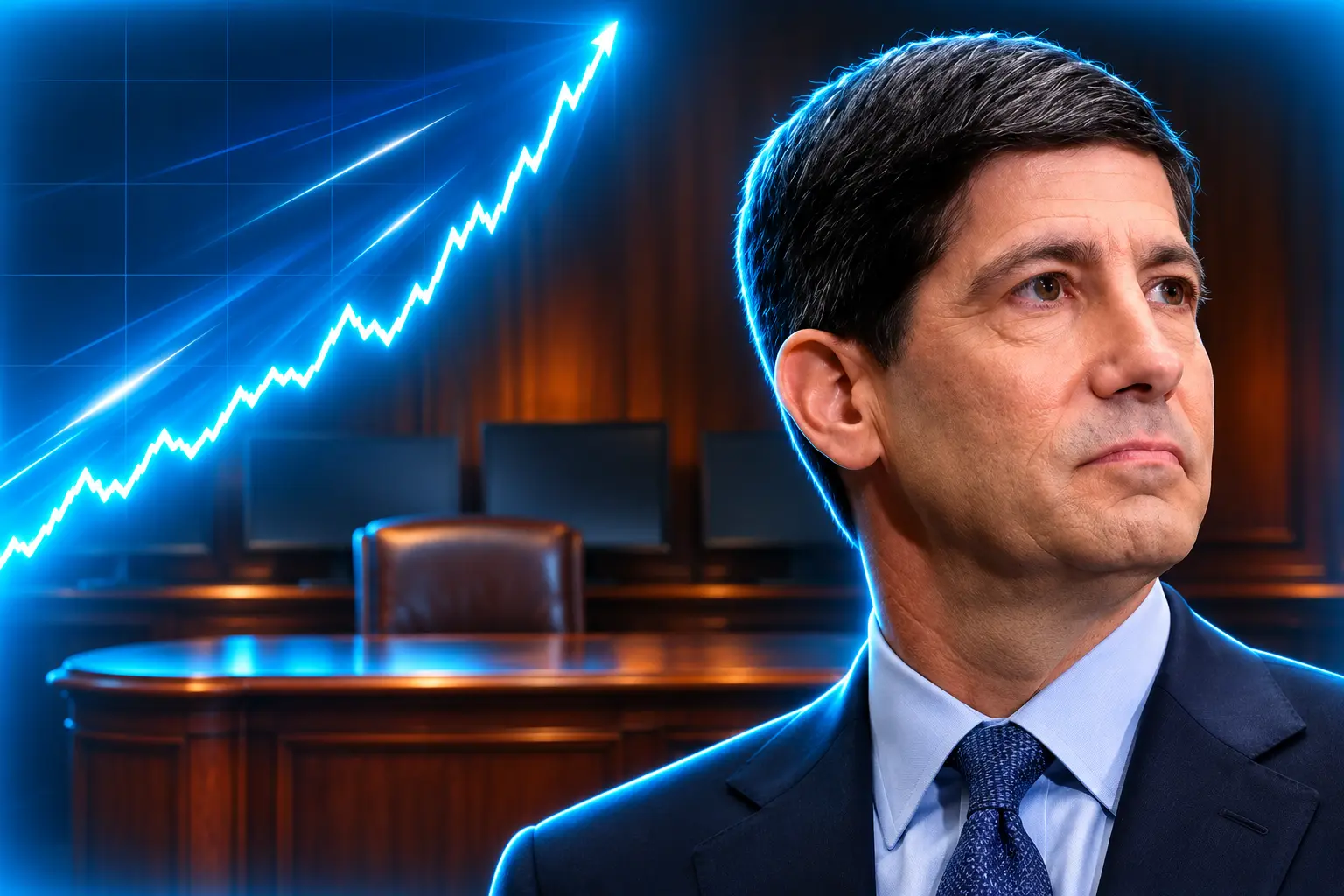
A quieter Fed left Waller to name a 50-basis-point CPI trigger, and the 2-year yield posted its biggest four-session jump since 2022.

The 2-year Treasury yield jumped 38.8 basis points over four trading sessions to 4.86% on Nov. 12, the largest such move since the Federal Reserve’s 2022 hiking cycle. Bond trading skipped Nov. 11 for Veterans Day.
The move followed Governor Christopher Waller’s London remarks and an October consumer-price report that matched the threshold he had set. Chair Kevin Warsh did not add a fresh rate signal that week.
Four Sessions, 38.8 Basis Points
The 2-year is the part of the curve that tracks the funds rate, and it did the heavy lifting. On the Treasury’s par yield curve it closed at 4.86% on Nov. 12, up from 4.73% on Nov. 10 and 4.56% on Nov. 9. A year earlier, on Nov. 12, 2025, it was 3.56%, a 130-basis-point rise.
Tuesday’s session did most of the damage. The par-curve 2-year rose 17 basis points from Nov. 9 to Nov. 10, then another 13 basis points from Nov. 10 to Nov. 12. J.P. Morgan economist Michael Feroli has put the standard deviation of daily 2-year changes since 2000 at about 5.5 basis points, which makes a 17-basis-point day a genuine outlier rather than noise.
TREASURY PAR CURVE CLOSES
| Date | 2-Year | 10-Year | 2s10s |
|---|---|---|---|
| Nov. 12, 2026 | 4.86% | 5.10% | +24 bp |
| Nov. 10, 2026 | 4.73% | 4.98% | +25 bp |
| Nov. 12, 2025 | 3.56% | 4.08% | +52 bp |
The 38.8-basis-point four-session figure is a market measure of that same jump, not a restatement of the par-curve closes. The 10-year settled at 5.10% on Nov. 12, so the curve stayed upward-sloping. Over the past year the 2-year has run from 3.38% in the week of Feb. 27 to this week’s 4.86%. The 3-year closed at 4.90% on Nov. 12 and the 5-year at 4.95%.
Waller Drew a Line at 0.3 Percent
Waller spoke in London at the Bank of England Watchers Conference before the October CPI release, and he did not hide the next vote. He said he would back a 25-basis-point increase at the Dec. 8-9 meeting even if monthly inflation cooled. Then he attached a harder option to one decimal.
That’s my plan if things proceed as I expect. But if the October CPI inflation data out later today are similar to the past two monthly readings, with core CPI inflation around 0.3 percent or even higher, then a stronger policy move may be needed. In that case, I believe a 50 basis point hike in the policy rate should be considered at the December meeting. Hiking only 25 basis points would put our credibility at risk, a risk I am not eager to take.
Christopher J. Waller, Governor, Bank of England Watchers Conference, London
Hours later the Bureau of Labor Statistics said CPI for all items increased 0.4% in October, seasonally adjusted, and the index excluding food and energy rose 0.3 percent. That core reading matched August and September. It was the print Waller had said would put a half-point move in play, and he had already said a 50 basis point hike should be considered in that case.
The bureau could not publish a 12-month change for October. A 2025 lapse in appropriations left October 2025 indexes missing, so the year-over-year comparison is unavailable for most series. Waller still called inflation “too high, well above the FOMC’s 2 percent goal.” He also said real GDP rose 3.4% in the third quarter on the initial estimate, the unemployment rate ticked down to 4.1% in October, and payrolls rose 165,000, with 85,000 jobs added to the prior two months. The 6-month and 12-month average payroll gain, he said, has been closer to 80,000 a month.
THE WEEK THE FRONT END BROKE
- October 28, 2026: The FOMC holds the funds rate at 3.75% to 4% on a 10-2 vote. Lisa D. Cook and Beth M. Hammack prefer a quarter-point increase.
- November 9, 2026: Treasury auctions $58 billion of 3-year notes. The 2-year closes at 4.56%.
- November 10, 2026: Waller speaks in London. October CPI prints 0.4% headline and 0.3% core. Treasury auctions $42 billion of 10-year notes. The 2-year closes at 4.73%.
- November 11, 2026: The bond market is closed for Veterans Day.
- November 12, 2026: Treasury auctions $25 billion of 30-year bonds. The 2-year closes at 4.86% and the 10-year at 5.10%.
- November 13, 2026: The producer price index for October is due at 8:30 a.m. Eastern.
Waller voted to hold in October. His reason was that talk of tightening had already done some of the work in markets, and that the timing of hikes matters less than actually delivering them before traders pull the bets out.
What a Quieter Fed Was Built to Avoid
Warsh took the chair in May and has spent the year stripping the ritual that used to tell traders the next move. At Jackson Hole on Aug. 28, marking his 100th day, he asked the room not to treat his outline as a rate path. “You can call it an outline. You can call it a trail map. Just don’t call it forward guidance,” he said.
He wanted markets to stop using the Fed as a trade. “Transparency in communications about future policy decisions is not a virtue unto itself,” he said. “Communications must be in service to the Fed’s paramount responsibility: getting monetary policy right.” He described a hall-of-mirrors problem in which markets lean on Fed guidance and the Fed leans on market prices, and both miss the turn.
Finally, a quieter Fed, more purposeful in its communications, is better able to meet its objectives. And we can be held accountable for delivering on our remit, the only true test of our credibility.
Kevin Warsh, Chair, Jackson Hole symposium
In the same speech he argued for a quieter Fed, more purposeful in its communications, and he told colleagues not to run policy off isolated prints. “Nor should we rely on isolated data points. Trends matter most,” he said. The 2% PCE target, he added, is “a firm, fixed target,” and price stability is not self-executing.
Waller then did what that doctrine was built to avoid. He named a monthly core CPI line and invited the market to treat it as a switch. October printed on the line. The 2-year did the rest. Brent Donnelly of Spectra Markets put the resulting confusion in one sentence: it is hard to understand what the framework is, because nobody knows what to do with policy in a supply shock.
The Refunding Calendar Met a Bond Rout
While the front end repriced, Treasury still had coupons to sell. On Nov. 4, Assistant Secretary for Financial Markets Hunter McMaster said the department was offering $125 billion of Treasury securities to refund about $97 billion of privately held notes and bonds maturing Nov. 15, raising about $28 billion of new cash from private investors.
THE NOVEMBER COUPON SALES
- 3-year note: $58 billion, auctioned Nov. 9, maturing Nov. 15, 2029.
- 10-year note: $42 billion, auctioned Nov. 10, maturing Nov. 15, 2036.
- 30-year bond: $25 billion, auctioned Nov. 12, maturing Nov. 15, 2056.
Those three sales are the refunding package. Separate from them, the November calendar also listed a $69 billion 2-year note, the maturity that just did the moving. The 10-year sale landed on the CPI morning. The 30-year sale landed on the session that completed the four-day jump. All three settle Nov. 16.
Warsh has said the Fed needs unfiltered prices from Treasury trading, including “the prices and trading volumes of Treasury securities.” This week those prices arrived in the middle of the refunding. The department was asking the same market that was repricing December to take $125 billion of duration.
A 5 Percent 10-Year and a Yen at 160
A 5.10% 10-year is the reference that feeds mortgage quotes, auto loans, and a lot of corporate borrowing. The 2-year at 4.86% sits 86 basis points above the 4% top of the funds range. That gap is how the front end says a December move is not the last meeting that matters.
The dollar crossed 160 yen on Nov. 12 for the first time since Sept. 2, then slipped back within minutes. Japanese officials have spent this year buying yen when the rate runs that far, and a wider U.S. yield gap is the pressure under that trade. Dollars pay more than yen, and the gap widens when U.S. front-end yields jump 38.8 basis points in four sessions.
Waller, in the same London speech, gave the inflation side of that dollar bid. He said tanker insurance and ship-to-ship transfers in the Strait of Hormuz were adding $20 to $30 a barrel to oil, and that diesel constraints could keep energy from fading the way older models assume. Fed research he cited warns that core inflation may now pass through energy shocks more than it did before the pandemic, with pressure that could last into 2027. That is one reason a single CPI decimal moved the 2-year as hard as it did.
He also described a labor market that looks stable and still feels off. Hiring and firing are both low, a “low hire, low fire” mix he called unusual and maybe unprecedented. The unemployment rate is 4.1%, but long spells among the jobless have climbed since 2022, and new entrants are a larger share of unemployment than in most expansions of the past 20 years. That is not a story of an overheating payroll. It is a story of inflation that has not come down anyway.
Futures Price a December Hike, Not the Size
On Oct. 28 the FOMC kept the funds rate at 3.75% to 4% on a 10-2 vote. Governor Lisa D. Cook and Cleveland Fed President Beth M. Hammack wanted a quarter-point increase that day. The statement ran short and skipped the usual hint about the next meeting. “Inflation remains elevated,” it said. “The Committee will deliver price stability.”
The Fed had raised rates a quarter point in September to that 3.75% to 4% range. Waller voted to hold in October, arguing that if promised hikes are not delivered in a reasonable time, markets will pull them and loosen policy by accident. By Nov. 12, futures priced some December increase as certain. A Nov. 11 snapshot of the CME FedWatch tool showed an 88.8% chance of a quarter-point rise and an 11.2% chance of a half-point rise.
Dallas Fed President Lorie Logan said at least two more quarter-point increases are needed. Vincent Reinhart, chief economist at BNY Investments, said after Warsh’s October press conference that the chair “was setting up more tightening, but he was also bracketing that it need not be all that much more tightening.” The 2-year at 4.86% is not bracketing. It is running ahead of the funds ceiling the committee actually set.
WHERE OFFICIALS SPLIT
- Waller: Back a 25-basis-point December rise even if inflation cools; consider 50 basis points after a 0.3% core CPI print.
- Logan: Deliver at least two more quarter-point increases to bring inflation down.
- Cook and Hammack: Vote for a quarter-point hike on Oct. 28, two meetings before December.
- Reinhart’s read of Warsh: More tightening is coming, and it need not be all that much more.
The producer price index for October is due at 8:30 a.m. Eastern on Nov. 13. Economists have been looking for a 0.4% monthly rise after a 1.3% jump in September. The FOMC meets Dec. 8-9. Until then the 2-year is doing the talking Warsh declined to do, and it is talking in 38.8-basis-point bursts.
Disclaimer: This article is news reporting and analysis of Treasury yields and Federal Reserve policy, and it is for information only. It is not investment advice, a recommendation to buy or sell bonds or other securities, or a prediction of how the FOMC will vote. Readers should consult a licensed financial adviser or fixed-income professional before making portfolio decisions. Yields, policy odds, and auction results change with new data, including the producer-price report and the Dec. 8-9 FOMC meeting.

Record Diesel Lifts UK Inflation Before Food Prices Follow

Nvidia Stops China H200 Sales as Cloud Licenses Close

Wake Forest Joins the Field; Texas Tech Stays Out

Supreme Court Lets Restored Research Grants Keep Flowing

FAA Ground Stop Began on a Network It Does Not Own

Rolex Made Drake the Daytona It Fights Jewelers Over

Treasury’s First Iran Bank Shot Lands on an Ally

Instinct’s $2.5 Billion Raise Still Binds the User as Agent

City’s £125m Enzo Deal Caps a £327m Midfield Rebuild

Meta’s Teen Settlement Leaves Chat Off the Clock
-
 ENTERTAINMENT3 months ago
Rolex Made Drake the Daytona It Fights Jewelers Over
-
 BUSINESS3 months ago
Treasury’s First Iran Bank Shot Lands on an Ally
-
 NEWS3 months ago
Instinct’s $2.5 Billion Raise Still Binds the User as Agent
-
 NEWS3 months ago
City’s £125m Enzo Deal Caps a £327m Midfield Rebuild
-

 ENTERTAINMENT3 months ago
Ricky Gervais Wants Alley Cats to Run Until He Dies
-
 NEWS3 months ago
Meta’s Teen Settlement Leaves Chat Off the Clock
-

 NEWS3 months ago
CSIRTs Inherit Europe’s Missing security.txt Before Article 14
-

 BUSINESS3 months ago
Berkshire Anchors Alphabet’s Record Raise With a $10 Billion Check