
BUSINESS
IEA Oil Surplus Leaves Land Tanks at 2016 Lows
The IEA’s first surplus since the Iran war is oil on tankers and weaker demand, while land stocks sit at 2016 lows and Hormuz stays restricted.

Global oil supply ran ahead of demand in October for the first time since the Iran war, the International Energy Agency said, even as land tanks sat at their lowest since at least 2016. Observed stocks rose by 52 million barrels, but 86 million of that sat on tankers, and diesel still trades far above pre-war levels.
The Paris-based agency, which advises industrial countries, published the finding on November 13, 2026. It now sees supply averaging 105 million barrels a day in the fourth quarter, 1.7 million above demand, after months of deficit.
The Surplus Is Sitting on Tankers
The IEA’s own books show why the surplus is a thinner comfort than the headline. Global supply jumped another 2.3 million barrels a day in October to 105.4 million barrels a day, after a 3 million jump in September, an extraordinary 5.3 million since August. Those extra barrels showed up as the first observed stock rise since June. They did not refill the tanks on shore.
WHERE THE OCTOBER BARRELS WENT
| Measure | October change | What the IEA recorded |
|---|---|---|
| Observed global stocks | +52 million barrels (1.7 million a day) | First increase since June |
| Oil on the water | +86 million barrels | Highest since January |
| OECD stocks | -47 million barrels | Industry stocks down 41 million |
| On-land stocks | Kept falling | Lowest since at least 2016 |
| Draw since the war began | -462 million barrels | Cumulative, late February onward |
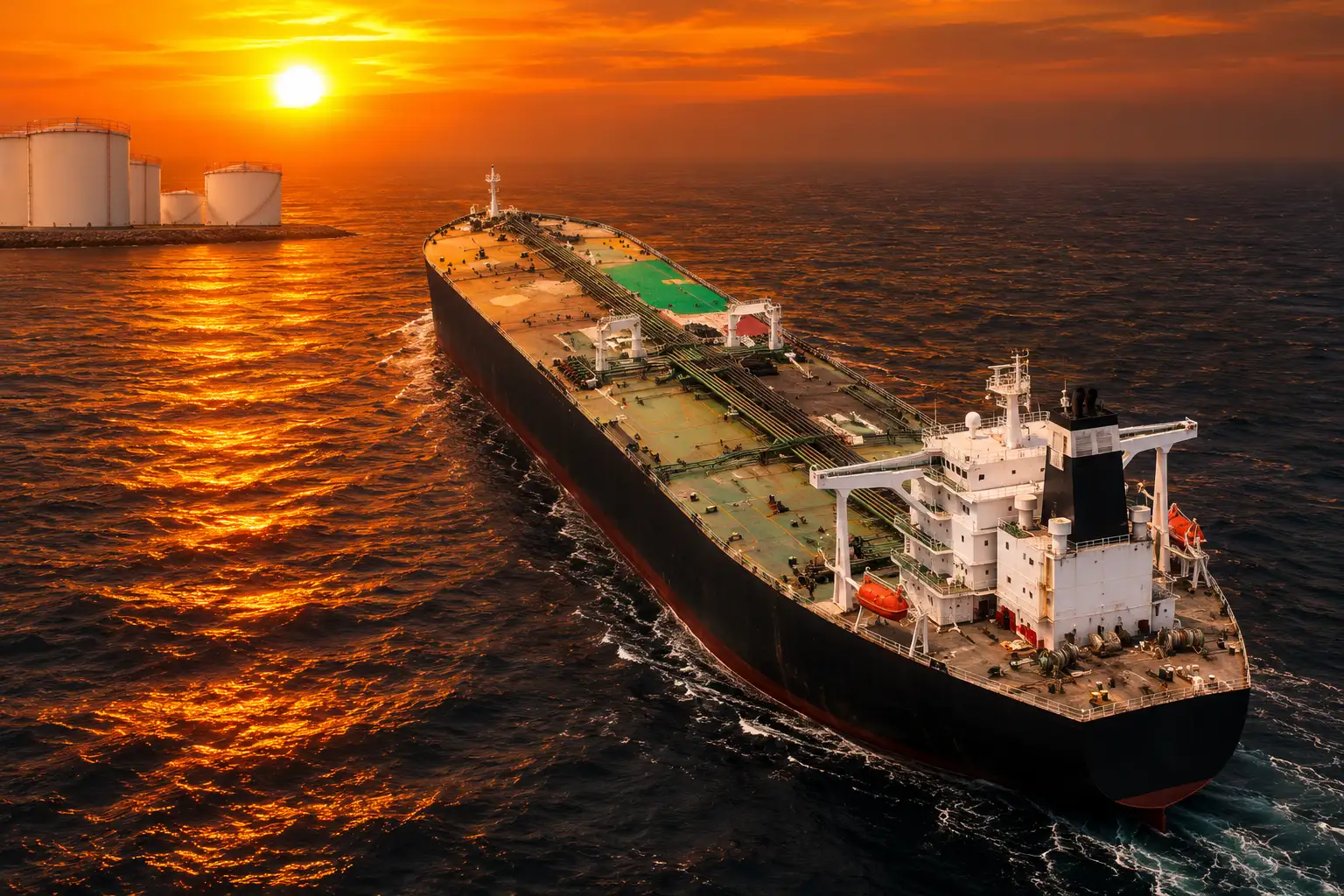
A barrel counted at sea is a barrel that has left the Gulf and has not yet landed. If shipping seizes up again, that floating crude is the first volume that stops. On-land stocks, the buffer refiners actually burn, kept falling through the same month and now sit at the weakest level the IEA can see back to 2016.
North Sea Dated crude, the physical benchmark the agency tracks, tumbled 32 percent from $136 a barrel on October 8 to about $93 when the report was written, still $22 above pre-war. Brent, the futures contract, had already slipped to $89.66 after President Donald Trump told reporters the war was “effectively over,” then traded near $95 around the report. The price drop is real. The spare oil on land is not.
Saudi Arabia and Iraq Reopened the Tap
Gulf barrels did the heavy lifting. Exports from the Gulf, excluding Oman, reached 18.4 million barrels a day in October, still 26 percent below pre-war. Crude in that flow recovered to 15 million barrels a day, 82 percent of pre-war volumes, even as attacks on tankers continued. The agency raised fourth-quarter supply by 3.3 million barrels a day on the back of those loadings, and trimmed the 2026 supply drop to 4.8 million a day.
IEA GULF PRODUCTION IN OCTOBER
| Producer | September | October |
|---|---|---|
| Saudi Arabia | 8.93 million b/d | 9.99 million b/d |
| Iraq | 4.06 million b/d | 4.6 million b/d |
| Kuwait | 1.58 million b/d | 2.03 million b/d |
| OPEC-8 subtotal | 17.54 million b/d | 19.55 million b/d |
OPEC, using secondary sources in its own monthly report, put the wider OPEC+ group at 41.23 million barrels a day in October, up 2.04 million from September and 97 percent of the 42.72 million it recorded in February. Iran, inside the IEA table, slipped from 1.94 million barrels a day to 1.86 million against 3.8 million of capacity, which is why the agency cut its 2027 supply view on constrained Iranian shipments.
Five producers outside the Gulf are filling part of the hole. The IEA’s Americas Quintet, the United States, Canada, Brazil, Argentina and Guyana, is on track to add 1.6 million barrels a day in 2026 and another 1.1 million in 2027. Gulf output is still the swing: the agency sees it rising 5.3 million barrels a day in 2027 as part of a 6.6 million rebound in world supply to 108.1 million.
A 2.7 Million Barrel Hole in Demand
Supply is only half of a surplus. World oil use is forecast to fall by 2.7 million barrels a day in 2026, to 102.3 million, after implied 2025 demand of 105.0 million. The year-on-year drop eases to 2.7 million in the fourth quarter, from 5 million in the second and 3.8 million in the third, a 4.4 million average across those two middle quarters. High fuel prices, broken product and LPG exports from the Gulf, and a weaker economy did that damage. The IEA does not see demand turning up until around March 2027.
THE 2026 DEMAND BREAK
- 2026 use: 102.3 million barrels a day, down 2.7 million from 2025.
- Second-quarter hit: a 5 million barrel a day year-on-year drop, the worst quarter of the war.
- 2027 rebound: 2 million barrels a day, still short of 2025, with growth starting around March.
- Where it comes from: LPG, ethane and naphtha, about 80 percent of next year’s gain as Gulf product chains normalise.
Road fuel is the piece that does not bounce. The agency says high prices are speeding electrification and fuel efficiency across the global car fleet, so gasoline and diesel get only a modest lift even after supply chains heal. A surplus against that demand is a lower market, not the 2025 market with the lights turned back on.
Diesel Is Still the Bottleneck
Crude availability and product availability are not the same market. Global refinery runs fell 1.3 million barrels a day in October to a seasonal low of 81.3 million, and the IEA sees them recovering to 84.7 million in December. Diesel in Europe fell 11 percent from the early-October spike and still sat close to $180 a barrel, 77 percent above pre-war. Russian refinery attacks keep cutting that country’s diesel exports, on top of lost Gulf product cargoes.
For now, the severe tightness in product supply, especially for diesel, remains the overriding concern of the broader market and consumers.
International Energy Agency, November Oil Market Report
Atlantic Basin plants, especially in the United States, have been running hard to capture those margins. Asia may raise throughputs if more crude arrives and China uses new product export quotas. Until that product shows up, a crude surplus and a diesel shortage can live in the same month, which is the market traders actually have.
Another 71 Million Barrels From Emergency Tanks
Governments are still pouring official oil into that mix. IEA members plan to release about 71 million barrels of emergency crude and products through the end of February 2027, roughly double the September-October pace, with about 15 million barrels of diesel, almost all from government stocks in France and Germany, peaking at 4 million to 5 million barrels in January. Some 349 million barrels have already come out. If the remaining schedule holds, the total reaches about 420 million, above the 400 million pledged in March after the strait seized up.
THE WAR AND THE STOCKPILE DRAW
- February 28, 2026: The United States and Israel strike Iran; the Hormuz crisis begins.
- March 2026: IEA members commit to a record collective release of up to 400 million barrels.
- October 15, 2026: The IEA Governing Board says it will speed the remaining volumes, with diesel the priority.
- November 13, 2026: The monthly report schedules 71 million more barrels through February 2027, taking the cumulative draw to about 420 million.
Those official barrels helped keep the physical market from breaking. They also mean part of today’s surplus is policy oil, not spare capacity sitting in commercial tanks. The agency now calls the remaining diesel releases a bridge until refineries and product output recover. That is a wartime tool still running after the IEA has already printed a surplus.
Restricted Traffic on Day 260 of the Crisis
The strait that usually carries this crude is not open in any normal sense. Independent AIS counts on November 14 put the crisis on day 260, and AIS-visible traffic is about 7% of normal, 6.3 commercial ships a day over the prior week against 84.8 before the war. Ships still cross under U.S. naval coordination. Iran claims control and wants transit permits. The official threat level is severe. About 588 commercial ships were stationary in the region, and tankers that switch transponders off never appear in those counts, so the visible number understates dark sailings.
The U.S. Energy Information Administration put 20.9 million barrels a day in early 2025 through Hormuz, about a fifth of world oil use and a quarter of seaborne oil trade. The IEA’s own chokepoint note says alternative pipelines, Saudi crude to the Red Sea and the UAE line to Fujairah, can move only 3.5 to 5.5 million barrels a day around the strait. That is the ceiling on a workaround if the shooting intensifies.
WHAT THE STRAIT LOOKS LIKE NOW
- Visible traffic: About 7 percent of the pre-crisis average on AIS, with dark sailings uncounted.
- Waiting ships: 588 commercial vessels stationary in the region as of the November 14 snapshot.
- Attacks: UKMTO logged further tanker strikes around November 10-11, including a fire on Dominica Prosperity off Ras Al Khaimah.
- Bypass capacity: 3.5 to 5.5 million barrels a day on the Saudi and UAE pipelines, a fraction of pre-war Hormuz flow.
Gulf crude at 82 percent of pre-war is a workaround success, not a reopened strait. Freight from the Middle East to Asia was still near record levels in the IEA report. That cost is the market’s way of saying the route remains a combat zone.
Why 2027’s Glut Still Hinges on Hormuz
The agency’s balances now point to a surplus in the fourth quarter of 2026 and a larger build in 2027, when supply is seen at 108.1 million barrels a day. Almost 80 percent of the 2 million barrel demand rebound is petrochemical feedstocks, LPG, ethane and naphtha, as Gulf product chains come back. Vehicle fuel stays soft. Iran’s constrained shipments already took some oil out of that 2027 supply line. Attacks on shipping, the agency wrote, remain the downside risk because maritime security is what any lasting recovery has to rest on.
Dated crude at about $93 is still $22 above the pre-war level, and April Brent had already printed $126. The war priced some oil demand out of the vehicle fleet, and the IEA does not put that volume back in 2027. A surplus measured against 102.3 million barrels a day of demand is easier to print than a surplus against 105.0 million. It is also easier to reverse if the next projectile finds a laden hull in the strait, because the extra barrels are on the water, the land tanks are empty, and governments are still draining the last of a 400 million barrel emergency pledge.
The IEA called the rebalancing tentative. That word is doing real work. Crude is loading again from Ras Tanura and Basra. Diesel is not back. Hormuz is not open. The surplus is the gap between those facts, and it lives on tankers until someone unloads it into tanks that, for now, are still running down.
Disclaimer: This article is news reporting and analysis of International Energy Agency balances, OPEC production figures and shipping data. It is informational only and is not investment, trading or energy-procurement advice. Readers who may act on oil prices, fuel costs or inventory strategy should consult a qualified financial adviser or energy-market professional who can judge their own position. The figures and statuses here reflect the IEA’s November 2026 Oil Market Report and the other dated sources named above, and they can change with the next monthly balances, a new attack on shipping, or a shift in official stock releases.

Nvidia Stops China H200 Sales as Cloud Licenses Close

Aidan Hutchinson’s Torn ACL Leaves Detroit Without Both Captains

The 49ers’ Record Road Night Points to Mexico City

America Loses Measles-Free Status as the Regain Clock Stalls

Huang’s Exit Opens Nvidia to an Outside CEO Fight

Rolex Made Drake the Daytona It Fights Jewelers Over

Treasury’s First Iran Bank Shot Lands on an Ally

Instinct’s $2.5 Billion Raise Still Binds the User as Agent

City’s £125m Enzo Deal Caps a £327m Midfield Rebuild

Meta’s Teen Settlement Leaves Chat Off the Clock
-
 ENTERTAINMENT3 months ago
Rolex Made Drake the Daytona It Fights Jewelers Over
-
 BUSINESS3 months ago
Treasury’s First Iran Bank Shot Lands on an Ally
-
 NEWS3 months ago
Instinct’s $2.5 Billion Raise Still Binds the User as Agent
-
 NEWS3 months ago
City’s £125m Enzo Deal Caps a £327m Midfield Rebuild
-

 ENTERTAINMENT3 months ago
Ricky Gervais Wants Alley Cats to Run Until He Dies
-
 NEWS3 months ago
Meta’s Teen Settlement Leaves Chat Off the Clock
-

 NEWS3 months ago
CSIRTs Inherit Europe’s Missing security.txt Before Article 14
-

 BUSINESS3 months ago
Berkshire Anchors Alphabet’s Record Raise With a $10 Billion Check