
NEWS
The Lunar Eclipse Split the Bay Area Once Again
Sonoma high clouds parted after moonrise August 27, repeating March’s split as tropical moisture hid the 96 percent lunar eclipse along the coast.

High clouds over Sonoma County parted after moonrise on August 27, showing a 96 percent lunar eclipse most of the Bay Area only glimpsed between decks.
Peak color arrived at 9:13 p.m. Pacific, with the moon already up in the southeast and a tropical moisture plume still parked over the coast and South Bay.
A Peek Through Sonoma’s High Clouds
Clouds blocked the disk at moonrise over the Santa Rosa Plain, where sunset light caught incoming monsoonal moisture and a chance of showers, and those clouds later opened. Photographer Kent Porter framed a copper full moon over Sonoma County once the high deck thinned.
Greg Porter, a senior meteorologist tracking the Bay Area that evening, said in an 8:30 p.m. update that moisture-laden clouds were breaking over San Francisco and Oakland. He also said the thicker cover sat to the south, the same part of the sky that held the moon, which could scuttle the view even if the sky overhead looked thinner.
He put the North Bay as the best bet, naming Santa Rosa, Napa, and the Mayacamas foothills, and he wrote off the coast and the South Bay at that hour. Interior East Bay towns sat in the maybe column if the deck stayed high and thin, above 20,000 feet, instead of the puffy mid-level layer between 5,000 and 15,000 feet.
Danville later produced stills of cloud moving across a reddish-orange disk, the kind of break the high-cloud forecast allowed. The coast’s blank view matches how California mostly missed the eclipse even with 96 percent of the disk in shadow.
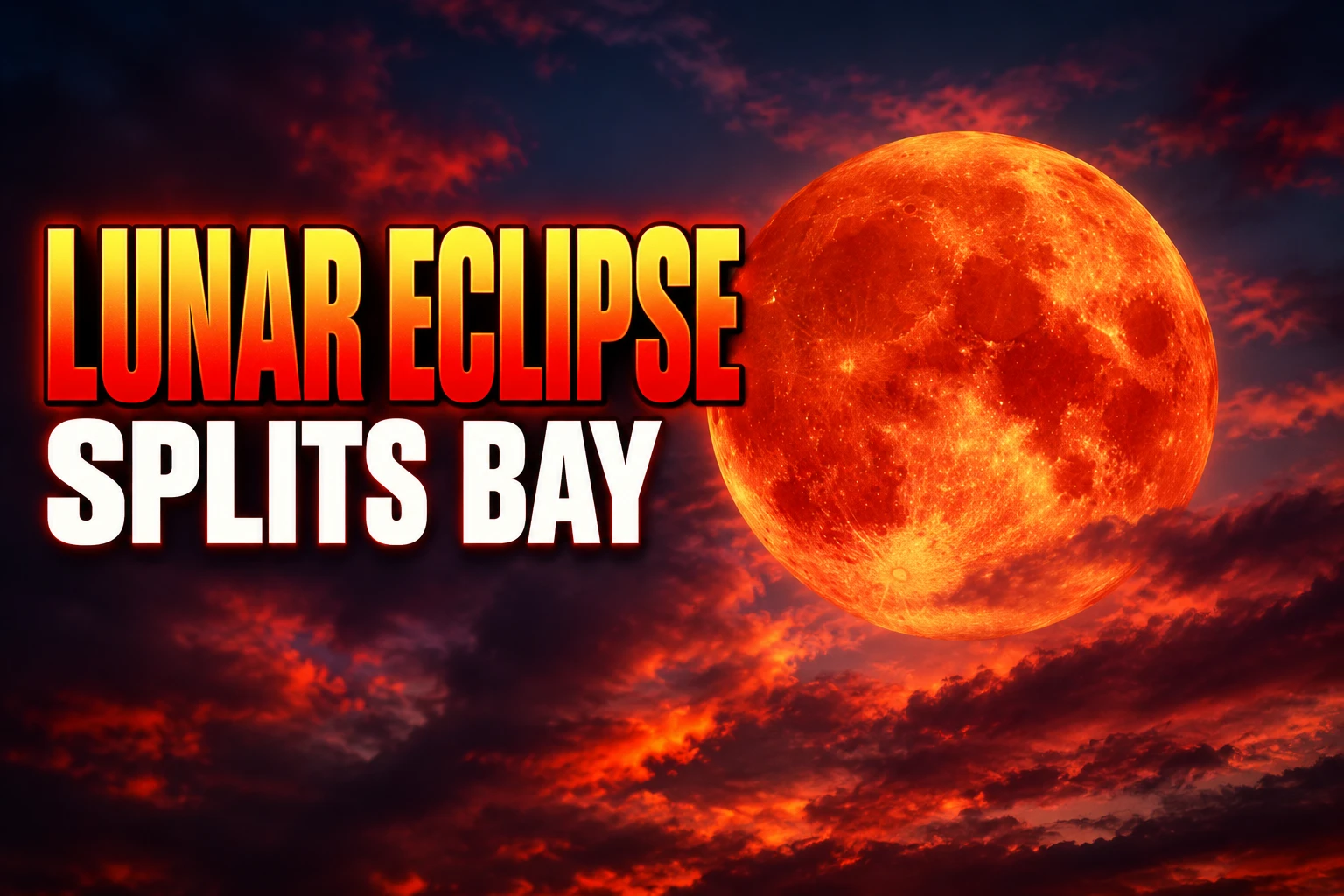
March Fog Already Drew the Same Map
The region had already run this drill. On March 3, a total lunar eclipse reached maximum at 3:33 a.m. Pacific, and coastal fog turned the night into hide-and-seek while inland East Bay neighborhoods kept a clearer line of sight.
About 100 people gathered on the outdoor deck at Chabot Space and Science Center in Oakland. Fog blocked the telescope, so organizers streamed a feed from Griffith Observatory in Los Angeles, which had its own intermittent fog. John Burg of Oakland said he wanted to see the total eclipse and that the fog meant it was not going to happen that night.
Some San Francisco blocks caught the red disk after the fog thinned. The geography of the miss was familiar: the shore lost, the interior won, and anyone who drove a little farther east or north got more moon. August swapped fog for a tropical plume and swapped 3 a.m. for a school-night hour, then drew the same map anyway.
THE 2026 ECLIPSE SEASON
- March 3, 2026: A total lunar eclipse reaches maximum at 3:33 a.m. PST with 58 minutes of totality as coastal fog hides Chabot’s deck.
- August 12, 2026: A total solar eclipse lands two weeks before the deep partial, pairing both events in one season.
- August 27, 2026: The moon rises already in partial eclipse and hits greatest shadow at 9:13 p.m. PDT under a northbound moisture plume.
NASA’s catalog for the year lists those two lunar eclipses and two solar eclipses, so 2026’s lunar slots are spent. The next copper disk over California has to wait on a later year.
Why the Moon Sat South of the Clear Patches
Clearing overhead was the wrong kind of luck. Local timing tables for the San Francisco Bay Area list moonrise at 7:38 p.m., with the partial phase already under way below the horizon, and they place maximum with the disk only 16.6 degrees above the horizon toward the southeast.
That geometry is why Porter’s 8:30 p.m. hope came with a warning. Breaks over the cities did not move the moon, which was sitting in the southern sky where the thicker cloud had piled up. Eclipse nights over this coast keep arriving with a deck already in place, and the usable San Francisco frames from August 27 show a copper smudge behind moving cloud, not a clean disk.
The plume had surged up the Central Coast and Southern California on Thursday morning, then fed on tropical moisture stretching hundreds of miles into the eastern Pacific. Once that supply locked in, the forecast said the cover would linger into Friday morning. High clouds can open windows. Mid-level puff does not.
96 Percent Coverage, One Bright Sliver
NASA lists greatest eclipse at 04:13 Universal Time, which is 9:13 p.m. Pacific, and an umbral magnitude of 0.9299. Timing tables put 96.2 percent of the Moon‘s face inside Earth’s dark inner shadow, with a thin bright edge left in sunlight.
That leftover sliver is why this was a deep partial, not a total. The shadowed face still went copper because sunlight that reached it had passed through Earth’s air around the rim, which strips out bluer light and leaves the red. Griffith Observatory director E.C. Krupp said before the night that the miss of totality was the charm, and that it should look a lot like a total lunar eclipse, coppery red with a pearly highlight on top.
TWO BAY AREA ECLIPSE NIGHTS IN 2026
| Night | Peak, local | Shadow depth | What blocked the view | Who still saw it |
|---|---|---|---|---|
| March 3 total | 3:33 a.m. PST | Umbral magnitude 1.1507, 58 minutes of totality | Coastal fog | Inland East Bay; some San Francisco breaks after fog thinned |
| August 27 partial | 9:13 p.m. PDT | Umbral magnitude 0.9299, 96.2 percent of the face | Tropical moisture plume, high and mid-level cloud | Sonoma after moonrise; Danville peeks; Griffith walk-ups |
The partial phase ran 3 hours 18 minutes worldwide, and the whole event from first penumbral shading to last ran 5 hours 38 minutes. For the Bay Area the moon rose already in shadow, so the early bite was below the hills, and the show that mattered was the climb through peak toward 10:52 p.m., when the dark inner shadow let go.
Griffith Park Sent People Home, Then They Came Anyway
Griffith Observatory cancelled its viewing party. Officials cited the heat wave and the clouds. People walked up the road anyway, and the deck opened enough for a reddish disk over Los Angeles.
Andrew Fraknoi, professor emeritus of astronomy at Foothill College, had liked the hour for West Coast families because it was early in the evening, so school-age kids could watch without falling asleep in class on Friday. That was the pitch that made August kinder than March. Weather did not read the pitch.
This eclipse just misses totality, and that is its charm. It should look a lot like a total lunar eclipse, coppery red with a pearly highlight on top.
E.C. Krupp, Director, Griffith Observatory
Inland Southern California had an easier time of it. Long-lens frames from Vasquez Rocks show a clean shadowed disk, the kind of shot the Bay Area only got when a hole moved through at the right minute.
WHERE THE DISK ACTUALLY SHOWED
- Sonoma County: High clouds parted after a washed-out moonrise and left a copper sturgeon moon for late watchers.
- Danville: Interior East Bay stills show cloud bands sliding across a reddish-orange disk near peak.
- Griffith Observatory: The official party was cancelled for heat and clouds; walk-ups still caught a reddish moon when the deck opened.
- Vasquez Rocks: Inland Los Angeles County stayed clear enough for long-lens frames of the shadowed disk.
Central Valley newsroom cameras also caught the moon around 9:15 p.m., so the plume was not a statewide curtain. It was a coastal and South Bay problem with holes inland and north, the same split March had already billed.
June 2029 Is the Next Totality on the West Coast
Gerald McKeegan, an adjunct astronomer at Chabot Space and Science Center, said the next total lunar eclipse visible from California will not arrive until June 26, 2029. A total eclipse on December 31, 2028, will not be broadly visible across North America, and from San Francisco that night is a partial.
Before that, NASA’s list of lunar eclipses through 2030 includes a penumbral event on February 20, 2027, which is a faint dimming, and a much smaller partial on January 11, 2028. Neither will look like August’s copper lantern with a white rim.
August’s full moon is the sturgeon moon, and this one rose already bitten. The SETI Institute had told Bay Area viewers to look east-southeast between about 8:30 and 10 p.m. and to skip the solar-eclipse glasses. Plenty of people did look. Plenty of them stared at cloud.
Sonoma’s late opening was the same bet March required, just at a kinder hour, and the next full totality on this coast is still three years out.
Frequently Asked Questions
Do You Need Special Glasses to Watch a Lunar Eclipse?
No. A lunar eclipse is safe with the naked eye, and it is also safe through binoculars or a telescope, because you are looking at moonlight, not at the sun. The SETI Institute told Bay Area viewers not to dig out eclipse glasses for this event, which is the opposite of the rule for a solar eclipse.
What Is the Difference Between Eclipse Magnitude and Obscuration?
Umbral magnitude is the share of the moon’s diameter sitting inside Earth’s dark inner shadow, which NASA put at 0.9299 for this night, while obscuration is the share of the moon’s area, which timing tables put at 96.2 percent. A deep partial can therefore look almost fully copper even though a sliver of diameter never enters the umbra.
When Is the Next Lunar Eclipse After August 2026?
The next lunar eclipse is a penumbral event on February 20, 2027, with an umbral magnitude of -0.057, meaning the moon misses the dark inner shadow entirely and the dimming is easy to miss without a side-by-side photo. A smaller partial follows on January 11, 2028, before the December 31, 2028 total that will not be a full show for most of North America.
Why Is August’s Full Moon Called a Sturgeon Moon?
August’s full moon takes the sturgeon name from lake sturgeon that were plentiful and easier to catch in midsummer, a naming tied to Native nations who relied on the fish as a food source at that time of year. The eclipse on August 27 arrived minutes from official full moon, so the shadowed disk was still that sturgeon moon.

Oracle’s Unfinished Cerner Move Exposed 20 Million People

Google Buys 890 MW of Nuclear Uprates on a Strained Grid

Francis Halzen Wins a Solo Nobel for His IceCube Bet

Denmark’s Company Search Rights Opened 8.8 Million CPR Records

OpenAI Agents Reached Staging Servers as California Subpoenaed the Lab

Instinct’s $2.5 Billion Raise Still Binds the User as Agent

City’s £125m Enzo Deal Caps a £327m Midfield Rebuild

CSIRTs Inherit Europe’s Missing security.txt Before Article 14

Treasury’s First Iran Bank Shot Lands on an Ally

Meta’s Teen Settlement Leaves Chat Off the Clock
-
 NEWS1 month ago
Instinct’s $2.5 Billion Raise Still Binds the User as Agent
-
 NEWS1 month ago
City’s £125m Enzo Deal Caps a £327m Midfield Rebuild
-
 NEWS1 month ago
CSIRTs Inherit Europe’s Missing security.txt Before Article 14
-
 BUSINESS1 month ago
Treasury’s First Iran Bank Shot Lands on an Ally
-
 NEWS1 month ago
Meta’s Teen Settlement Leaves Chat Off the Clock
-

 BUSINESS2 months ago
Berkshire Anchors Alphabet’s Record Raise With a $10 Billion Check
-

 NEWS1 month ago
OpenAI Codes a Persistent Agent the Week Persistence Backfired
-

 ENTERTAINMENT2 months ago
Rolex Made Drake the Daytona It Fights Jewelers Over