
ENTERTAINMENT
Weinstein’s 15-Year Sentence Leaves California’s Term Unwritten
Harvey Weinstein got 15 years in New York for assaulting Miriam Haley, while a vacated 16-year California term still has no replacement date.

Harvey Weinstein was sentenced to 15 years in prison on September 23, 2026, for sexually assaulting Miriam Haley in 2006. Manhattan Supreme Court Justice Curtis Farber imposed the term after a 2025 retrial, then left a harder question to California, where a 16-year sentence was vacated in June and has not been replaced.
Farber said Los Angeles will decide whether the New York time runs with, or on top of, whatever term is written next on the West Coast. Weinstein is 74. He has been in jail or prison since 2020.
Fifteen Years on One Remaining New York Count
The count was a first-degree criminal sexual act against Haley, a former production assistant on Project Runway. A jury found in June 2025 that Weinstein forcibly performed oral sex on her at his SoHo apartment on July 10, 2006. The charge carried a ceiling of 25 years.
Assistant District Attorney Nicole Blumberg asked for 20 years plus five years of post-release supervision, telling Farber that 20 years was the only fit punishment because Weinstein had not shown an ounce of remorse and had kept up public victim-shaming, including a 2025 podcast interview with Candace Owens. Defense lawyers asked for nine years and pointed to his health. Farber announced the sentence at 11:40 a.m. ET: 15 years in prison, then five years of supervised release, with sex-offender registration.
THE ASKS AGAINST THE TERM FARBER IMPOSED
| Benchmark | Prison term |
|---|---|
| Statutory maximum on the count | 25 years |
| Prosecutors’ request | 20 years |
| Defense request | 9 years |
| 2020 New York sentence, later vacated | 23 years |
| Farber, September 23, 2026 | 15 years, then 5 years’ supervision |
That is eight years shorter than the 23-year term Justice James Burke imposed in March 2020, five years below the office’s ask, and six years above what the defense wanted. The 2020 number covered Haley and a rape count involving aspiring actress Jessica Mann. This one covers Haley alone.
Farber told Weinstein he had been king in an industry that decided whose dreams flourished, then said he would be remembered as the man who a great woman finally stood up against. He also said Weinstein took what he wanted by force and has never accepted responsibility.
You had it all. Your legacy could have been cemented with greatness. But you threw it all away by assaulting Miriam Haley.
Justice Curtis Farber, Manhattan Supreme Court, September 23, 2026
Weinstein arrived in a wheelchair, his hands cuffed to the seat. When Farber finished, he shook his head as he was wheeled out.
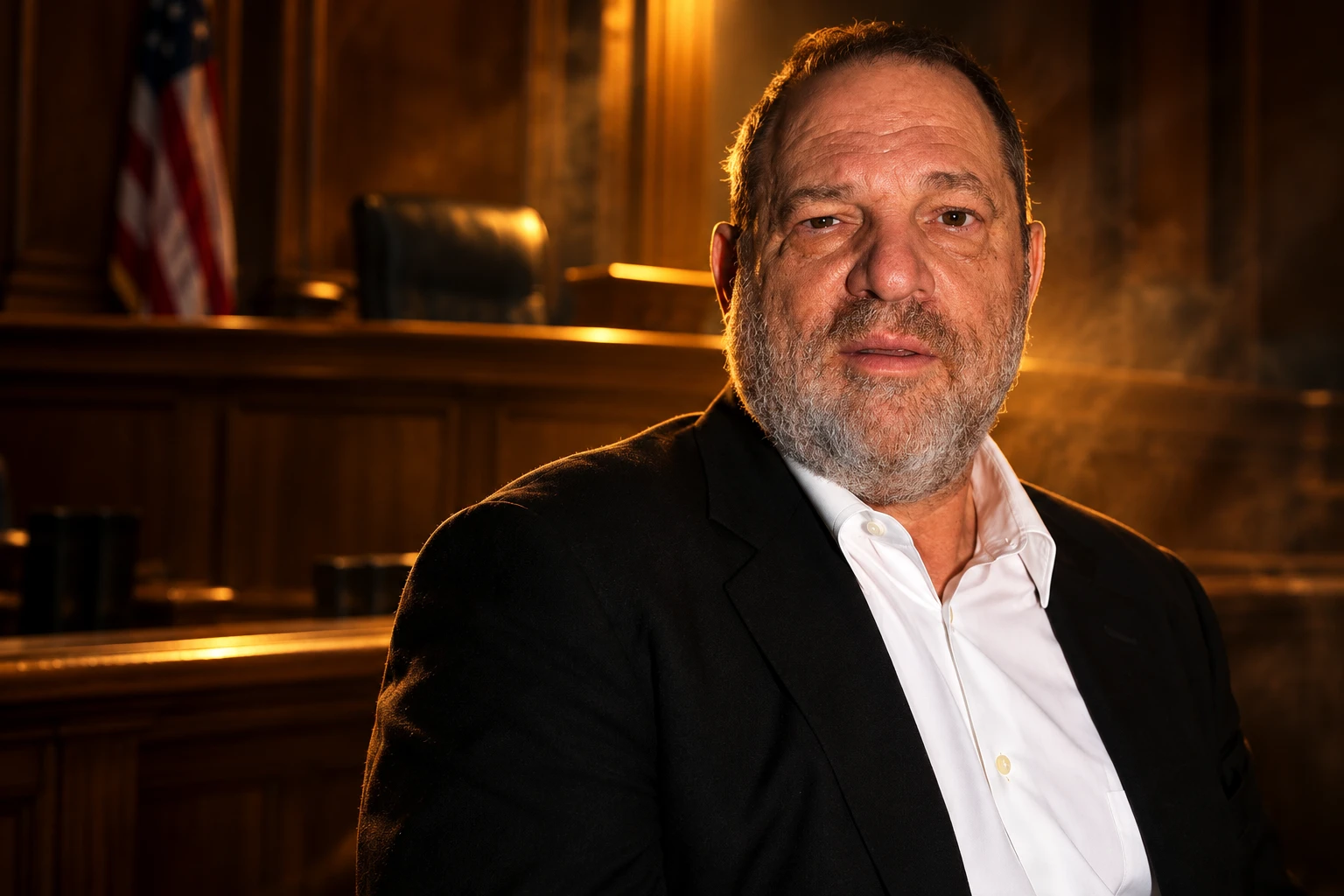
Why the 2024 Overturn Did Not End the Case
The road to this number is the reason 15 years is not a simple sequel to 2020. New York’s Court of Appeals threw out the first conviction on April 25, 2024, in a 4-3 ruling that ordered a new trial. Associate Judge Jenny Rivera wrote that Weinstein had been judged on untested allegations of prior bad acts, not only on the charged conduct, and that those errors were egregious.
The extra witnesses had been called under People v. Molineux, the 1901 case that sometimes lets a jury hear other alleged crimes. The majority said that testimony served no material non-propensity purpose and that the threat of a brutal cross-examination also undermined Weinstein’s right to testify. Associate Judge Madeline Singas dissented, writing that the majority allowed predators to escape accountability and missed how consent cases actually work in a courtroom.
Manhattan District Attorney Alvin L. Bragg Jr. tried the case again anyway. The retrial produced a split: guilty on Haley, not guilty on a similar count involving former model Kaja Sokola, and no verdict on Mann. A later trial on the Mann count ended in a mistrial in May 2026. The Haley conviction is what Farber sentenced.
THE PATH BACK TO A NEW YORK SENTENCE
- July 10, 2006: Haley says Weinstein assaults her at his SoHo apartment after inviting her to stop by the night before a Los Angeles premiere.
- March 11, 2020: A Manhattan jury’s split verdict produces a 23-year sentence on Haley and Mann.
- April 25, 2024: The Court of Appeals reverses, 4-3, and sends the case back.
- June 11, 2025: A second jury convicts on Haley, acquits on Sokola, and hangs on Mann.
- May 2026: A third trial on Mann ends in a mistrial.
- June 25, 2026: Prosecutors dismiss the Mann count after she says she will not testify a fourth time.
- June 26, 2026: A California appeals court affirms a 2022 rape conviction and vacates a 16-year sentence.
- September 23, 2026: Farber imposes 15 years on the Haley count.
Arthur Aidala, who spoke for Weinstein after the 2024 reversal, said then that his client would tell a new jury there had been a sexual encounter with Haley and that he never forced her to do anything. The 2025 jury rejected that account on the Haley count and accepted it, or at least could not agree, on the others.
Haley Said the Process Itself Became the Punishment
Haley has now testified at two criminal trials about the same night. Before Farber sentenced Weinstein, she told the court she had not expected to be standing there again six years after the first conviction, and that she trusted this would be her final time. She described a draining process, belittling cross-examination, and harassment and threats online.
It has often felt like I was the one on trial. This process has been the worst decision of my life, for me personally. I considered pulling out so many times.
Miriam Haley, victim impact statement, Manhattan Supreme Court
She also said the assault and the years spent chasing a verdict had given her a life sentence. After the hearing she told reporters she viewed Farber’s term as fair and, in the next breath, that for her personally it was never going to be fair. Gloria Allred, who appeared with her, said on September 24 that she was proud of Haley, whom she called Mimi, for holding her ground through two trials.
Bragg, speaking outside court, said the day was about the survivors and that Haley’s remarks were powerful, moving, and eloquent. He thanked her first, then the other survivors who came to sit with her. The New York case that once named three complainants in a single retrial is now a sentence for one woman who stayed after the others’ counts fell away.
Farber Left the Stacking Question to Los Angeles
Farber did not decide how this term interacts with California. He said the California courts will decide whether the sentences run concurrently or consecutively. No resentencing date has been set in Los Angeles.
Weinstein was convicted in December 2022 of forcible rape, forcible oral copulation, and sexual penetration by a foreign object in a Los Angeles hotel room on or about February 18, 2013. Variety has identified the accuser as Italian model and actor Evgeniya Chernyshova; the California opinion calls her Jane Doe No. 1. Superior Court Judge Lisa B. Lench sentenced him in February 2023 to 16 years: eight years on oral copulation, six on penetration, and two on rape. That upper-term package used the New York convictions as an aggravating factor. Those convictions were later wiped out, so the aggravator died with them.
On June 26, 2026, a three-judge panel of the California Court of Appeal, Second District, Division One, in People v. Weinstein, case B327696, affirmed the guilty verdicts and vacated the sentence and remanded for resentencing. Justice Michelle C. Kim wrote that the panel rejected his attempts to disturb the jury’s guilty verdicts, and that the attorney general agreed he was entitled to a new sentencing because the upper term rested on a now-invalid factor. Jennifer Bonjean, his California lawyer, said significant legal issues still deserve review and that the defense would ask the California Supreme Court to take the case.
THE CALIFORNIA COUNTS UNDER THE VACATED TERM
- Forcible oral copulation: Eight years, the high end on that count in the 2023 package.
- Sexual penetration by a foreign object: Six years, consecutive in the original math.
- Forcible rape: Two years, bringing the vacated total to 16 years.
Until Lench, or another Los Angeles judge, writes a new number, New York’s 15 years is the only active prison term on the books. That is the quiet fact under every headline that treats 15 years as a life sentence by arithmetic. It may yet be one. It is not one by court order.
WHAT WE KNOW
- The New York term: Fifteen years, then five years of supervision, plus registration, imposed on September 23, 2026.
- The California verdicts: The 2022 guilty findings still stand after the June 26, 2026 ruling.
- The 16-year term: Vacated and not replaced; Farber left concurrent-versus-consecutive to California.
WHAT IS UNCONFIRMED
- A new Los Angeles number: No hearing date is set, and the defense is still seeking California Supreme Court review.
- How the clocks combine: Consecutive time would add California on top of New York; concurrent time would overlap them.
- Jail credit: How much of the more than six years already served will be applied, and against which term, has not been spelled out in the New York sentence.
A consecutive California term would turn 15 years into a floor. A concurrent term, with credit for time already in, would make the New York number look larger on paper than it feels on a remaining-years calendar. Farber did not pick.
Six Years Served Does Not Close the Clock
Weinstein has been locked up since 2020, which is more than six years as of this sentence. His lawyers used that time, and his health, to argue for nine years. He has been treated for chronic myeloid leukemia and diabetes and has serious trouble walking, which is why he was sentenced from a wheelchair. Defense papers also cited heart disease. Blumberg still asked for 20 years, and Farber still went to 15.
In court Weinstein complained about Rikers Island, calling the conditions torturous and saying he was being denied basic human rights and treated worse than an animal. He said he wanted his remaining time to include work for other prisoners. Farber was not moved off the term. He said Weinstein no longer poses a physical threat and is still a sexual predator, and that recent jailhouse interviews in which Weinstein cast himself as the victim of money-hungry women weighed on the sentence.
THE FILE ON SENTENCING DAY
- Age: 74, in a wheelchair, already in custody since 2020.
- Live New York term: 15 years plus five years of supervision.
- Live California term: None. The 16-year sentence is vacated.
- Open appeal track: He disagrees with Farber’s sentence and has indicated he will appeal the New York conviction and the term.
Fifteen years is being judged in public as too little for the history attached to his name, and as a term he may not outlast. Both readings skip the paperwork. The live number is 15. The number that decides whether that 15 is the rest of his life is the one Los Angeles has not written.
No Fourth Trial on the Mann Count
The collapse of the Mann count is why this sentencing was a one-count hearing. Mann testified through two grand juries and three trial juries over eight years, Bragg’s office said. After the May 2026 mistrial, she told prosecutors she did not want to take the stand a fourth time. On June 25, 2026, the office informed the court it would not retry rape in the third degree, while saying it still believed her account.
The same statement recommended 20 years in prison on Haley. That recommendation is what Blumberg carried into Farber’s courtroom three months later. Sokola’s acquittal in 2025 had already taken a second first-degree count off the table. The New York case that started as a landmark with multiple named complainants ended as a sentence for Haley.
He Apologized and Still Calls Himself Innocent
Weinstein spoke before the term was imposed. He said he was not a perfect person, and that he was a person who had made mistakes. He said reflecting on what has happened since 2017 helped him see how his past conduct had hurt others, that he lives with many regrets, and that he sincerely apologized to anyone he may have hurt. He also said he had remorse for Haley’s pain, that he is not a violent man, and that he had to reiterate his innocence.
I do have remorse for Miriam Haley’s pain. But I have to reiterate my innocence.
Harvey Weinstein, Manhattan Supreme Court, September 23, 2026
A spokesman said Weinstein maintains his innocence and strongly disagrees with the sentence. Bragg’s office put the result on the record the same afternoon.
ICYMI: Today Harvey Weinstein was sentenced to 15 years in state prison for his violent sexual assault of Miriam Haley. Read more: https://t.co/PmXUvsxCrt pic.twitter.com/S7ZnyrqKtP
— Alvin Bragg (@ManhattanDA) September 23, 2026
Haley’s row in the gallery hugged and cried when it was over. Weinstein was wheeled out still shaking his head, a 15-year New York term now on the docket and a California number still blank.

MLB and the Union Will Not Extend the Labor Deal

Amazon Found PHP2Shell Probes Four Days Before the Patch

Brent Clears $117 After Gulf Crude Already Came Back

Chipmakers Took the Nasdaq Hit After Meta Burned Cash

Netflix Scored Its 2026 Series as Flops Against Home Runs

Rolex Made Drake the Daytona It Fights Jewelers Over

Treasury’s First Iran Bank Shot Lands on an Ally

Instinct’s $2.5 Billion Raise Still Binds the User as Agent

City’s £125m Enzo Deal Caps a £327m Midfield Rebuild

CSIRTs Inherit Europe’s Missing security.txt Before Article 14
-
 ENTERTAINMENT2 months ago
Rolex Made Drake the Daytona It Fights Jewelers Over
-
 BUSINESS2 months ago
Treasury’s First Iran Bank Shot Lands on an Ally
-
 NEWS2 months ago
Instinct’s $2.5 Billion Raise Still Binds the User as Agent
-
 NEWS2 months ago
City’s £125m Enzo Deal Caps a £327m Midfield Rebuild
-
 NEWS2 months ago
CSIRTs Inherit Europe’s Missing security.txt Before Article 14
-

 BUSINESS2 months ago
Berkshire Anchors Alphabet’s Record Raise With a $10 Billion Check
-

 NEWS2 months ago
Meta’s Teen Settlement Leaves Chat Off the Clock
-

 ENTERTAINMENT2 months ago
Ricky Gervais Wants Alley Cats to Run Until He Dies