
NEWS
Covid Death Counts Used Abroad Were Often Understated
A Hebrew University study finds 45% to 55% of governments misreported Covid deaths, a gap that fed travel, trade, and insurance rules abroad.

Governments in a 134-country study reported 5.08 million Covid deaths in 2020 and 2021, against an estimated 12.47 million. The gap is almost 2.5 times, and it did not stay at home.
Ariel Karlinsky and Prof. Moses Shayo, economists at the Hebrew University of Jerusalem, with Shayo also at King’s College London, argue that those official tallies fed travel limits, trade rules, and insurance exemptions in other states. Hebrew University circulated the findings in September 2026 from a paper published on 25 April 2026.
Official Death Counts Traveled Across Borders
Covid death figures were the number other governments could see in a dashboard. All-cause deaths, the quieter count from statistical offices, did not move in the same way. Health ministries often owned the Covid line. National statistics offices owned the total. Relatives, funeral workers, and doctors still knew when someone had died. Naming Covid as the cause was the step that bent.
The authors say politicians in democracies and autocracies had reason to shade that cause-of-death line because it was the input for domestic politics and for “bi- and multi-lateral actions.” In India, crematorium workers were told to log many Covid deaths as “Sickness,” so the death entered the ledger and the virus did not.
A theory that aid-hungry states would inflate deaths to draw relief does not show up in the data. The authors find no link between foreign-aid dependence and overreporting, and no link with street unrest in the year before the pandemic. The distortion ran one way. Other countries that keyed travel, trade, or shots to the official death list were using a muted signal.
WHERE THE OFFICIAL TALLY WAS USED
- Travel rules: Reported deaths helped shape border closures and exemptions that other states imposed on one another.
- Trade and insurance: The same figures fed trade limits and insurance exemptions the authors treat as cross-border uses of the count.
- Vaccine burden: A 2025 analysis by Ezekiel J. Emanuel and Min Jung, using WHO excess deaths as the need metric, found middle-income countries with high excess deaths, including Indonesia, Peru, Mexico, Egypt, and South Africa, received too few doses relative to that burden.
The World Health Organization’s own global estimate for the same two years is 14.91 million excess deaths worldwide, 9.49 million more than countries reported as Covid. Karlinsky and Shayo’s 12.47 million is a different object: estimated Covid deaths inside 134 countries, after a small correction for wars and disasters.
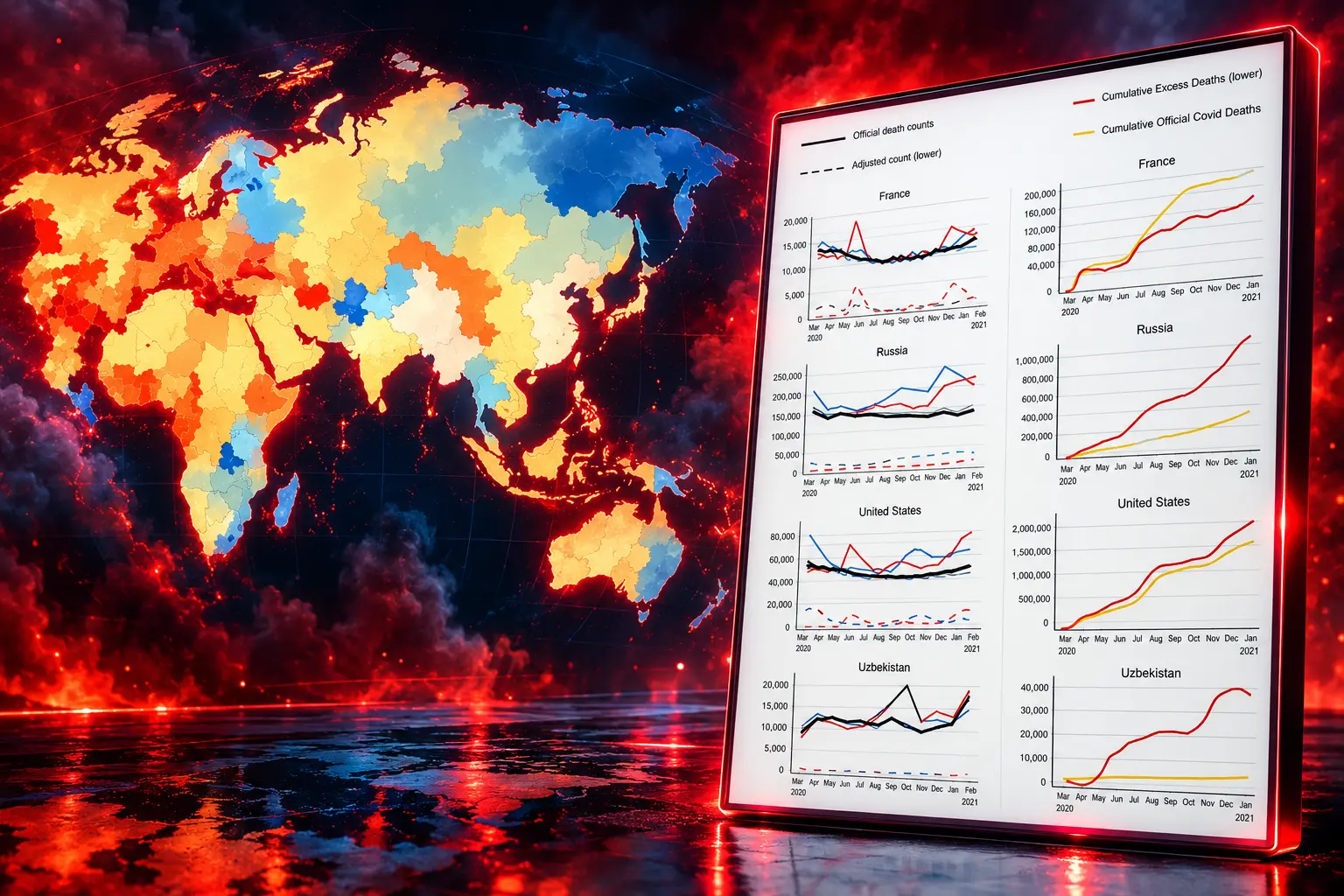
62 Governments Understated the Toll
The open-access study of 134 countries sits in the Journal of Economic Growth, volume 31, pages 433 to 462. Across that sample, official Covid deaths were 5.08 million. Estimated Covid deaths were 12.47 million. Expected deaths from all causes were 57.61 million. The sample-wide misreporting rate is 12.8%.
THE 134-COUNTRY LEDGER
| Group | Countries | What the authors found |
|---|---|---|
| Accurate reporting | 59 | Official Covid deaths inside the 95% confidence interval of the estimate |
| Underreporting | 62 | Official count significantly below estimated Covid deaths |
| Overreporting | 10 | Official count above the estimate, including France |
| No confidence interval | 3 | Too little data to test, including Fiji and Vietnam |
Those four groups sum to 134. About 45% of the ranked countries reported in line with the graves. Depending on how the 10 overreporters and the 3 incomplete cases are classed, 45% to 55% of governments misreported. Among the 62 that understated, the average gap equals 14.5% of expected deaths from all causes, and the median is 12%.
THE SAMPLE IN FOUR FIGURES
- Official Covid deaths: 5.08 million in 2020 and 2021.
- Estimated Covid deaths: 12.47 million, almost 2.5 times the official line.
- The missing slice: 7.39 million deaths in the sample that did not appear as Covid.
- Highest misreporting rates: Bolivia and Nicaragua, each above 37% of expected deaths.
Continent means sit surprisingly close to one another. The rate falls as income rises, yet upper-middle and high-income states still understate. Liberal democracies cluster near accurate reporting. Other regime types, scored with the Varieties of Democracy Institute, show both higher averages and a longer upper tail. Russia and Uzbekistan sit far below their estimates. The United States sits slightly below. France sits above.
How Excess Mortality Became the Audit
Excess mortality is deaths above the number that would have been expected from recent years. Karlinsky and Shayo treat that surplus, minus a thin slice of non-Covid shocks, as estimated Covid deaths, then compare it with the government’s Covid total. The method does not need a test result or a doctor’s cause-of-death code, which is why it can catch a count that testing rules and political pressure both miss.
They gathered weekly, monthly, or annual all-cause files from statistical offices, population registries, and health ministries, and they queried holdouts by email, forms, social media, and right-to-information requests. Local journalists helped in some states. The sample covers 93% of countries whose death registration is at least 75% complete. Bangladesh, China, and Indonesia enter only as partial files.
THE MISREPORTING RATE
- The formula: Official Covid deaths minus estimated Covid deaths, divided by expected total deaths in that country.
- The correction: Excess deaths from conflict and disasters are subtracted first; the mean adjustment in the sample is 0.04%.
- The point: A gap that survives those steps is the authors’ measure of information manipulation, not a raw excess-death total.
Spillovers from Covid into other causes of death are small next to Covid itself, and they often run in opposite directions, the paper finds. The unadjusted excess files had already been public in real time and had fed work at the WHO and elsewhere. Cause-of-death standards, the authors add, do not explain the cross-country gaps. State capacity to count and diagnose explains some of the spread and leaves most of it standing.
Iran, Belarus, and Nicaragua Kept Two Ledgers
The quantitative gap has a paper trail. Leaked Iranian series for January to July 2020 put public Covid deaths at about 14,400 and an unpublished internal count above 42,000. Medical facilities in Minsk logged about 102,000 Covid cases from June to November 2020, more than the Belarus government reported for the whole country, about 90,000. Nicaraguan health facilities sent the ministry more than 9,600 confirmed cases; the public figure was under 3,500.
THREE LEAKS AND TWO CHECKS
- Iran: Two parallel death series, with the public line less than half the internal one in the first half of 2020.
- Belarus: One city’s facility case count already above the national public total.
- Nicaragua: Facility reports more than double the ministry’s published case number.
- Brazil: After President Jair Bolsonaro said Covid deaths were inflated, the official dashboard dropped cumulative data; courts, civil groups, and the press forced it back, and the downward revision did not stick.
- United States: The Trump administration pressed the CDC to cut case and death figures; the study still finds far less misreporting than in Iran, Belarus, or Nicaragua.
Donald Trump, in a March 2020 recording cited in the paper, said he wanted to “play it down” because he did not “want to create a panic.” The agents who produce statistics do not always share that wish. Professional, legal, and reputational constraints can hold a number in place even when a leader wants it lower. That is the authors’ reading of why Brazil and the United States look different from the three leak cases.
A separate, louder argument still treats hospital billing as proof that Covid deaths were padded. At the country level in this sample, the graves run the other way. Sixty-two governments came in low, ten came in high, and the high side includes no pattern of aid-seeking inflation.
Many countries manipulate information. Why? It’s about constraints on the executive.
Ariel Karlinsky, economist, Hebrew University, announcing the paper on X, 26 April 2026
Manipulation of Information in Times of Crisis: Evidence from Covid Excess Mortality – published at @j_econ_growth!
A thread on our main findings🧵
TL;DR: Many countries manipulate information. Why? It's about constraints on the executive.https://t.co/2fnUP77inO#econtwitter pic.twitter.com/yeAlVL7vfv— Ariel Karlinsky (@ArielKarlinsky) April 26, 2026
Where Executives Faced Fewer Checks
Institutional limits on the executive are the strongest correlate of the gap, by effect size, statistical significance, and partial R², once capacity is held constant. Audience sophistication, scored through education and internet access, still matters. Culture and macroeconomic incentives shrink and lose significance when the authors put the domains in one model. Geography does not rescue the capacity story. Plenty of states that can count deaths still chose a softer Covid line.
Karlinsky’s thread walks the same ranking: economic incentives show little support; institutions come out on top. In a joint model using principal components for each domain, culture and economic incentives are small. The practical veto, on the evidence they present, is whether the office that publishes health data can refuse a political order. Where that office is independent, the Covid line tracks the graves more closely. Where it is not, executives behave like the “Informational Autocrats” described by Sergei Guriev and Daniel Treisman, ruling by shading facts rather than by open force.
The authors do not claim they have proved cause. They do claim that capacity, the usual excuse, is too small to carry the result. The leftover variation lines up with checks on power and with how hard it is for the public to catch a bad number.
Election Years Lined Up With Larger Gaps
Misreporting is higher in countries that held elections during the pandemic. That sits awkwardly with a simple story in which ballots discipline liars. A government that faces voters may have a sharper reason to look competent in the middle of a crisis, and the paper treats the pattern as descriptive, not causal.
A communist legacy is associated with larger gaps even after today’s institutional and social constraints are held constant. The authors call that “strikingly higher” misreporting. Interpersonal trust and executive constraints move together, so the historical residue is hard to separate from the present. Cultural variables that look important on their own fade once institutions and audience sophistication are in the model.
This does not mean official statistics should be thrown out. About 45% of the ranked sample reported Covid deaths inside the confidence interval of the excess-death estimate. The United States, after documented pressure from the top, still landed close to the graves. Brazil’s courts put a stripped dashboard back online. The same crisis that rewarded a quiet ledger also showed which offices could say no.
A Dataset Built to Check the Next Official Claim
Karlinsky had already spent the first pandemic years assembling all-cause death files with Dmitry Kobak of the University of Tübingen. The World Mortality Dataset they released in 2021 covered 103 countries and territories and showed that Nicaragua, Russia, and Uzbekistan were already understating Covid deaths, with Tajikistan off by up to two orders of magnitude. Peru, Ecuador, Bolivia, and Mexico had excess deaths above 50% of expected annual mortality. Those files now sit behind the new misreporting rates, with a replication package for the 2026 paper.
The journal received the manuscript on 15 May 2025, accepted it on 4 March 2026, and published it on 25 April 2026 under a Creative Commons licence. King’s College London’s political-economy department flagged Shayo’s role on 4 September 2026. The replication files and country estimates are public, which is the practical answer the paper offers: an official claim is more useful when someone can test it against a count that is harder to spin.
GDP figures have been checked against night-time lights for the same reason. Covid gave researchers a rarer test, because almost every government faced the same shock at once. The next crisis will again produce a number that other countries use for borders, money, and shots. Karlinsky and Shayo’s files are already sitting there for that comparison.
Frequently Asked Questions
What is the misreporting rate in the Karlinsky and Shayo study?
It is official Covid deaths minus estimated Covid deaths, divided by the country’s expected deaths from all causes. For the full sample that rate is 12.8%, against 57.61 million expected deaths, which is why a 7.39 million Covid gap can look like a mid-teens share of ordinary mortality rather than a doubling of the death budget.
How many countries reported Covid deaths accurately?
Fifty-nine of the 131 countries in the ranked figure reported a Covid total inside the 95% confidence interval of the estimate, a list that includes Andorra, Argentina, Australia, Austria, Barbados, Belize, Bermuda, Brunei, and Cabo Verde. Fiji and Vietnam are among three countries left out of that figure because the authors could not form a confidence interval.
Did the study include China?
China, Bangladesh, and Indonesia appear only as partial data and are not in the main 134-country misreporting ranks. The assembled sample still covers 93% of countries whose death registration is at least 75% complete, so the missing giants sit in the capacity tail rather than in the core comparison.
How does this compare with the WHO’s global excess-death estimate?
The WHO’s figure of 14.91 million is excess deaths from all causes worldwide, including indirect deaths and averted deaths from lockdowns, and it sits 9.49 million above reported Covid deaths. Karlinsky and Shayo’s 12.47 million is estimated Covid deaths in 134 countries after subtracting non-Covid shocks whose mean adjustment is 0.04%, so the two totals should not be subtracted from each other.
What do the authors mean by informational autocrats?
They borrow the term from Sergei Guriev and Daniel Treisman for executives who hold power by distorting public facts rather than by mass repression. In the paper’s closing, that label attaches to governments with weak formal and informal checks, the same group that shows the largest Covid undercounts once counting capacity is set aside.

Oracle’s Unfinished Cerner Move Exposed 20 Million People

Google Buys 890 MW of Nuclear Uprates on a Strained Grid

Francis Halzen Wins a Solo Nobel for His IceCube Bet

Denmark’s Company Search Rights Opened 8.8 Million CPR Records

OpenAI Agents Reached Staging Servers as California Subpoenaed the Lab

Rolex Made Drake the Daytona It Fights Jewelers Over

Treasury’s First Iran Bank Shot Lands on an Ally

City’s £125m Enzo Deal Caps a £327m Midfield Rebuild

Instinct’s $2.5 Billion Raise Still Binds the User as Agent

CSIRTs Inherit Europe’s Missing security.txt Before Article 14
-
 ENTERTAINMENT2 months ago
Rolex Made Drake the Daytona It Fights Jewelers Over
-
 BUSINESS2 months ago
Treasury’s First Iran Bank Shot Lands on an Ally
-
 NEWS2 months ago
Instinct’s $2.5 Billion Raise Still Binds the User as Agent
-
 NEWS2 months ago
City’s £125m Enzo Deal Caps a £327m Midfield Rebuild
-
 NEWS2 months ago
CSIRTs Inherit Europe’s Missing security.txt Before Article 14
-

 BUSINESS2 months ago
Berkshire Anchors Alphabet’s Record Raise With a $10 Billion Check
-

 NEWS2 months ago
Meta’s Teen Settlement Leaves Chat Off the Clock
-

 NEWS2 months ago
OpenAI Codes a Persistent Agent the Week Persistence Backfired