
NEWS
Googlebook Laptops Open at $899 as Google Retries the Premium Bet
Google is betting $899 Android laptops from Dell, HP, Lenovo, ASUS, and Acer can win phone users after the Pixelbook’s $999 flop.

On September 21, Google opened pre-orders for Googlebook laptops starting at $899, with five flagship models due in U.S. stores on October 4. Canada, the U.K., Ireland, France, Germany, and Australia follow on October 5.
The machines come from Acer, ASUS, Dell, HP, and Lenovo, and they run Googlebook OS, a desktop built from Android with ChromeOS windowing and a Gemini layer on top. Google is asking phone owners to pay MacBook-class money for a laptop that treats the Android handset as the other half of the computer.
Google Is Asking MacBook Money for an Android Laptop
John Solomon, Google’s vice president and general manager for laptops, tablets, and Android enterprise, wrote that Googlebook is built on the Android technology stack and paired with desktop foundations from ChromeOS. The company wants the laptop of choice for people who already start work on an Android phone.
That is a premium bet, not a Chromebook sequel. Starting prices run from $899 to $1,299. Every machine in the first wave uses aluminum, magnesium alloy, and carbon fiber, a touchscreen, a backlit keyboard, and a haptic glass trackpad. Google’s hardware post puts the lineup at up to 14 hours of video playback and 16 hours of web browsing, with NPUs rated at over 45 TOPS.
Google tried this price band before. It announced the Pixelbook on October 4, 2017, at $999, then stopped selling that machine in 2020 and canceled a follow-on Pixelbook in 2022. U.S. Googlebooks land on shelves on October 4, 2026, nine years to the day after that Pixelbook unveil.
Rick Osterloh, Google’s head of hardware, has called the project a focusing move after years of shipping two PC operating systems, ChromeOS on laptops and Android everywhere else. He has also said the $899 to $1,299 band sits against devices such as the MacBook Air, and that cheaper Googlebooks and other shapes can come later. The first wave does not wait for those cheaper SKUs.
HOW GOOGLE GOT BACK TO A $999 LAPTOP
- October 4, 2017: Google announces the Pixelbook, a ChromeOS 2-in-1 starting at $999.
- September 2020: Google stops selling the original Pixelbook and points buyers to Pixelbook Go.
- September 2022: Google cancels a follow-on Pixelbook and dissolves that hardware team.
- May 12, 2026: Google previews Googlebook with Acer, ASUS, Dell, HP, and Lenovo as partners.
- September 21, 2026: Pre-orders open for five OEM Googlebooks from $899.
- October 4, 2026: U.S. stores begin selling the first machines.
- October 5, 2026: Canada, the U.K., Ireland, France, Germany, and Australia get retail stock.
The loud objection writes itself: almost nobody was walking around asking for Android on a laptop, and Google’s last expensive ChromeOS clamshell did not stay in the store. The more useful split is whether Googlebook is a phone companion or a way to leave Windows. The spec sheet already kills the cheap-Chromebook reading. No launch config ships with less than 16 GB of RAM or 512 GB of storage.
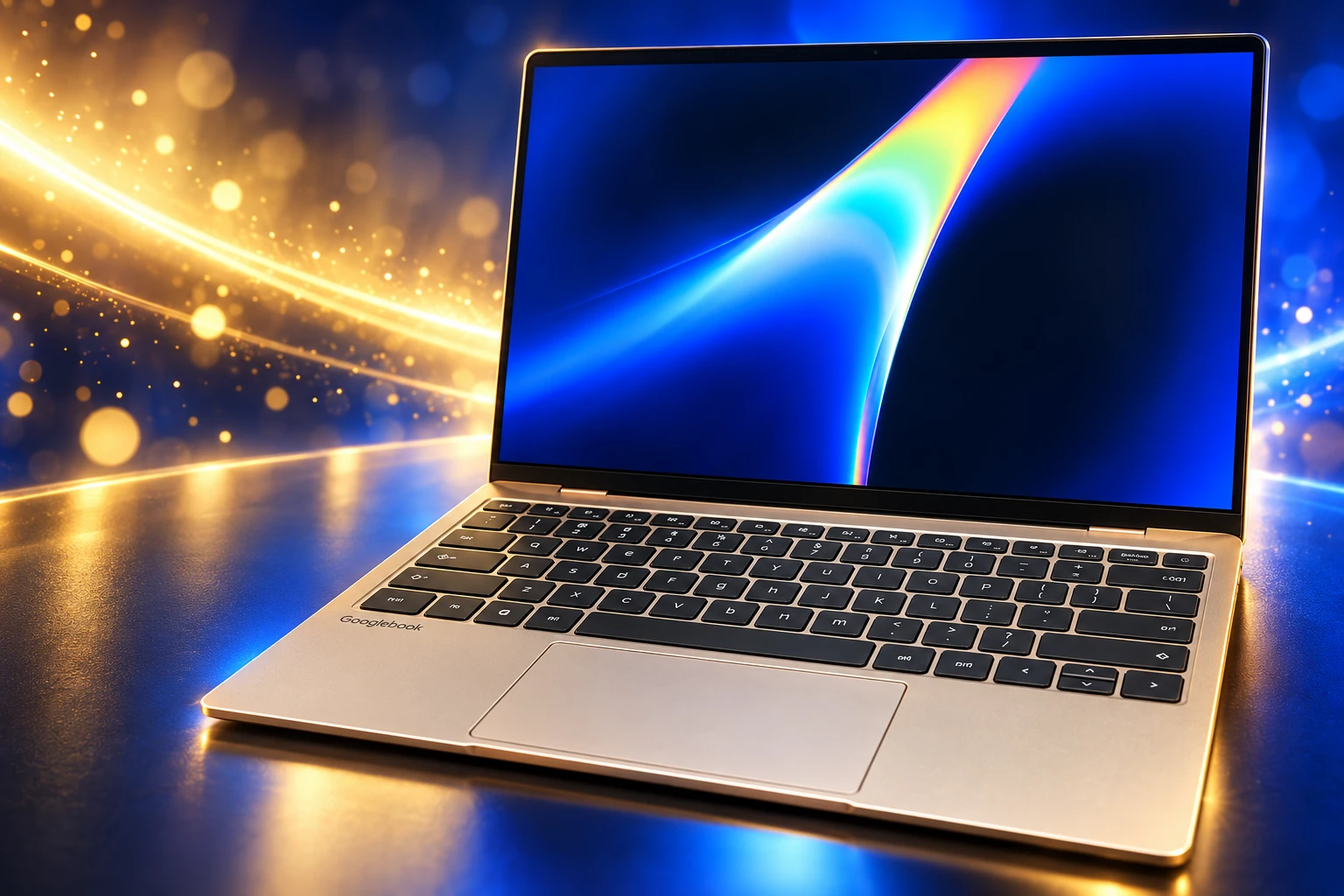
Five Flagships and One Spec Floor
Google set a high floor and then let five makers differentiate above it. You can compare every launch Googlebook side by side on the company’s shop pages, where every starting setup lists 16 GB of RAM and 512 GB of storage. Some models climb to 32 GB of RAM. Intel Core Ultra 5 (Series 3, Panther Lake) and Qualcomm Snapdragon X Elite split the lineup; MediaTek is listed as a partner, with no MediaTek machine at launch.
THE FIVE LAUNCH GOOGLEBOOKS
| Model | Starts at | Processor | Display | Weight | Web battery |
|---|---|---|---|---|---|
| Acer Googlebook 14 | $899 | Intel Core Ultra 5 | 14-inch 2.8K OLED touch | 2.51 lbs | Up to 16 hours |
| XPS Googlebook | $999 | Snapdragon X Elite | 13.4-inch 2.5K LCD touch | 2.2 lbs | Up to 18 hours |
| Lenovo Googlebook 15 | $1,099 | Intel Core Ultra 5 | 15.3-inch 2.8K OLED touch | 2.84 lbs | Up to 13 hours |
| ASUS Googlebook 14 | $1,299 | Intel Core Ultra 5 | 14-inch 2.8K OLED touch | 2.2 lbs | Up to 16 hours |
| HP Googlebook 14 | $1,299 | Snapdragon X Elite | 14-inch 2.8K OLED touch | 2.74 lbs | Up to 19 hours |
Those battery figures are Google’s controlled web-browsing claims, not the 14-hour video number from the hardware blog. The Acer Googlebook 14 from $899 is the only convertible, with a 360-degree hinge. ASUS matches the XPS on weight at 2.2 lbs. Lenovo is the only 15-inch machine and the shortest claimed web runtime, at up to 13 hours. HP posts the longest web claim, at up to 19 hours.
Every lid carries a Glowbar, an LED strip Google is bringing back from the old Chromebook Pixel. It lights at startup, sweeps to show charge, and plays animations when you talk to Gemini. Third-party apps can drive custom Glowbar patterns, which Pixel Glow on phones does not allow. Up to six speakers with Dolby Atmos and noise-canceling mics are part of the hardware brief. U.K. listings start at £999.
Each purchase includes 12 months of Google AI Pro, which Google prices as a $249.99 value with 5TB of cloud storage and Gemini Advanced tools, plus 3 months of YouTube Premium, Adobe Photoshop, and CapCut. The shop pages also bundle 12 months of Luminar and GeForce NOW and put the extra apps at up to $300+.
Sign In and the Phone Comes With You
Solomon’s pitch is blunt. If you use an Android phone, the laptop should not treat it like a stranger. Sign-in pulls over phone settings, saved passwords, Wi-Fi networks, and messages, with end-to-end encryption. Phone features in the Dell materials require Android 17 or newer.
If you use an Android phone, your laptop shouldn’t treat it like a stranger.
John Solomon, Vice President and General Manager, Laptops, Tablets and Android Enterprise, Google blog
Material 3 Expressive, already on phones and watches, lands on the desktop. Quick Settings and notifications sit in the top right, close to Pixel. The dock is centered, and a G mark opens the app drawer. Google is selling continuity, not a new window manager.
WHAT MOVES FROM THE PHONE
- Continue On: An app you were using on the phone, such as BandLab on a commute, shows up on the laptop taskbar so you pick up the same task.
- Files: The laptop Files app can view, search, and open documents and photos that still live on the phone, instead of mailing them to yourself.
- Cast My Apps: A phone app can stream into a desktop window when you do not want to install it, including a delivery app or a one-time code in Messages.
Solomon’s example for Continue On is a music session started on the phone and finished from the Googlebook taskbar. Hands-on accounts describe the reverse path too, grabbing the phone and taking the same document onto a train. That does not help a buyer who lives on iPhone, and Google is not pretending otherwise. The audience is the Android phone owner who already starts tasks on a small screen.
What Googlebook OS Can Run
Google is not asking developers to pick a new runtime from scratch. Chrome is a desktop-class browser here, with extensions, a Gemini side panel, and vertical tabs. The company notes that 70% of time spent on laptops is in a browser, which is the old Chromebook argument wearing a nicer chassis.
The rest of the day is supposed to be Android. The Play Store is the app source, with a badge for desktop-class titles that handle keyboard, mouse, and large screens. Photoshop, Lightroom, and CapCut are named as native creative tools. Netflix and HBO Max are called out with offline viewing. John Maletis, vice president for laptops and tablets, has said Googlebooks run truly native Android apps rather than the emulated copies Chromebooks have used.
Gaming is a pile of three offers. Google says 20,000 mobile and PC titles will run, tuned for keyboard, mouse, and touch, with monthly launches through Play Games Level Up. Everything outside that list is meant to ride the included year of GeForce NOW. That is a cloud-gaming IOU, not a local GPU story, and it will be the first thing a Windows gamer notices.
Gemini is wired into the cursor and the keyboard. Magic Pointer brings Gemini to whatever is on screen when you wiggle the pointer, for jobs such as cleaning up a calendar or translating text, and Google says it only acts when asked. Rambler sits next to the Quick Insert key and turns a spoken stream of notes into headers and checklists, including in more than one language. Create My Widget builds desktop widgets from a plain-language prompt. Gemini Spark can keep working after the lid closes, which is the feature Qualcomm’s chief, Cristiano Amon, flagged on the XPS model.
An XPS That Ships Without Windows
Dell did the most revealing hardware thing in the launch. It put Googlebook OS on XPS, the company’s halo consumer line, instead of burying the software on a no-name SKU. Donnie Oliphant, senior director of XPS, published the first XPS that runs Googlebook OS as a 13-inch machine for Android users, not a Chromebook with a nicer badge.
The XPS portfolio is expanding with a device designed for a new audience.
Dell XPS blog, September 21, 2026
Introducing XPS Googlebook. Learn more on https://t.co/89LCGnSjLx.
— Dell Technologies (@Dell) September 21, 2026
The XPS Googlebook starts at $999, the same figure as the 2017 Pixelbook, with Snapdragon X Elite, a machined aluminum body, 2.2 lbs, and a 12.7mm profile. Dell’s panel is a 2.5K (2560×1600) InfinityEdge touch LCD at 500 nits, covering 100% of DCI-P3, with a 30Hz to 120Hz variable refresh rate. RAM goes to 32 GB of LPDDR5X and storage to 1TB. Ports are two USB-C 3.2 connectors at 10Gbps, with DisplayPort 1.4 and power delivery. The U.S. color is Shimmer. Dell quotes up to 16 hours of Netflix streaming, a different test from Google’s 18-hour web-browsing claim for the same model.
Dell still sells Windows Copilot+ XPS machines in the same store aisle, including Snapdragon X Elite configs listed around $1,299. Putting Googlebook OS on XPS is a hedge, and it is also a cannibal. HP, Lenovo, ASUS, and Acer are making the same trade on flagship-priced metal. They get a Google-blessed SKU in the Android-phone funnel. They also now stock a third OS next to Windows, and in some shops next to ChromeOS, on hardware that costs as much as the Windows machine beside it.
Antigravity Opens a Full Linux Terminal
Google is courting the buyer who would have written off a Chromebook in ten minutes. Antigravity is Google’s AI agent development platform on Googlebook, with a native UI that talks to the Linux environment. You can install the Linux build of Antigravity, plus Claude Code and OpenAI’s Codex. For Android work, Antigravity can deploy straight to the Googlebook.
Under that sits a Level 5 security-certified hypervisor powered by pKVM isolation, which Google calls a first in the laptop category. It hosts an isolated Linux environment with a full terminal, so you can run Linux tools, pull repositories, hit the network and ports, or execute autonomous agents. The rest of the security story is borrowed from ChromeOS: a Google Titan root of trust (Titan C2 on most models, Titan C on the ASUS), defense in depth, and on-device malware detection.
Googlebook OS is compiled for both ARM and x86, which is why Snapdragon X Elite and Intel Core Ultra Series 3 ship on day one. Updates are promised for up to 10 years, with quarterly feature drops in the Pixel style. That clock is the cleanest hardware argument in the deck, because a $1,299 Windows laptop often ages out of useful patches much sooner. It does not fill the hole Windows users will hit first. Google has not published a Win32 compatibility layer. If your day is desktop Outlook plugins, specialist CAD, or a game that is not in that 20,000-title bucket or on GeForce NOW, this is the wrong machine.
A Separate Track for Schools and Chromebooks
Google is trying to wall this launch off from the education fleet that actually made ChromeOS matter. After the May preview, the company told schools and businesses they could keep buying Chromebooks, keep 10 years of ChromeOS updates, and keep the Admin console. It also said many Chromebooks will be eligible to move to the new experience, with pathways to be spelled out later. Alexander Kuscher, senior director for laptops and tablets, has said Google remains committed to those education and institutional users and that new Chromebooks are still coming from partners.
That is two products, two prices, two stories. Chromebooks stay the cheap, managed laptop. Googlebooks take the $899-and-up metal, the Glowbar, and the Android phone hook. Whether the classroom machines ever boot Googlebook OS is still a list Google has not published. A Pixel-branded Googlebook is also missing; the Pixel hardware group has not put its badge on any of the five.
WHAT WE KNOW
- The order window: Pre-orders are open on the Google Store, Best Buy, and other retailers, with U.S. shelves on October 4 and six other markets on October 5.
- The software floor: Googlebook OS is Android plus ChromeOS desktop pieces, with Play apps, full Chrome, isolated Linux, and 10 years of updates.
- The phone catch: Continuity features are built for Android, and Dell’s notes require Android 17 or newer.
WHAT IS UNCONFIRMED
- Chromebook upgrades: Google has not named which existing Chromebooks can move to Googlebook OS, or when.
- A Pixel Googlebook: No Made-by-Google laptop is in the first five, and the Pixel team has not committed to one.
- MediaTek hardware: The chip is supported, and no launch SKU uses it.
Pre-orders are live and the lids still have a month to sit in warehouses. The wager is on the table anyway: five OEM flagships, a $899 floor, and an October 4 date that lands nine years after Pixelbook’s own $999 debut, this time with the phone’s operating system in the chassis instead of a browser standing in for one.

MLB and the Union Will Not Extend the Labor Deal

Amazon Found PHP2Shell Probes Four Days Before the Patch

Brent Clears $117 After Gulf Crude Already Came Back

Chipmakers Took the Nasdaq Hit After Meta Burned Cash

Netflix Scored Its 2026 Series as Flops Against Home Runs

Rolex Made Drake the Daytona It Fights Jewelers Over

Treasury’s First Iran Bank Shot Lands on an Ally

Instinct’s $2.5 Billion Raise Still Binds the User as Agent

City’s £125m Enzo Deal Caps a £327m Midfield Rebuild

CSIRTs Inherit Europe’s Missing security.txt Before Article 14
-
 ENTERTAINMENT2 months ago
Rolex Made Drake the Daytona It Fights Jewelers Over
-
 BUSINESS2 months ago
Treasury’s First Iran Bank Shot Lands on an Ally
-
 NEWS2 months ago
Instinct’s $2.5 Billion Raise Still Binds the User as Agent
-
 NEWS2 months ago
City’s £125m Enzo Deal Caps a £327m Midfield Rebuild
-
 NEWS2 months ago
CSIRTs Inherit Europe’s Missing security.txt Before Article 14
-

 BUSINESS2 months ago
Berkshire Anchors Alphabet’s Record Raise With a $10 Billion Check
-
 NEWS2 months ago
Meta’s Teen Settlement Leaves Chat Off the Clock
-

 ENTERTAINMENT2 months ago
Ricky Gervais Wants Alley Cats to Run Until He Dies