
BUSINESS
GFS Pride Sinks in Hormuz and Hits Abu Dhabi’s Feeders
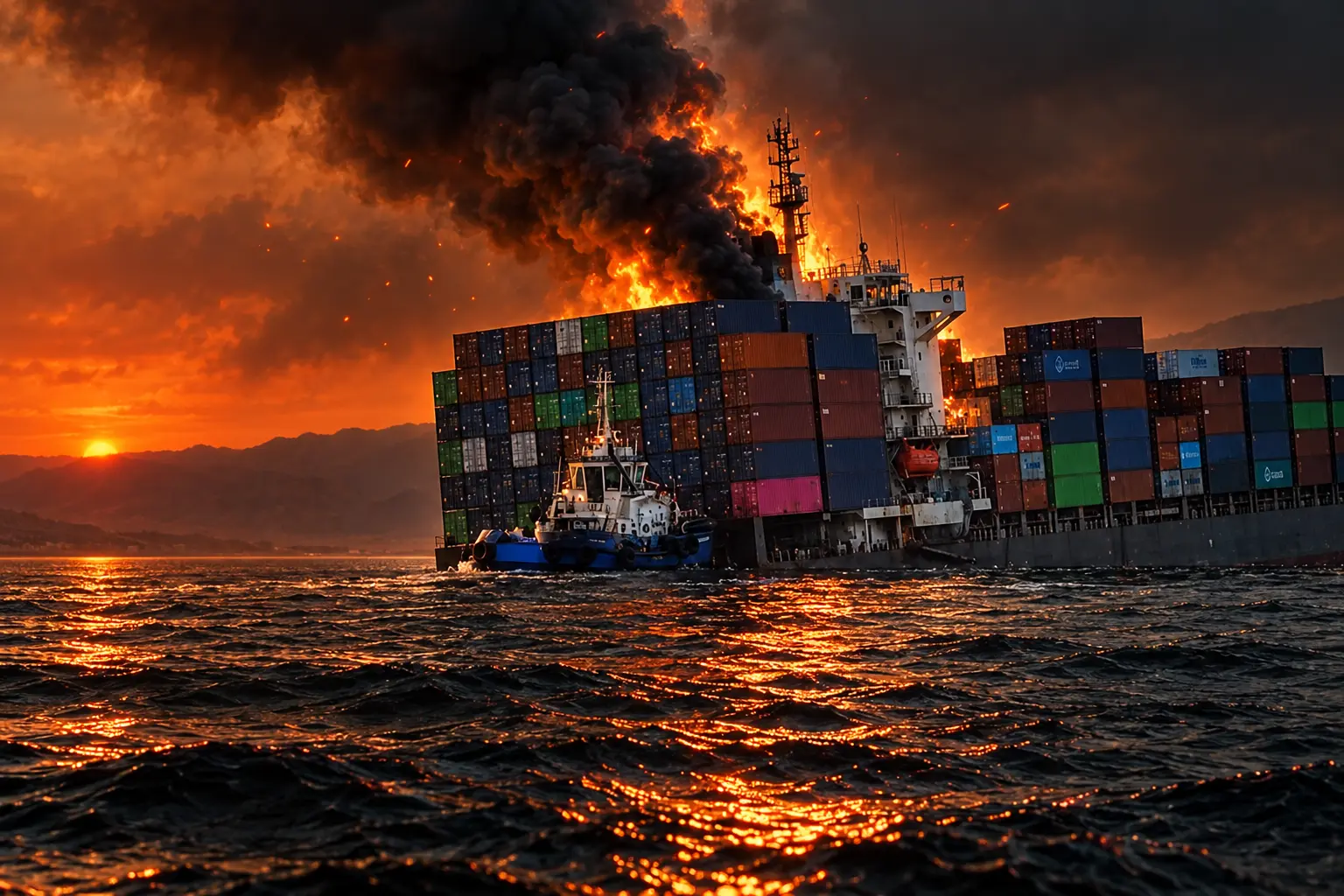
The GFS Pride sank in the Strait of Hormuz after a strike that hit Abu Dhabi’s feeder network and left all 21 crew unhurt.

The Singapore-flagged feeder GFS Pride sank in the Strait of Hormuz after a strike and fire on October 13, 2026, and all 21 crew got off unhurt. A sister ship, GFS Giselle, took hull damage the next day and reached anchorage under its own power with its 22 crew safe.
Both ships belong to Dubai-based Global Feeder Shipping, the line Abu Dhabi’s AD Ports Group tightened its grip on only in June. The oil-tanker watch missed that detail. The war that began on February 28 has now written off a boxship that moved cargo between the UAE, Karachi and Nhava Sheva.
A 2,824 TEU Feeder Went Down in Hormuz
GFS Pride was a 2008-built ship of 2,824 TEU, a regional feeder rather than a mainline giant. Industry listings put GFS Giselle at about 4,370 TEU and a 2015 build. Pride had been on a Khor Fakkan-Fujairah-Karachi rotation. Giselle was on Fujairah-Khor Fakkan-Nhava Sheva, and both had been due at Khor Fakkan at the end of that week.
Iran’s Islamic Revolutionary Guard Corps said an unnamed ship carrying more than 2,500 containers blew up after hitting a mine on what it called an unauthorized route. Singapore’s account names projectiles, not a mine. The wreck is a feeder hull, and the boxes now in the water are the Gulf’s short-sea trade, not crude.
THE TWO GFS SHIPS
| Detail | GFS Pride | GFS Giselle |
|---|---|---|
| Flag | Singapore | Singapore |
| Built | 2008 | 2015 |
| Capacity | 2,824 TEU | About 4,370 TEU |
| Crew | 21 | 22 |
| Strike (Singapore time) | October 13, 2026 | October 14, 2026 |
| Outcome | Fire, then sunk | Hull damage, reached anchorage |
No Singaporeans were on either vessel. Forty-three seafarers left both ships without a reported injury. The Antigua-and-Barbuda-flagged bulk carrier Cape Dao, hit on September 23 with one crew member killed, was separately recorded as sunk around the same two days, a delayed foundering rather than a second strike in that window.
AD Ports Holds 81% of the Line That Was Hit
On June 24, 2026, AD Ports Group exercised a call option agreed when it first bought 51% of GFS in February 2024, paying AED 1.1 billion ($300 million) for another 30% and raising its holding to 81%. The extra stake was priced off the same AED 3.67 billion ($1 billion) enterprise value set in 2024. GFS is the world’s fourth-largest container feeder by capacity, and it sits beside SAFEEN Feeders and Transmar in the group’s box-feeder business.
WHAT GFS WAS BUILT TO CARRY
- 2025 boxes: GFS moved 2.8 million TEUs across more than 700 voyages, 89 ports and 54 countries.
- Cash since 2024: Cumulative EBITDA after the first 51% stake has topped AED 1.8 billion ($500 million).
- Cluster weight: Maritime and shipping revenue reached AED 10.7 billion in 2025, up 33%, and EBITDA reached AED 2.5 billion, up 25%, making 51% of group revenue and 45% of group EBITDA.
- Sister brand: Maritime security firms also named a SAFEEN Feeders ship among the same October 13 targets in the strait.
Captain Mohamed Juma Al Shamisi, managing director and group chief executive, tied the June buy to the very runs now under fire.
GFS has expanded our reach into new markets and brought us closer to our customers, connecting our ports to more economies across the Red Sea and the Gulf at a time when reliable trade connectivity matters most.
Captain Mohamed Juma Al Shamisi, Managing Director and Group CEO, AD Ports Group, June 24, 2026 newsroom statement
Amir Maghami, chief executive of Global Feeder Shipping, said the tighter tie would help the line grow its fleet while the industry adapted to volatile conditions. Four months later one of those ships is on the bottom and another is in with a holed hull. Feeder revenue for the cluster had risen 17% in 2025. That growth sat on ships that still had to thread Hormuz.
What Singapore’s Maritime Authority Put on Record
The Maritime and Port Authority of Singapore published its account on October 14. It said GFS Pride and GFS Giselle were struck by unknown projectiles while transiting the strait on October 13 and 14, Singapore time. Pride took damage and a fire, then sank. Giselle took hull damage and arrived at a safe anchorage under its own power. MPA said it was in contact with the ships’ management company.
Such attacks are unprovoked, unjustifiable, and a breach of international law. All actions affecting international shipping must fully comply with international law, in particular the United Nations Convention on the Law of the Sea, and must not endanger the safety of seafarers and ships at sea.
Maritime and Port Authority of Singapore, media release, October 14, 2026
MPA called the strikes unprovoked, unjustifiable, and a breach of international law and said it was deeply concerned about continued attacks on commercial shipping in the strait. The statement does not name a weapon, a navy or a salvage plan. It records a total loss and a damaged sister, both under the Singapore flag.
THE 72 HOURS AROUND THE WRECK
- October 13, 2026: GFS Pride is struck in the strait, Singapore time, and a fire starts on board. UK Maritime Trade Operations logs a cluster of attacks that day on a tanker and three container ships.
- October 14, 2026: GFS Giselle is struck and makes a safe anchorage. MPA confirms Pride has sunk and all 21 crew are off. The IRGC Navy says a boxship hit a mine on an unauthorized route.
- October 15, 2026: U.S. Central Command calls the mine claim false, says an IRGC projectile hit the civilian ship, and says Pride sank while being towed to shore.
UKMTO had issued 24 warnings for October by October 14. The month’s pattern is a run of projectile reports, not a single freak accident on one feeder.
Iran’s Mine Story and the U.S. Rebuttal
The IRGC account is a mine, an illegal track and a fire that grew until the ship went down south of the strait. Singapore’s account is unknown projectiles. On October 15, U.S. Central Command put a third version on the record: an IRGC projectile, primary routes still clear of mines, and a hull that failed under tow.
WHERE THE ACCOUNTS DIVERGE
- IRGC Navy: The ship struck a naval mine on an unauthorized and dangerous route, caught fire and sank with more than 2,500 containers.
- MPA Singapore: Unknown projectiles hit both feeders; Pride burned and sank; Giselle steamed to anchorage; no cause beyond that is named.
- U.S. Central Command: The mine claim is false; M/V GFS Pride was hit by an IRGC projectile and sank while being towed to shore; more than 40 ships moved in the following 24 hours.
CENTCOM’s tow detail is the piece Singapore’s note does not carry. A ship that is already under tow and then goes down is a constructive total loss in the water, not a scorched hull that limps into Fujairah. That is the difference insurers price, and it is the difference a second feeder on the same flag just watched from a few hours astern.
Three FALSE Iranian claims in the past 24 hours:
🚫 CLAIM: The IRGC has continued to falsely claim control of the Strait of Hormuz.
✅ FACT: The United States and regional partners control the strait as commercial vessels continue to transit despite unwarranted IRGC… pic.twitter.com/rgpeZ95dvU
— U.S. Central Command (@CENTCOM) October 15, 2026
The same statement said the United States and regional partners control the strait and that commercial ships keep transiting. Replies treated that line as thin next to a feeder on the seabed. Forty ships in a day is not a closed waterway. It is also not the traffic the Gulf ran before February 28.
Four Nautical Miles Off Oman’s Musandam Coast
Pakistan’s hydrographer warned mariners that GFS Pride had gone down 4 nautical miles (7.4 km) northwest of Ras al-Sheikh Masud on Oman’s Musandam Peninsula. Video from the area showed containers in the water and a smear of oil. That debris field sits in one of the tightest working channels on earth, a passage the International Energy Agency measures at 21 nautical miles at its narrowest, with inbound and outbound lanes only 2 miles wide and a 2-mile buffer between them.
Public tracking on Pride had already gone quiet. VesselFinder’s last position was after a call at Fujairah on October 3, following a departure from Karachi on October 1, and the ping was more than a week old by the time of the strike. Ships in this war often run dark. The cost of that habit is that the first pictures of the loss are floating boxes, not a live AIS track.
Those boxes are now a navigation problem of their own. A mine field, if it existed, would be one kind of hazard. Loose containers off Musandam are another, and they do not need a new shot to hole the next hull that meets them at night.
Hormuz Crude Is Already Down to 8.5 Million Barrels
Before this war, the strait was an oil story, and it still is one. In the first half of 2025 the U.S. Energy Information Administration put total oil flows through Hormuz at 20.9 million barrels a day, about 20% of global petroleum liquids use and a quarter of seaborne oil. Crude and condensate were 14.7 million barrels a day of that, products 6.1 million. Some 89% of the crude went to Asia, and China, India, Japan and South Korea took 74% between them.
HORMUZ BEFORE THE FEBRUARY WAR
- Total oil, 1H25: 20.9 million barrels a day, EIA, based on Vortexa tanker tracking.
- LNG: 11.4 billion cubic feet a day, over 20% of global LNG trade, most of it from Qatar.
- Qatar and UAE gas: The IEA says 93% of Qatar’s LNG and 96% of the UAE’s LNG still had to use the strait, together about 20% of world LNG trade.
- Bypass pipe: Saudi Aramco’s East-West line and the UAE’s Abu Dhabi pipeline together offer about 4.7 million barrels a day of capacity around the strait, EIA figures, a fraction of the seaborne total.
Kpler’s wartime read is lower and newer. It put crude exports through Hormuz at 8.5 million barrels a day in the week ending October 12. A separate Kpler daily print for the Monday of that siege week showed only 4.147 million barrels of oil getting through, less than a quarter of the 1H25 total-oil baseline. Those two wartime prints are not the same series as EIA’s 20.9 million. They still show a strait that was already half-empty of crude before Pride burned.
CENTCOM’s “more than 40 ships” in 24 hours to October 15 sits on that thinner flow. The remaining traffic is a mix of tankers, feeders and whatever else still accepts the extra premium. Pride was in the second group. So was Giselle. The oil barrels get the headlines. The 2,824 TEU ship is what actually went down.
Another Total Loss for War-Risk Underwriters
Marcus Baker, global head of marine at Marsh, put the pre-war extra war-risk rate at about 0.25% of hull value. Brokers have since quoted 6% to 10% for tankers in the region, which can mean as much as $20 million for a single supertanker voyage. Those quotes are for VLCCs. Pride is a small feeder. The point for underwriters is the same: the policy now has to pay a hull that will not come back.
Lars Lange, secretary general of the International Union of Marine Insurance, has put marine insurers’ losses on this war at a rough $2 billion, mostly off-hire and ship damage, even after the jump in headline rates. Fewer ships mean less premium income, which is why a market that looks expensive per voyage can still bleed. A confirmed sinking is the claim file those rates were supposed to fund.
Allianz Commercial’s Safety and Shipping Review 2026 counted 905 total losses over the past decade for vessels above 100 gross tons, including 43 in 2025. Cargo ships accounted for 328 of the decade’s losses. Foundering, fire and grounding remain the usual causes. A projectile, a fire and a failed tow in Hormuz is that list with a warhead attached.
Giselle’s 22 crew made it to a safe anchorage. Pride’s 21 crew made it into boats. The wreck and the loose boxes sit about 4 nautical miles off Ras al-Sheikh Masud, and the next feeder on the Karachi run has to decide whether that gap is still a living.

MLB and the Union Will Not Extend the Labor Deal

Amazon Found PHP2Shell Probes Four Days Before the Patch

Brent Clears $117 After Gulf Crude Already Came Back

Chipmakers Took the Nasdaq Hit After Meta Burned Cash

Netflix Scored Its 2026 Series as Flops Against Home Runs

Rolex Made Drake the Daytona It Fights Jewelers Over

Treasury’s First Iran Bank Shot Lands on an Ally

Instinct’s $2.5 Billion Raise Still Binds the User as Agent

City’s £125m Enzo Deal Caps a £327m Midfield Rebuild

CSIRTs Inherit Europe’s Missing security.txt Before Article 14
-
 ENTERTAINMENT2 months ago
Rolex Made Drake the Daytona It Fights Jewelers Over
-
 BUSINESS2 months ago
Treasury’s First Iran Bank Shot Lands on an Ally
-
 NEWS2 months ago
Instinct’s $2.5 Billion Raise Still Binds the User as Agent
-
 NEWS2 months ago
City’s £125m Enzo Deal Caps a £327m Midfield Rebuild
-
 NEWS2 months ago
CSIRTs Inherit Europe’s Missing security.txt Before Article 14
-

 BUSINESS2 months ago
Berkshire Anchors Alphabet’s Record Raise With a $10 Billion Check
-

 NEWS2 months ago
Meta’s Teen Settlement Leaves Chat Off the Clock
-

 ENTERTAINMENT2 months ago
Ricky Gervais Wants Alley Cats to Run Until He Dies