AUTO
BMW Cost Cuts Run Into a Tariff Trap in China
BMW’s 2.3 percent auto margin already includes a 1.25-point duty hit, while China deliveries keep falling and Shenyang still builds the rescue EVs.

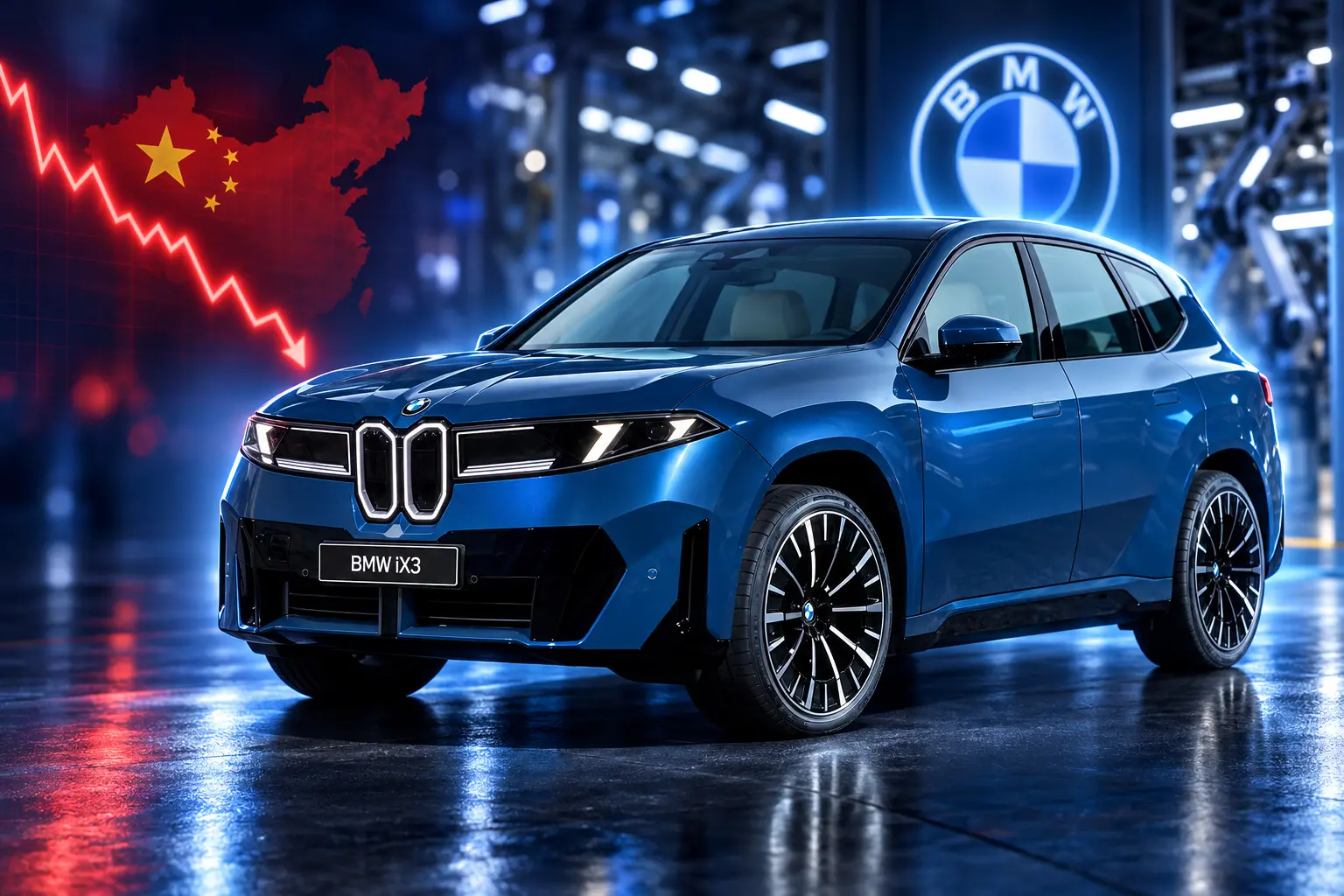
BMW opened China pre-orders for a long-wheelbase iX3 from 269,900 yuan on Aug. 21, with first deliveries due in November. That is the car the company is now asking Chinese buyers to fund after a quarter in which China sales fell 30.2 percent.
Shares last closed at 61.20 euros on Sept. 1, against a 52-week low of 56.40 euros on July 24. The equity debate still circles a 60-euro floor. The bill has already moved, into German offices, a Mexican plant that does not build the new electrics until 2027, and a Brussels fight over plug-in hybrids.
A 30 Percent Drop in China Hit the Car Business
The BMW Group delivered 590,947 cars in the second quarter, 4.9 percent fewer than a year earlier, because a collapse in China wiped out gains of 7.6 percent in Europe and 11.9 percent in the United States. China took 117,927 cars, down from 168,959, so its share of group volume slipped from about 27 percent to 20 percent in a single quarter. For the first half, China deliveries were 261,999, down 20.4 percent, in line with a home market that the company said contracted 20.2 percent.
The car business absorbed that mix shift. Automotive EBIT fell to 629 million euros from 1.602 billion, a 60.7 percent drop, and the margin printed at 2.3 percent against 5.4 percent a year earlier. About 1.25 percentage points of that margin came from higher import duties in the United States and the EU, and about 1.2 points from depreciation on the BMW Brilliance purchase. Even after those items, the operating profit is a thin base for a premium house that still talks about an 8 to 10 percent corridor.
BMW DELIVERIES BY REGION
| Region | Q2 2026 | Q2 change | H1 change |
|---|---|---|---|
| China | 117,927 | -30.2% | -20.4% |
| USA | 110,573 | +11.9% | +3.9% |
| Europe | – | +7.6% | +5.4% |
| Group total | 590,947 | -4.9% | -4.2% |
Group revenue in the quarter was 31.259 billion euros, down 7.9 percent, and pre-tax profit was 1.697 billion, down 35.1 percent. Earnings per ordinary share fell to 2.05 euros from 2.85. Automotive free cash flow in the quarter was 513 million euros, down 73.4 percent, though finance board member Walter Mertl is still guiding the full-year car-business cash figure above 2.5 billion euros.
Europe and the United States did what they could. All-electric deliveries in Europe rose 37.9 percent to 81,500 in the quarter after the iX3 launch in early March, and fully electric cars were 31.3 percent of European volume, up from 24.4 percent. In the United States, where battery-car demand in the wider market fell, combustion models drove an 11.9 percent BMW gain. Financial Services pre-tax profit even rose 15.7 percent in the quarter to 627 million euros. None of that closed a China hole that large.
Dr. Milan Nedeljković, chairman of the board of management since mid-May, told analysts the China slide was the main reason the group cut its 2026 outlook on June 16. He also said performance in China this year was at least in line with the market. Matching a shrinking market is still a shrinking business, and the company now expects a slight drop in global deliveries, a “significant” fall in group pre-tax profit, and an automotive EBIT margin of 1 to 3 percent for the year.
Desk Jobs Leave Munich as Mexico Adds Lines
On July 29, Nedeljković and works-council chief Martin Kimmich put a voluntary severance plan in front of staff at the Munich home plant. The company’s own wording is a “workforce restructuring program” in indirect functions in Germany. People briefed on the deal have described a target of about 8,000 roles worldwide, roughly 5 percent of a group that employed about 150,000 to 154,000 people, with more than half of the cuts in Germany, where BMW has about 84,000 to 90,000 staff.
HOW THE JOB PLAN IS BUILT
- Who is in scope: Office, development, planning, sales and other indirect roles, with Munich headquarters and the Research and Innovation Centre most exposed.
- Who is spared: Factory production in Germany stays outside the programme, unlike the plant-closure fights at other German car groups.
- How it runs: A voluntary scheme in Germany from October 2026 through the end of 2027, with attrition and partial retirement used abroad, and no compulsory redundancies planned.
- When it shows up: Nedeljković said the leaner cost base should be visible from 2027, which is also when the Mexican plant is scheduled to build Neue Klasse cars.
Tens of thousands of German office staff are expected to receive an offer. The company already cut 2.5 billion euros of cost in 2025, then another 400 million in the second quarter and 900 million in the first half, according to Mertl’s briefing. Research spending in the first half fell 7.6 percent to 3.714 billion euros, capital spending fell 30.5 percent to 1.9 billion, and selling and admin costs fell 6.1 percent. The job plan is the next turn of that screw, not the first.
The same week the cuts were outlined, BMW confirmed that San Luis Potosí in Mexico will build the i3 and the iX3 from 2027. The plant is one of four Neue Klasse vehicle sites, with Debrecen in Hungary, Munich, and Shenyang in China. BMW is putting 800 million euros into the Mexican expansion, including about 500 million for a high-voltage battery shop, and it has said the project creates around 1,000 jobs. Debrecen has already built 50,000 iX3s and added a second shift ahead of schedule. Hungary and Mexico gain assembly. Munich’s offices shrink.
That split is the second-order cost of the China quarter. The cars that are supposed to restore margin will be built closer to American and Chinese customers. The German sites that still stamp the brand keep the factories and lose the desks. Factory workers in Bavaria were told they are safe. The people who design, plan and sell the cars were told to take a packet.
Plug-in Hybrids Became Europe’s Open Door
Chinese brands are not only squeezing BMW inside China. Industry tallies put their share of the European car market at about 9.5 percent in the first half, on 685,990 registrations, roughly double a year earlier, and above 11 percent in July. In plug-in hybrids, the same tallies give Chinese marques 28.3 percent of the European segment in the first half, or 208,368 cars, and about a third of the category in July.
The EU already adds extra duties of 7.8 to 35.3 percent on China-built battery-electric cars, on top of the standard 10 percent tariff. Plug-in hybrids were left out. Chinese exporters moved into that gap, which is why Volkswagen chief executive Oliver Blume told investors “we have no time to lose” on extending the duties. The German Association of the Automotive Industry said in mid-August that it is reviewing whether to change its China positions while still backing “free and fair trade.”
Lower Saxony premier Olaf Lies, who sits on Volkswagen’s supervisory board, wrote in July to Commission president Ursula von der Leyen, Chancellor Friedrich Merz and Vice-Chancellor Lars Klingbeil calling the hybrid gap a loophole that would wreck plants that cannot be rebuilt. Environment minister Carsten Schneider said at the end of August that China-built plug-in hybrids should face duties comparable to those on full electrics. “We are open to the world, but not naive,” he said.
Campaign research has already recorded how the first round of duties behaved. The made-in-China share of EU electric sales fell to 17 percent in the first quarter from a 22 percent peak in 2024, but a large part of that drop was Western brands shipping fewer China-built battery cars, while Chinese names took a bigger slice of the remaining flow. Tariffs changed the mix. They did not freeze the share.
BMW is not the loudest voice in that lobby. It is living with the same arithmetic. A 30 percent China miss at home, plus Chinese plug-in hybrids taking European volume that used to sit with German brands, is the backdrop for both the Munich packets and the Mexican investment. Protection in Brussels, if it comes, will arrive after the jobs plan is already in motion.
What the China iX3 Price Buys
The first Neue Klasse model built for China is not a European iX3 with extra chrome. It is a long-wheelbase car from the BMW Brilliance plant in Shenyang, shown at the Chengdu motor show, sold at a single national list, with the pre-order price locked through launch. BMW’s China press office set a nationwide price from 269,900 yuan (about $40,000) for the 30L, 299,900 yuan for the 40L xDrive, and 339,900 yuan for the 50L xDrive.
CHINA IX3 LIST PRICES
| Version | National list (yuan) | Drive |
|---|---|---|
| iX3 30L | 269,900 | Rear-wheel |
| iX3 40L xDrive | 299,900 | All-wheel |
| iX3 50L xDrive | 339,900 | All-wheel |
Deliveries are due to start in November. Nedeljković said the China iX3 and a long-wheelbase i3 were developed with local tech firms for local taste, which is the group’s “local-for-local” line in compressed form. In Europe the standard-wheelbase iX3 is on track for 100,000 orders, a figure management keeps repeating because it is the one Neue Klasse proof that is not still a forecast. In China the proof has to be a sticker that can live next to BYD and the rest of the domestic pack, without the old dealer haggle.
Price cuts on combustion BMWs, Mercedes and Audi cars in China have not reversed the slide. Electric volume at the German three has stayed thin while local firms hold both the volume and, in some cases, the higher transaction prices. A 269,900-yuan iX3 is BMW admitting that the rescue car has to be built in Shenyang, stretched for the rear seat, and ticketed for a market that no longer pays Munich-level money for a roundel. If that car misses, the German office cuts and the Mexican outlay are paying for a platform that still cannot hold China.
Plant Munich Starts the Electric 3 Series
On Aug. 6 the home plant began series production of the BMW i3, the second Neue Klasse model, after orders opened early in mid-June. Plant boss Peter Weber said the i3 launch lowers manufacturing costs in Munich by another 10 percent. From 2027 the same plant will build only fully electric cars, with the next combustion 3 Series moving to Dingolfing. Regular i3 ordering is due to open at the end of September, and the company plans 40 new or updated models by the end of 2027, including the China long-wheelbase pair.
Jochen Goller, the board member for customer, brands and sales, said demand for the i3 has been strong since the early order window. That is the domestic half of the product bet: a new electric 3 Series from the plant that has built 3 Series cars for decades, at a lower factory cost, into a European market where BMW’s battery mix is already above 30 percent. The other half is Shenyang in November and San Luis Potosí in 2027. Three continents, one architecture, and a two-year wait before Mexico adds volume.
We remain ambitious and intend to return to our strategic EBIT margin corridor of 8-10% by the beginning of the next decade. In the interim, we will work our way back to this target step-by-step.
Dr. Milan Nedeljković, Chairman of the Board of Management of BMW AG, Q2 2026 conference call
An 8 to 10 percent car margin “by the beginning of the next decade,” set against this year’s 1 to 3 percent guide, is a timetable, not a rebound. Nedeljković also said the second-quarter figures were “not satisfactory” and that new rivals are expanding in Asia-Pacific, Latin America and Europe. The product cadence is not the delay. The delay is the years between a 2.3 percent quarter, a China list price that has to win in November, and a margin band the company will not even claim until the 2030s.
The Margin Target Slips to the Next Decade
The sequence is now fixed on the calendar, which is why the 60-euro argument feels late. China broke first. The outlook was cut in June. The office programme was agreed in July. Munich started the i3 in August. China got a locked list price later that month. German packets go out in October. Shenyang starts delivering in November. Mexico does not add Neue Klasse volume until 2027, the same year the job plan is meant to be finished and Munich goes electric-only.
THE 2026 CLOCK
- June 16, 2026: The group cuts full-year guidance after the China market worsens, putting automotive EBIT in a 1 to 3 percent range.
- July 29 to 30, 2026: Half-year results land with a 2.3 percent car margin, and the works council signs the voluntary office plan.
- August 6, 2026: Plant Munich starts i3 series production and claims a further 10 percent cut in factory cost.
- August 21, 2026: Pre-orders open in Chengdu for the China-only iX3 from 269,900 yuan, with November deliveries.
- October 2026: The German severance programme is due to start.
- November 2026: First China iX3 handovers, the first Neue Klasse test in the market that caused the profit warning.
Hold those dates against the stock. A 61.20-euro close is a few euros above the July low, not a verdict on whether Shenyang can sell an iX3 next to local electrics at 269,900 yuan. Cost taken out of Munich offices will not show up in the 2026 margin guide. Mexican output will not show up in 2026 volume. The PHEV tariff file is still sitting in Brussels, with German ministers now louder than the VDA.
The company can point to 50,000 iX3s already built in Debrecen, a 10 percent factory-cost cut in Munich, and a China sticker that no longer pretends the old import premium still exists. It can also point to a car margin of 2.3 percent, a China quarter down 30.2 percent, and a strategic profit band that has been pushed to the next decade. November is when those two lists meet, in a long-wheelbase iX3 that has to earn its price in the market that opened the hole.
Disclaimer: This article is news reporting and analysis of BMW Group’s published results, product plans and share price, and it is for information only. It is not investment advice, a recommendation to buy or sell BMW shares or any other security, and it is not a forecast of future returns. Readers should consult a qualified financial adviser or licensed broker before making any investment decision. Figures, ratings, delivery totals and programme dates reflect company reports and market data as of Sept. 2, 2026, and they can change with later results, tariff decisions and order intake.


Oracle’s Unfinished Cerner Move Exposed 20 Million People

Google Buys 890 MW of Nuclear Uprates on a Strained Grid

Francis Halzen Wins a Solo Nobel for His IceCube Bet

Denmark’s Company Search Rights Opened 8.8 Million CPR Records

OpenAI Agents Reached Staging Servers as California Subpoenaed the Lab

Rolex Made Drake the Daytona It Fights Jewelers Over

Treasury’s First Iran Bank Shot Lands on an Ally

Instinct’s $2.5 Billion Raise Still Binds the User as Agent

Berkshire Anchors Alphabet’s Record Raise With a $10 Billion Check

City’s £125m Enzo Deal Caps a £327m Midfield Rebuild
-
 ENTERTAINMENT2 months ago
Rolex Made Drake the Daytona It Fights Jewelers Over
-
 BUSINESS2 months ago
Treasury’s First Iran Bank Shot Lands on an Ally
-
 NEWS2 months ago
Instinct’s $2.5 Billion Raise Still Binds the User as Agent
-
 NEWS2 months ago
City’s £125m Enzo Deal Caps a £327m Midfield Rebuild
-
 BUSINESS2 months ago
Berkshire Anchors Alphabet’s Record Raise With a $10 Billion Check
-

 NEWS2 months ago
CSIRTs Inherit Europe’s Missing security.txt Before Article 14
-

 NEWS2 months ago
Meta’s Teen Settlement Leaves Chat Off the Clock
-

 ENTERTAINMENT2 months ago
Ricky Gervais Wants Alley Cats to Run Until He Dies