
BUSINESS
Japan’s 3% Yield Pulls the Bid Out of Global Bonds
Japan’s 10-year yield hit 3% for the first time since 1996, thinning the Japanese bid that has long absorbed Treasuries, gilts and bunds.

Japan’s 10-year government bond yield touched 3% on Tuesday, the first time since September 1996, and dragged borrowing costs higher from London to New York. Screens showed an intraday high of 3.003% and a close of 2.996%. At that coupon, Japanese money that spent three decades buying other countries’ debt finally earns a reason to stay home.
Oil, a hawkish shove from Washington, and a spending-minded cabinet in Tokyo all hit the same week. The bill lands on governments that borrowed cheap for years, and on the households behind them. The quieter shift is who still shows up to buy.
Japan’s 10-Year Yield Touches 3% for the First Time Since 1996
The 10-year was the headline. The rest of the Japanese government bond curve had already broken older records. Two-year paper yielded 1.81%, a 31-year high. Five-year yields printed a record 2.26%. Twenty-year bonds paid 3.8%, and 30-year bonds 4.18%. Forty-year yields reached 4.28%, just under a 4.4% high from May.
In early 2022 the same 10-year loan cost Japan about 0.1%. The rise from that floor to 3% is a 2,900% jump in the coupon, arithmetic that still startles people who lived through yield-curve control. When Prime Minister Sanae Takaichi took office in October 2025, the 10-year sat near 1.6%. It has almost doubled on her watch.
THE JAPAN CURVE ON TUESDAY
- 10-year: Touched 3.00%, first print at that level since September 1996, high 3.003%, close 2.996%.
- 2-year: 1.81%, highest in 31 years, the cleanest read on near-term Bank of Japan hikes.
- 5-year: 2.26%, a record, where banks and insurers actually fund.
- 30-year: 4.18%, with 40-year paper at 4.28%.
Demand at Tuesday’s 10-year sale still showed up. The bid-to-cover ratio was 3.29 times, in line with the 12-month average, so this was not a failed auction. It was a clearing price the state has not had to pay in 30 years. Quotes on Wednesday still held the 10-year at the 3% line.
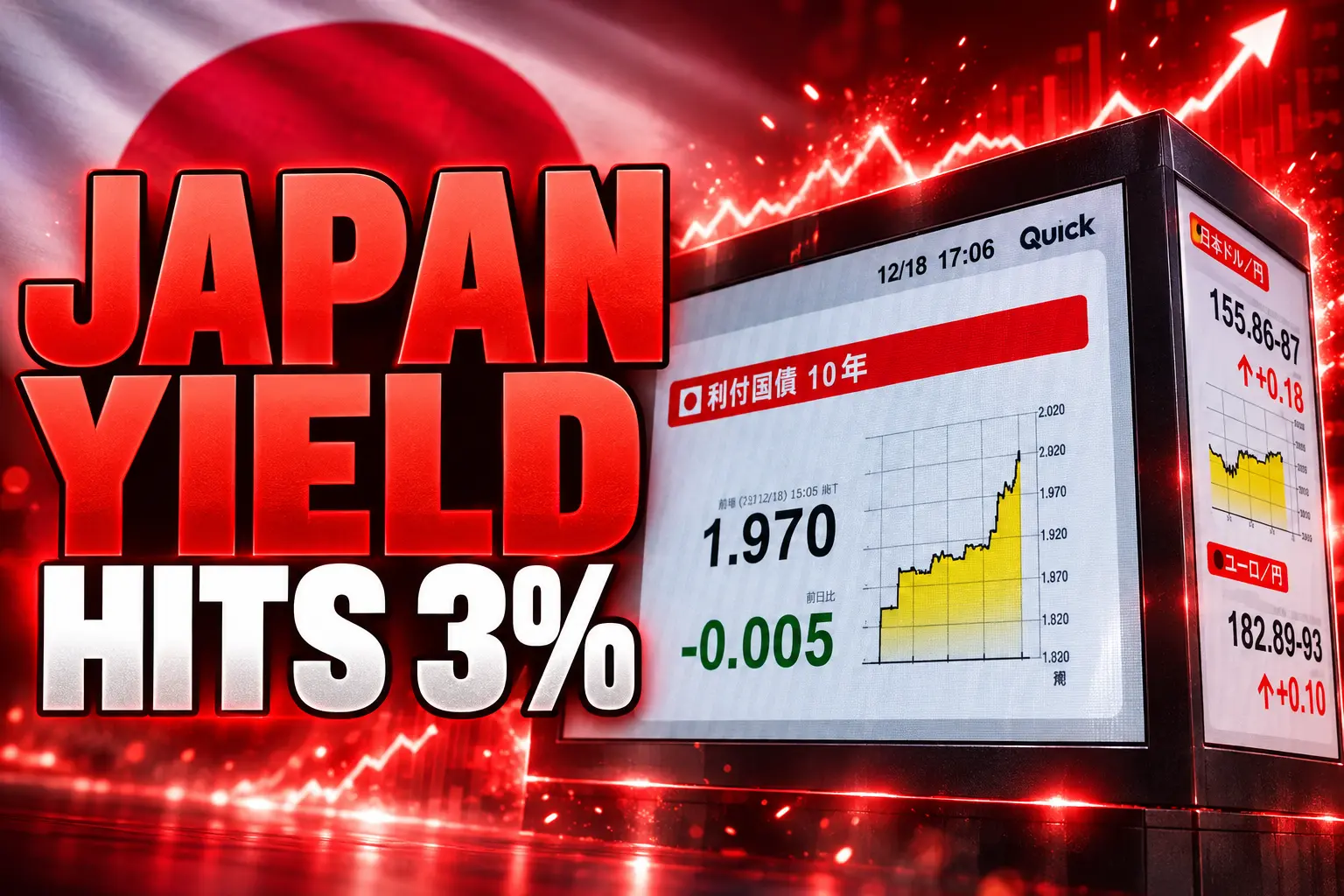
Oil, Rate Hikes and a Prime Minister Who Spends
Three forces stacked in a few sessions. Fighting around the Strait of Hormuz flared again, with U.S. and Iranian strikes after a quieter month, and Brent crude settled at $94.65 a barrel, up $4.16. West Texas Intermediate closed at $90.22. Shipping through Hormuz, which used to carry about a fifth of seaborne oil, has been badly disrupted since late February. Energy that stays expensive feeds inflation prints, and inflation prints keep central banks from cutting.
The Bank of Japan already lifted its policy rate to 1% in June, the highest in 31 years. It meets on September 17 and 18, and markets put an 80% to 90% chance on a move to 1.25%. Overnight-index swaps have priced more than a 90% chance of a quarter-point step this month and about a 70% chance of a half-point in total by December. The bank’s July outlook already pointed to prices rising clearly above 2% later this year, with crude as one of the drivers.
THE STACK THAT LIFTED YIELDS
- February 28, 2026: The United States and Israel open military action against Iran; Hormuz traffic seizes up and oil stays elevated.
- June 2026: The Bank of Japan takes its policy rate to 1%, a 31-year high, and keeps shrinking bond purchases.
- July 31, 2026: Tokyo and Washington buy yen together for the first time since 1998; the currency still drifts back toward 160 per dollar.
- August 2026: The Finance Ministry sketches a record debt-service request and lifts its assumed long-term rate to 3.8%.
- September 1, 2026: U.S. Treasury Secretary Scott Bessent, at the G20 gathering in Asheville, North Carolina, tells Japanese officials to hike faster; the 10-year then prints 3%.
Takaichi ran on fiscal expansion, including growth spending and talk of a sales-tax cut. Ministries have put in budget requests around ¥143 trillion ($890 billion) for the year that starts next April. Bessent, on the same G20 sidelines, called the U.S. Treasury market “the best performing market” in the world after Fitch reaffirmed its AA+ rating. Steve Englander, head of global G10 FX research at Standard Chartered, was less impressed.
I think ‘best performing’, as Bessent said, isn’t the same as well performing. Everybody has a deficit problem. I don’t think there’s any reason to cheer.
Steve Englander, head of global G10 FX research, Standard Chartered, on Squawk Box Europe
Finance Minister Satsuki Katayama declined to comment when asked about the 10-year near 3% after the first day of that G20 meeting.
The Bid That Used to Arrive From Tokyo
For a generation, Japanese banks, life offices and investment trusts were the world’s most reliable buyers of other people’s duration. Domestic yields were tiny, so the money left. Berenberg, the German private bank, tallied nearly $1.6 trillion of foreign bond buying by Japan’s financial sector from 2000 through May 2026. Japan is still the largest foreign holder of U.S. Treasuries. That stock is no longer growing.
Treasury International Capital data show Japan’s Treasury holdings fell to $1.12 trillion at the end of June, from $1.24 trillion at the end of February, a drop of $123 billion in four months. Some of that selling funded yen defense. The rest is the start of a simpler trade: if a 10-year JGB pays 3% and a 30-year pays 4.18%, the case for hedging a Treasury or a gilt gets thinner.
Berenberg’s July note put numbers on a harder version of the same shift. The Government Pension Investment Fund, about $1.8 trillion, still aims at a quarter each in home bonds, foreign bonds, home stocks and foreign stocks. If that foreign-bond sleeve were cut back toward the pre-Abe mix, the fund would need to shed about $280 billion of overseas fixed income, including about $140 billion of Treasuries and about $18 billion of German bunds. A Kansas City Fed survey of earlier studies, cited in that note, implied a 45 to 65 basis-point lift in Treasury yields from sales of that size, before counting lost coupon reinvestment.
That is a scenario, not a trade that printed this week. The GPIF’s next regular mix review is due in 2030, and Katayama has said there is no immediate plan to rewrite the targets. She has also said Japan may “consider” a tweak if the investment climate changes sharply, and she has talked about steering pension money toward “substantially greater” holdings of Japanese assets inside the bands the fund already has. A six-point band around a 25% domestic-bond target is already a large checkbook.
Why Japanese Pensions Are Buying at Home Again
Corporate pension funds are already moving, according to a JPMorgan survey of the industry published as the 10-year tagged 3%. After years of cutting domestic bonds, more of those funds are adding them again. The state giant has not flipped its mix, but the weights at the end of June show how little it would take to matter.
GPIF MIX AT THE END OF JUNE
| Asset | Holdings (¥ trillion) | Share |
|---|---|---|
| Domestic bonds | 82.00 | 25.59% |
| Foreign bonds | 78.80 | 24.60% |
| Domestic stocks | 78.43 | 24.48% |
| Foreign stocks | 81.15 | 25.33% |
Those four sleeves are split almost evenly across four asset classes, on ¥317.76 trillion of assets. Foreign bonds at 24.60% sit just under the 25% target. A walk to the bottom of the allowed band would be a bid for JGBs and a smaller bid for everyone else, without any change in the published mix.
Life insurers are slower, and they are nursing losses. The four largest, Nippon Life, Dai-ichi, Sumitomo Life and Meiji Yasuda, reported combined unrealized losses of ¥15.13 trillion ($96 billion) on domestic bonds in the April-June quarter, up 7% from the prior three months. They sold a net ¥201.2 billion of super-long JGBs in May after buying ¥327.2 billion in April. Several of the ten majors, in April plans, still wanted more hedged foreign bonds, not fewer. Those plans were written when 30-year JGBs were well below today’s 4.18%.
Daisuke Ishida, who runs finance and investment planning at Nippon Life, said the firm could become a net buyer of JGBs next fiscal year if the risk of still-higher rates fades. He expects the Bank of Japan to hike once or twice this fiscal year and again next, with a terminal rate in the upper 1% range.
Since we still hold a considerable amount of low-yield bonds, we want to firmly capture the current high yields through replacement. We will not halt replacement based solely on market outlook.
Daisuke Ishida, executive officer, Nippon Life Insurance
Replacement is the unglamorous version of repatriation. Insurers do not need a government order to swap a 0.5% bond they already own for a 3% bond they can buy this week. Each swap is a yen that does not roll into a Treasury or a gilt.
Tokyo’s Debt Bill Jumps to a Record 36.6 Trillion Yen
The same coupon that lures buyers is a problem for the issuer. Japan carries the developed world’s largest government debt pile, mostly in yen and mostly held at home, which is why a default scare has never been the base case. Refinancing at 3% instead of 0.1% still eats the budget.
The Finance Ministry is seeking a record ¥36.6 trillion ($230 billion) for debt service in the initial fiscal 2027 budget, up 17% from ¥31.28 trillion this year. About ¥16.6 trillion of that is interest, up 27.2%. About ¥20 trillion is principal coming due. The assumed long-term rate used to build those figures is 3.8%, up from 3.0% in the fiscal 2026 budget and the highest such assumption in 29 years. A 3% 10-year already sits on the old assumption. Anything above it adds strain the budget has not booked.
THE FISCAL 2027 DEBT LINE
- Debt service: ¥36.6 trillion, a 17% jump and the largest request on record.
- Interest: ¥16.6 trillion, up 27.2%, the piece that rises with every auction.
- Assumed rate: 3.8%, set 1.1 points above recent long yields as a buffer.
- New issuance: Takaichi says she wants to cap it near ¥40 trillion, against ¥32.7 trillion planned for this year.
The official account of Japan’s public debt is still written for a market the Bank of Japan dominates. That dominance is fading by design. Quarterly cuts of about ¥400 billion in monthly purchases have already taken buying down to ¥3.7 trillion in the July-September quarter. A state that issues more, buys less, and pays 3% is a different credit, even if every bond is still in yen.
Takaichi has said extra tax revenue can keep new issuance near last year’s level. Daiwa Securities economist Toru Suehiro called a ¥40 trillion cap “somewhat expansionary” if it is meant to match the larger fiscal 2025 figure rather than this year’s ¥32.7 trillion plan. Growth spending on AI, chips and robots, more than ¥10 trillion in ministry requests, now competes with interest for the same yen.
Gilts, Bunds and Treasuries Reprice Together
Tokyo set the tone. It did not trade alone. The U.K. 30-year gilt yield jumped 9 basis points to 5.89%, the highest since March 1998. The 10-year gilt rose to 5.23%, the highest since June 2008. Germany’s 10-year bund yield reached 3.36%, a 15-year high and a level last seen in 2011. France’s 10-year yield was 4.21%. Italy sat at 4.17%, Australia at 5.16%.
The U.S. 10-year Treasury yield climbed to 4.80%, a level last seen in January 2025, and logged a fifth straight up session. The 30-year ended at 5.27%. The two-year, which tracks hike odds, rose to about 4.39%, its highest since early 2025. Euro-area inflation printed back above 3% in August on energy, which keeps a September hike in play at the European Central Bank as well.
WHERE BENCHMARK YIELDS CLEARED
| Market | Yield | Last at this level |
|---|---|---|
| Japan 10-year | 3.00% | September 1996 |
| U.K. 30-year | 5.89% | March 1998 |
| U.K. 10-year | 5.23% | June 2008 |
| Germany 10-year | 3.36% | 2011 |
| U.S. 10-year | 4.80% | January 2025 |
| France 10-year | 4.21% | More than a decade |
Craig Inches, head of rates and cash at Royal London Asset Management, called the tape a “doom loop”: wider deficits, more issuance, higher yields, still wider deficits. U.S. public debt is already past $40 trillion. Large technology firms raising cash for AI data centers are in the same queue as finance ministries. Duration is not scarce because traders turned moody. It is scarce because too many borrowers arrived at once, and one of the old buyers is being paid to go home.
The Carry Trade Has Less Cheap Yen to Ride
A 3% JGB does not, by itself, blow up a government that still collects taxes in yen. It does change the funding math for everyone who used Japan as a cheap liability. For years, investors borrowed yen at near zero and bought higher-yielding assets abroad. That trade needs a low Japanese short rate, a sleepy long end, and a weak yen. All three legs are wobbling. The two-year at 1.81% is the market saying the Bank of Japan is not done. The 10-year at 3% is the market saying fiscal risk has a price. The yen near 160, even after a joint intervention, is the currency still leaking, which keeps import prices hot and the bank under pressure to hike anyway.
July 2024 already showed how fast a yen squeeze can travel when a Bank of Japan hike collides with a weak U.S. jobs print. Positioning against the yen is stretched again. A slow grind higher in Japanese yields can be absorbed. A fast one forces the same cross-asset selling that hit in that summer, because the hedge that was supposed to be cheap stops being cheap.
Households feel it in the usual places. Mortgage and credit-card rates track the same global curve that just repriced. Governments feel it when they roll old cheap debt into new expensive debt, which Japan will do every week at auction. The winners are the holders who can sit through the mark-to-market hit and clip a 3% or 4% coupon they could not buy at home for 30 years. Nippon Life is describing that trade in public. Corporate pensions are already doing it. The GPIF has the legal room to follow without a new law.
The Bank of Japan’s next meeting is September 17 and 18. The 10-year is already at the 3% line the fiscal 2026 budget treated as a ceiling. If the bank hikes, and if oil stays near $95, the coupon that pulled Japanese money home this week will still be there next month, and the rest of the world’s borrowers will still be bidding for a smaller Japanese bid.
Disclaimer: This article is news reporting and market analysis for general information only. It is not investment advice, a recommendation to buy or sell any bond, currency or fund, or a forecast you should trade on. Readers who are considering changes to a portfolio, a mortgage or a business-loan hedge should speak with a licensed financial adviser or fixed-income specialist who can look at their own duration, currency and cash-flow needs. Yields, holdings figures and policy odds are those published by the cited official data and company comments as of September 2, 2026, and they can move in a single session.

Oracle’s Unfinished Cerner Move Exposed 20 Million People

Google Buys 890 MW of Nuclear Uprates on a Strained Grid

Francis Halzen Wins a Solo Nobel for His IceCube Bet

Denmark’s Company Search Rights Opened 8.8 Million CPR Records

OpenAI Agents Reached Staging Servers as California Subpoenaed the Lab

Rolex Made Drake the Daytona It Fights Jewelers Over

City’s £125m Enzo Deal Caps a £327m Midfield Rebuild

Instinct’s $2.5 Billion Raise Still Binds the User as Agent

Treasury’s First Iran Bank Shot Lands on an Ally

CSIRTs Inherit Europe’s Missing security.txt Before Article 14
-
 ENTERTAINMENT2 months ago
Rolex Made Drake the Daytona It Fights Jewelers Over
-
 NEWS2 months ago
Instinct’s $2.5 Billion Raise Still Binds the User as Agent
-
 NEWS2 months ago
City’s £125m Enzo Deal Caps a £327m Midfield Rebuild
-
 BUSINESS2 months ago
Treasury’s First Iran Bank Shot Lands on an Ally
-
 NEWS2 months ago
CSIRTs Inherit Europe’s Missing security.txt Before Article 14
-

 BUSINESS2 months ago
Berkshire Anchors Alphabet’s Record Raise With a $10 Billion Check
-

 NEWS2 months ago
Meta’s Teen Settlement Leaves Chat Off the Clock
-

 NEWS2 months ago
OpenAI Codes a Persistent Agent the Week Persistence Backfired