
NEWS
Spain’s €1.7 Billion Tech Table Mixes Debt and State Cash
Spanish tech companies raised €1.7 billion in H1 2026, but the top line was private credit, a state chip cheque and rocket money, not a broad venture surge.

Spanish tech companies raised €1.7 billion in the first half of 2026, and the ten largest cheques accounted for around 68% of that total. Spacetech led every industry on the list, yet the single biggest line was a private credit facility for a travel and spend platform that now dates its press releases from Boston and London.
The half-year ranking stacks that credit line with a Recovery Plan chip subscription and a rocket round that has already grown since June 30. Read as one boom, the number flatters a market that is doing something narrower: concentrating late cheques on hardware, health and a handful of software scale-ups, while the Spanish state writes industrial-policy equity.
The €1.7 Billion Mixes Three Kinds of Money
The H1 tally is a completed snapshot, not a forecast. It covers everything from pre-seed tickets to growth rounds, and it counts debt. About 19% of the €1.7 billion arrived as financing rather than as shares, which is how a credit facility can sit at the top of a “funded” list.
Dealroom’s Spanish Tech Ecosystem Report 2026, compiled with Kfund, Wayra, SpainCap, Endeavor, GoHub Ventures, BBVA Spark and Enisa, put €3.1 billion of venture capital into Spanish startups for the whole of 2025, the third-best year on that series, and valued the ecosystem at €125 billion, eighth in Europe. That 2025 baseline is equity. The 2026 half-year figure sitting next to it is not a like-for-like sequel, because the new ranking lets lenders and SETT, the Sociedad Española para la Transformación Tecnológica, into the same column as Series D funds.
H1 2026 SPANISH TECH FUNDING
- Headline total: About €1.7 billion raised by Spanish tech companies in the first half of 2026.
- Concentration: The ten companies that raised the most accounted for around 68% of the total.
- Debt share: About 19% of the capital arrived as debt rather than equity.
- Largest industry: Spacetech, at about €354.3 million, ahead of travel at about €266.1 million.
Early-stage deals were common. Larger growth-stage rounds, plus the credit and the state cheque, did more of the work on value. Software took about €85 million and fintech about €70 million, which is what a concentrated half looks like once space, travel, health and chips have been paid.
Perk Borrowed the Number That Tops the Table
Perk, the Barcelona-founded company formerly called TravelPerk, $300 million private credit facility closed on June 3, 2026. Neuberger Specialty Finance led the deal, with Blue Owl Capital, Hercules Capital and Liquidity in the group. The facility upsizes and replaces Perk’s 2024 credit line on terms the company called materially improved.
That is borrowed money. It is also, in the ranking, the reason travel comes in as the second-best-funded industry, at about €266.1 million. Perk said 2025 revenue grew 48% and that annualized revenue crossed $300 million, the same figure as the new facility and a different fact: the credit line matches last year’s run-rate, it does not multiply it.
AI is a huge tailwind for Perk and its deployment throughout our product has enabled us to drive gross margins from 40% to mid-70s in 3 years, whilst maintaining the highest levels of customer experience.
Roy Hefer, CFO of Perk, company announcement, June 3, 2026
Proceeds are earmarked for product, technology and AI, and for a US launch of the integrated spend platform Perk unveiled when it dropped “travel” from its name in November 2025. The June 3 release is datelined Boston and London. The company still lists more than 12,000 customers, among them On Running, Breitling and Fabletics, and it still carries a 2015 founding date in Barcelona. On a Spanish league table, it now reads as a global credit story that happens to have started there.
Laura Johnson, managing director at Neuberger Specialty Finance, called Perk “a clear AI-native leader in a massive market” when the facility closed. Kurt Tenenbaum of Blue Owl said the firm was backing Perk again after two years on the account. Lenders talking like equity sponsors is the point: this is how late software companies fund themselves when they can show mid-70s gross margins and a path to profit, and it is not a Series round.
Recovery Funds Bought a Barcelona Chip Designer
Openchip sits fifth on the same list with a €115 million SETT investment authorised on June 29, 2026. The Council of Ministers cleared the Ministry for Digital Transformation and the Civil Service to put that money into Openchip & Software Technologies through SETT’s Next Tech facility, which draws on Spain’s Recovery, Transformation and Resilience Plan.
Openchip was founded in 2021 by Catalan engineering group GTD and the Barcelona Supercomputing Center. It employs about 300 people and designs RISC-V processors and accelerators for AI and high-performance computing, then sends the wafers to specialist foundries. The government’s own note frames the cheque as European strategic autonomy: open chip designs, lower energy use in data centres, and skilled semiconductor jobs in Spain, not a classic venture markup.
The Government of Catalonia had already approved its own entry into the shareholding, with Openchip’s registered office, operations and activity staying in Catalonia and the Generalitat taking a board seat. SETT’s ticket is equity, but it is public-mission equity. Treating it as if a US fund had led a Series C erases the buyer.
SETT was not finished for the year. In July, after the half closed, Multiverse Computing of San Sebastián announced a Series C targeting $570 million (€500 million) at a $1.7 billion pre-money valuation, with SETT committing €107 million alongside Forgepoint Capital International, BNPP Solar Impulse Venture Fund and Bullhound Capital. That round is H2 money and does not sit inside the €1.7 billion. It does show the same institution writing a second deep-tech cheque once the ranking had been frozen.
After the Half Closed, the Rocket Company Kept Raising
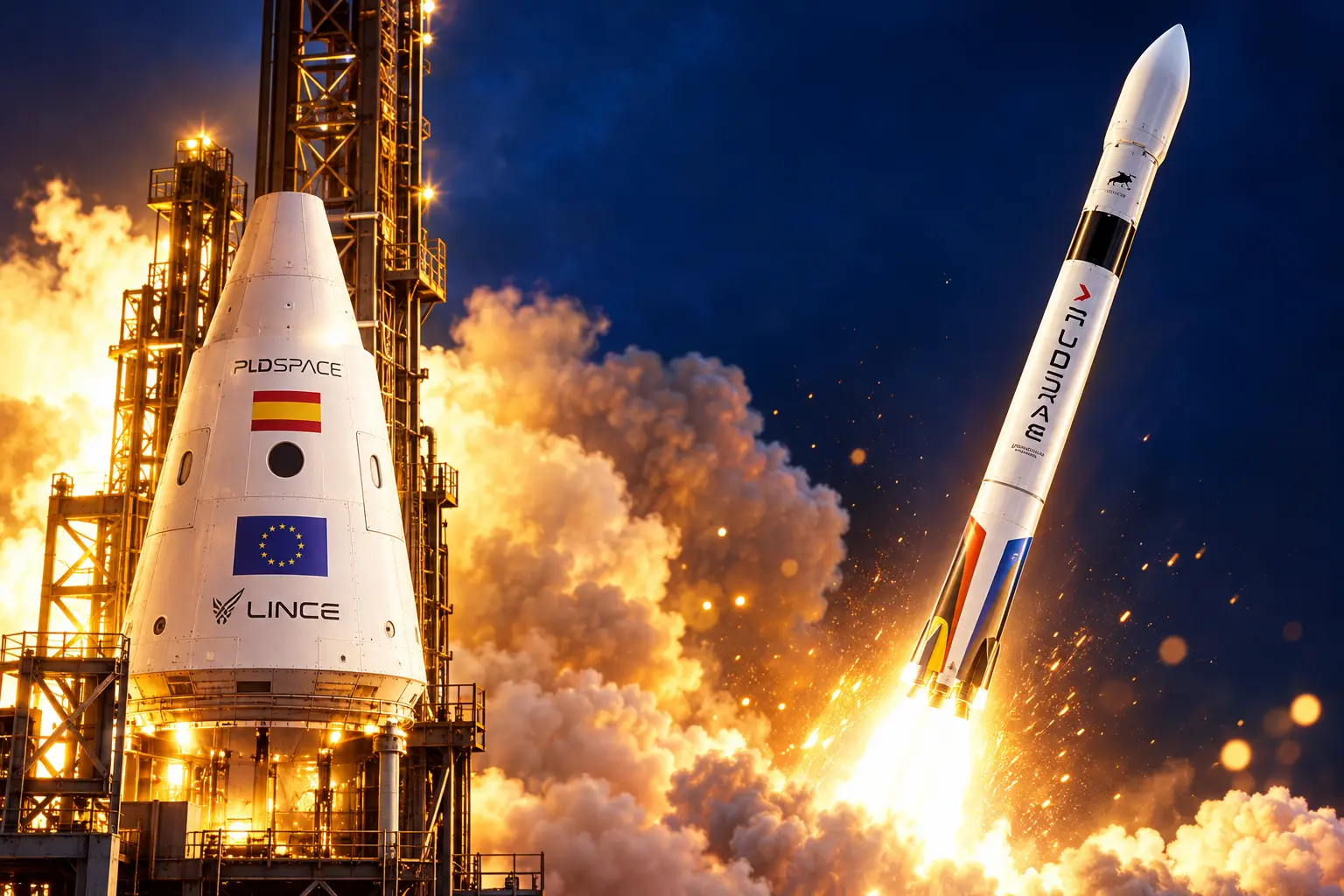
PLD Space, the Elche launcher company, is the cleanest industrial story on the H1 list and the reason the snapshot aged fast. It recorded €210 million in the half across two instruments, then came back in September for more.
Mitsubishi Led the March Round
On March 4, 2026, PLD Space closed a €180 million Series C led by Mitsubishi Electric, which joined as a strategic launch customer for MIURA 5 in Japan and the wider Asian market. Tomonori Sato, Mitsubishi Electric’s executive officer and group president for defense and space systems, said the firm wanted PLD Space’s launchers next to its own satellite business. Spain’s CDTI and COFIDES, the partly state-owned financing company, also took part. After that close the company said it had raised over €350 million to date.
On April 7 the European Investment Bank signed a €30 million venture debt loan for the last stretch of MIURA 5 and for industrial and launch capacity. Ezequiel Sánchez, PLD Space’s executive president, said that loan took 2026 financing to €210 million after the March Series C. That is the H1 number on the ranking: mostly equity, with a public bank’s venture debt sitting underneath it, and a first demonstration flight from Kourou still in front of the company.
PLD SPACE’S 2026 MONEY
- March 4, 2026: Closes a €180 million Series C led by Mitsubishi Electric, with CDTI and COFIDES in the round.
- April 7, 2026: Signs €30 million of EIB venture debt, taking 2026 financing to €210 million.
- September 1, 2026: Adds €108 million to the Series C, lifting the round to €288 million and cumulative funding to €488 million.
- September 10, 2026: Hosts Prime Minister Pedro Sánchez in Elche and unveils MIURA 9 as the commercial name for MIURA 5 Block 1.2.
The September Extension and a New Rocket Name
On September 1, Mitsubishi Electric led another €108 million into the same Series C, with COFIDES returning and Endeavor Catalyst and the Spain Oman Private Equity Fund, managed by MCH Private Equity, coming in. The round is now €288 million. Cumulative funding is €488 million. The extra money is for MIURA 5 industrialisation, test capacity, launch infrastructure and the shift into commercial operations.
Nine days later the company put a heavier vehicle on the board. MIURA 9, developed under ESA’s European Launcher Challenge, is specified at 1,500 kg to a 500 km sun-synchronous orbit, flying from the Guiana Space Centre. The company described it as the evolution of MIURA 5 Block 1.2.
Hoy anunciamos #MIURA9 , la evolución de #MIURA5 (block 1.2) , un lanzador desarrollado en el marco del contrato #ELC @ESA , capaz de lanzar 1500kg a 500km SSO, lanzado desde Guayana Francesa @EuropeSpacePort https://t.co/Jcuvgk7LR8 pic.twitter.com/0lcK9VGKOV
— PLD Space (@PLD_Space) September 10, 2026
The objection writes itself, and it is the right one: a first MIURA 5 demonstration flight is still ahead, and a second name does not substitute for cadence. Replies to the announcement kept returning to that sequence. Fly the rocket that is in final system-level validation, then talk about the heavier one. Prime Minister Pedro Sánchez, visiting the Elche headquarters with minister Diana Morant, said Spain had more than doubled its ESA contribution since 2018 and had put more than €170 million into PLD Space through investments, R&D aid and pre-commercial public procurement, including €40 million of pre-commercial buying for MIURA 5. That public support is a third stream, next to the Series C and the EIB loan, and it is not in the H1 “raised” cell.
MIURA 5 is a two-stage vehicle, 42 metres tall and 3 metres across, with nine Teprel engines on the first stage. The company has pointed at up to 30 missions a year by 2030. ESA’s launcher-challenge contract is worth €158.9 million. That is not H1 venture equity. All of it is why spacetech, at about €354.3 million, led the industry table, with EOS-X Space, Arkadia Space and FOSSA Systems in the same bucket.
Robots, Cancer Drugs and a $2.5 Billion HR Platform
Strip out Perk’s facility, SETT’s Openchip subscription and PLD Space’s mixed stack, and H1 still has a venture market. It is smaller, and it is clustered.
Factorial, the Barcelona workforce-software company, closed a $150 million Series D on the same June 3 as Perk’s credit close, at a $2.5 billion valuation. General Catalyst led its first equity cheque into the company, with Atomico and Four Rivers joining. Factorial said it serves more than 16,000 businesses in over 90 countries and is opening a Munich office because Germany is its most important European market. CEO and co-founder Jordi Romero said the firm is putting team, capital and product roadmap behind that bet. General Catalyst is also committing up to $540 million through its Customer Value Fund, a separate, non-dilutive pool that pre-funds sales and marketing and takes a capped return tied to customer value rather than to more shares.
THEKER, another Barcelona company, raised $85 million on June 11 in a Series A led by CRV, with Samsung, LVMH, Cathay, 20VC, Henkel, Korelya, Sonae and Mercadona alongside existing backers including Inditex, Itnig, Kfund, Kibo Ventures and Mission. THEKER called it Europe’s largest robotics Series A. Samsung’s first investment in a Spanish company and LVMH’s first in the Spanish startup market arrived in the same syndicate. Co-founders Carla Gómez Cano and Jiaqiang Ye Zhu are building AI-native generalist robots for messy factory and logistics work rather than single-task arms. Gómez Cano said they did not build the company to run pilots. The seed, less than a year earlier, was €18 million.
Ona Therapeutics raised $86.6 million in a Series B to push antibody-drug conjugate ONA-255 in breast cancer and ONA-389 toward first-in-human studies in colorectal cancer. Biorce raised $52 million in a Series A for Aika, its clinical-trial design and operations platform. Xoople raised $130 million in a Series B to commercialise Earth-observation data for AI systems. Embat raised €30 million in a Series B for treasury software, with the UK, Ireland and DACH as the expansion targets. EOS-X Space, which is building a five-hour stratospheric-balloon trip toward the edge of space and a dual-use AI and data arm, closed a $140 million Series D in May, about €120 million at the then-going rate, and did not name its investors.
THE TEN LARGEST H1 2026 CHEQUES
| Company | H1 2026 amount | Instrument | Lead or source |
|---|---|---|---|
| Perk | $300 million | Private credit | Neuberger Specialty Finance |
| PLD Space | €210 million | Series C equity plus EIB debt | Mitsubishi Electric, then EIB |
| Factorial | $150 million | Series D equity | General Catalyst |
| EOS-X Space | $140 million | Series D equity | Not disclosed |
| Openchip | €115 million | SETT public equity | SETT / Council of Ministers |
| Xoople | $130 million | Series B equity | Nazca Capital |
| Ona Therapeutics | $86.6 million | Series B equity | Mérieux, Columbus |
| THEKER | $85 million | Series A equity | CRV |
| Biorce | $52 million | Series A equity | Not disclosed |
| Embat | €30 million | Series B equity | Not disclosed |
The dollar and euro amounts sit as announced. At mid-2026 rates the Openchip and Xoople lines are close enough that a ranking can flip on the conversion. That is another reason a single ordered list is a blunt instrument: it mixes currencies, then mixes instruments.
Ten Cheques Took 68% of the Half
Around 68% of €1.7 billion in ten names is the structure of the half, not a side note. Medical and healthcare companies together raised about €195.1 million. Artificial intelligence companies raised about €150.9 million, a figure that does not include every firm that now describes itself as AI-native, Perk and Factorial among them. Jobs and recruitment took about €135 million. Semiconductors took about €121 million, almost all of it Openchip.
H1 2026 FUNDING BY INDUSTRY
- Spacetech: About €354.3 million, the largest industry total, with PLD Space, EOS-X Space, Arkadia Space and FOSSA Systems named on the list.
- Travel: About €266.1 million, largely Perk’s credit facility.
- Medical and healthcare: About €195.1 million, including Ona Therapeutics and Biorce.
- Artificial intelligence: About €150.9 million on the industry cut, before the AI labelling on travel, HR and robotics software.
- Jobs and recruitment: About €135 million.
- Semiconductors: About €121 million, dominated by SETT’s Openchip cheque.
- Software: About €85 million.
- Fintech: About €70 million, with Embat’s Series B inside the wider total.
What the ranking still gets right is the industrial tilt. Rockets, RISC-V chips, generalist factory robots, antibody-drug conjugates and Earth data are where the large cheques went, with Factorial as the software scale-up that can still clear $150 million at a $2.5 billion valuation. What it blurs is the source of funds. A Neuberger-led credit facility, a Council of Ministers subscription and a Mitsubishi Series C are three different capital markets. Adding them up produces €1.7 billion. It does not produce one story about Spanish venture.
H1 2026 closed on June 30. By September 11 the rocket company on that list had already added €108 million and a new launcher name, and SETT had already committed another nine-figure cheque in San Sebastián. The next half-year table will have to split debt, state equity and venture if the ranking is going to mean anything more than a sort.
Frequently Asked Questions
What does SETT do besides the Openchip cheque?
SETT, the Spanish Society for Technological Transformation, sits under the Ministry for Digital Transformation and the Civil Service and deploys Recovery Plan money through several facilities. Openchip went through Next Tech, which is aimed at deep-tech startups and scale-ups. SETT also manages PERTE Chip, the microelectronics and semiconductor programme, and Spain Audiovisual Hub, which funds digitalisation in the audiovisual sector. The same house later committed €107 million to Multiverse Computing’s Series C, announced on July 27, 2026, after the H1 window had closed.
What is the difference between MIURA 5 and MIURA 9?
MIURA 5 is PLD Space’s small-satellite launcher, in final system-level validation for a first demonstration flight from Kourou in French Guiana. MIURA 9 is the commercial name the company assigned on September 10, 2026 to MIURA 5 Block 1.2, specified at 1,500 kg to a 500 km sun-synchronous orbit under ESA’s European Launcher Challenge, with that contract valued at €158.9 million. The heavier name is a block upgrade and a payload claim, not a flown vehicle.
How is Factorial’s $540 million Customer Value Fund structured?
It is not part of the $150 million Series D and it does not buy more shares. General Catalyst’s Customer Value Fund pre-funds Factorial’s sales and marketing, then takes a return tied only to the customer value Factorial actually generates, capped at a fixed amount. Factorial said that structure lets it expand in Germany and other European markets without diluting founders and existing holders, which is why the $540 million sits beside the $2.5 billion equity valuation rather than inside it.
Where is EOS-X Space based, and is it still a Spanish company?
EOS-X Space started in Spain, with operations tied to Seville, and it still turns up on Spanish funding lists. The $140 million Series D in May 2026 was presented at the New York Stock Exchange, where the company has set its financial headquarters after buying US balloon operator Space Perspective, and it has discussed a New York listing in a window from March to August 2027. Founder Kemel Kharbachi is building a five-hour stratospheric-balloon experience plus a civil and defence AI and data arm; the round’s investors were not named.

Oracle’s Unfinished Cerner Move Exposed 20 Million People

Google Buys 890 MW of Nuclear Uprates on a Strained Grid

Francis Halzen Wins a Solo Nobel for His IceCube Bet

Denmark’s Company Search Rights Opened 8.8 Million CPR Records

OpenAI Agents Reached Staging Servers as California Subpoenaed the Lab

Rolex Made Drake the Daytona It Fights Jewelers Over

City’s £125m Enzo Deal Caps a £327m Midfield Rebuild

Instinct’s $2.5 Billion Raise Still Binds the User as Agent

Treasury’s First Iran Bank Shot Lands on an Ally

CSIRTs Inherit Europe’s Missing security.txt Before Article 14
-
 ENTERTAINMENT2 months ago
Rolex Made Drake the Daytona It Fights Jewelers Over
-
 NEWS2 months ago
Instinct’s $2.5 Billion Raise Still Binds the User as Agent
-
 NEWS2 months ago
City’s £125m Enzo Deal Caps a £327m Midfield Rebuild
-
 BUSINESS2 months ago
Treasury’s First Iran Bank Shot Lands on an Ally
-
 NEWS2 months ago
CSIRTs Inherit Europe’s Missing security.txt Before Article 14
-

 BUSINESS2 months ago
Berkshire Anchors Alphabet’s Record Raise With a $10 Billion Check
-
 NEWS2 months ago
Meta’s Teen Settlement Leaves Chat Off the Clock
-

 NEWS2 months ago
OpenAI Codes a Persistent Agent the Week Persistence Backfired