
BUSINESS
IMF Ties Circular AI Deals to Growth and a Deeper Correction
The IMF lifted 2026 growth to 3.1 percent on AI outlays, then warned $1.4 trillion in circular deals could deepen a correction.

The IMF raised its 2026 growth forecast to 3.1 percent on AI spending, then warned that circular AI deals worth $1.4 trillion could deepen a market correction. Both findings landed at the Fund’s annual meetings in Bangkok, which run from October 12 to 18, 2026.
Managing Director Kristalina Georgieva had already told delegates that AI outlays were holding world growth near 3 percent even as an energy shock dragged. A day later the World Economic Outlook printed the upgrade, and the Global Financial Stability Report named weaker AI profits as one of three shocks that could tighten financial conditions fast.
The Growth Upgrade Rests on the Same AI Money
The outlook says growth is projected to slow to 3.1 percent in 2026, a tenth of a point above the July estimate, then rebound to 3.4 percent in 2027. That is still down from 3.5 percent in 2025. Inflation is seen at 4.7 percent this year and 4.1 percent next, and the Fund says energy importers outside the technology chain face the hardest stretch.
Georgieva, speaking in Singapore on October 7 on the way to Bangkok, said global AI investment as a share of output will match and probably exceed the sums that once built railways, power grids and telecom networks. AI hardware and related tech goods already make up more than 10 percent of world merchandise trade, she said, and the technology could add as much as 0.5 percentage point to annual world growth if it is used well.
In Bangkok she called the boom “a demand shock, an investment shock” and said the shift “is what is keeping the world economy growing at around 3 percent, despite the fact we are being dragged down by the energy supply shock.” Advanced Asian economies could gain 0.5 to 1 percentage point of growth from the buildout, she said, and emerging Asian economies 0.2 to 0.8 point.
THE BANGKOK PAPER TRAIL
- October 7, 2026: Georgieva, in Singapore, ties world growth near 3 percent to AI capital spending and puts AI hardware above a tenth of goods trade.
- October 9, 2026: An IMF staff note co-authored by assistant director Jason J. Wu maps circular financing across the AI stack and puts combined valuations near $20 trillion.
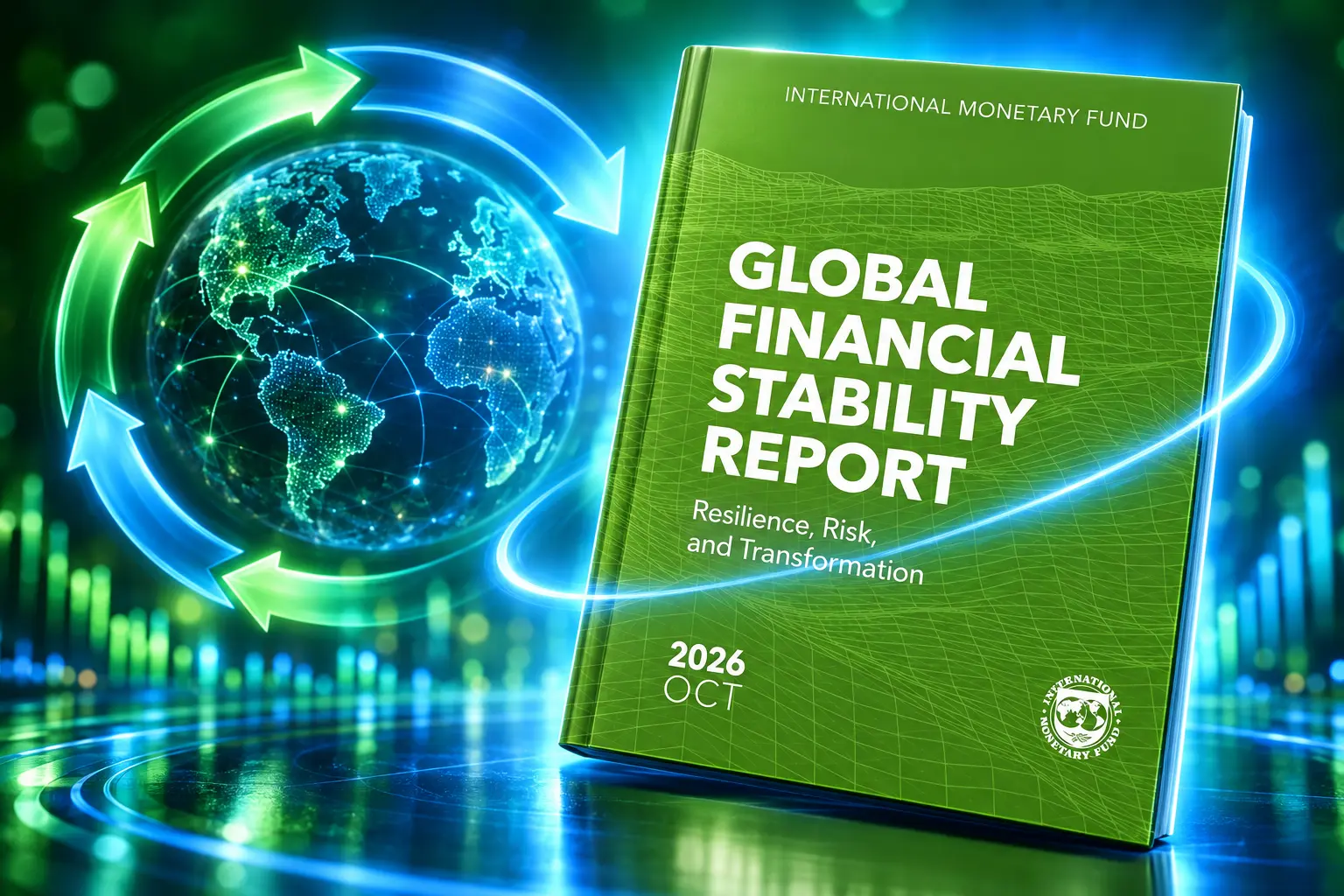
- October 12, 2026: The Global Financial Stability Report is published, listing an AI correction, a jump in sovereign yields and a major cyber incident as the three near-term market risks.
- October 13, 2026: The World Economic Outlook raises the 2026 growth forecast to 3.1 percent, crediting the same investment wave the stability report has just put on a watchlist.
Athanasios Vamvakidis, deputy division chief in the Monetary and Capital Markets Department, put the tension in one briefing line: markets have been held up by growth surprises, earnings and AI optimism, and that is not the same thing as safety.
Global financial markets have held up surprisingly well despite multiple shocks and very high uncertainty to a large extent because of upward growth surprises, strong corporate earnings, but also optimism on AI. But resilience is not safety.
Athanasios Vamvakidis, Deputy Division Chief, Monetary and Capital Markets Department, IMF media briefing
The Fund’s own newsroom account posted the same pairing, markets resilient and risks rising, as ministers sat down in Bangkok.
Read our latest Global Financial Stability Report here: https://t.co/YHsZQPZHTN
— IMF (@IMFNews) October 13, 2026
Fourteen Deals Bought $1.4 Trillion of Future Sales
Staff reviewed 14 publicly disclosed transactions since 2023. Investors led by hyperscalers, the giant cloud and data-center operators, put equity into financially weaker AI firms, added debt, and took back long-dated orders for chips or cloud time. A staff blog on the report tallies those promised sales as $1.4 trillion in future revenue commitments.
THE CIRCULAR STACK IN THE 14 DEALS
| Piece of the loop | Amount |
|---|---|
| Equity into weaker AI firms | about $300 billion |
| Debt alongside that equity | $650 billion |
| Of which sitting with the investees | about $320 billion |
| Future sales promised back (chips or services) | $1.4 trillion |
The investee slice includes debt backed by investor guarantees, contingent facilities and other off-balance-sheet borrowing. Financing and the sales promises are bunched in a handful of recipients. Investors, labelled firms 1 to 10 in the report’s diagram, look sound. Distress at a key investee is what the Fund calls wrong-way risk.
“Equity and debt investments in the firms depreciate in value precisely when future revenue streams tied to them are impaired,” the report says. Wu, at the press briefing, called that hit a “triple whammy”: the stake, the loan and the order book can all go at once.
The October 9 staff note is blunter about how the loop is built. Large firms finance suppliers, model shops and infrastructure companies while also buying from those same firms, a structure the note distinguishes from ordinary supply-chain credit that only covers working capital. Listed companies in the sampled deals account for close to 50 percent of the AI stack’s revenue and 40 percent of its market value. Fold in the private names and the market-implied valuation is about $20 trillion.
That $1.4 trillion is a stack of purchase promises, not cash already in the door, and the first real test is a refinance at a weaker borrower rather than a headline price-to-earnings multiple. The Bank for International Settlements, in a bulletin on circular relationships among AI firms, said 73 percent of those investment ties sit in computer and cloud infrastructure companies, where the supplier is often also the investor.
April’s stability report still described the financial-stability impact of this circularity as modest. By October it is one of three shocks the Fund thinks could jolt markets in the near term. A related staff scenario is already on the books: cut the assumed useful life of AI kit from seven years to three, and aggregate earnings before interest and taxes margins fall by more than 9 percentage points. In a high capital-intensity case, replacement spending can swallow operating profit whole.
Hyperscalers Now Issue 10% of World Bonds
The report lists three growing sources of leverage around AI firms and the people who own them. Core cloud groups still earn well from their established businesses, the Fund says, but free cash flow is falling as they keep spending on AI, so they sell more bonds. Newer “neocloud” operators, which rent out GPU capacity rather than run a full public cloud, already carry heavier debt and thinner profits, and the Fund flags them as possible weak links.
Hyperscalers alone spent roughly $500 billion on capital projects in 2025. Total AI-related capital spending is projected to exceed $4 trillion by 2029, with close to 75 percent of that coming from the same small group. An earlier Fund estimate put data-center capital spending through 2028 at about $2.9 trillion, financed from hyperscaler cash flow, bilateral credit, private capital, public debt and securitization.
THREE LEVERAGE GAUGES IN THE REPORT
| Gauge | Earlier reading | Latest reading in the report |
|---|---|---|
| Hyperscalers’ share of global investment-grade bond issuance | less than 1% in 2024 | 10% as of July 2026 |
| Hedge-fund gross equity positions plus equity margin loans | 10% of advanced-economy GDP in 2024 | about 15% as of June 2026 |
| Share of single stocks inside leveraged exchange-traded funds | 16% | 28% as of July 2026 |
The hedge-fund series uses notional equity exposures. The margin-loan slice covers China, Japan, Korea and the United States. Retail buyers have used geared funds to pile into individual AI names, which is why the single-stock share inside those products has jumped. The Fund says those three channels raise the odds of forced selling, equity-volatility spikes and wider credit spreads if AI investment or profits come in softer or prove less lasting than markets have priced.
That 10% share is the quiet path into ordinary credit portfolios. A correction that starts in a handful of AI names does not have to stay an equity story once the same issuers have become a tenth of global investment-grade supply.
Who Gets Hurt if a Weak Link Breaks
The report says the fallout of an AI correction would be global, with some markets more exposed than others. Advanced Asian stock markets, which move most closely with global AI shares, would likely take the largest hit. The euro area and the United Kingdom look less sensitive on that measure, though stress can still reach them through much larger holdings of US equities than they used to carry.
Georgieva’s growth map and the stability report’s loss map overlap. The Asian hardware suppliers she said would gain the most from the capex wave are also the equity markets the Fund says would suffer first in a re-rating. That is the same money, seen from two desks.
WHERE THE REPORT SAYS STRESS WOULD LAND
- Advanced Asia: Equity markets that track global AI shares most tightly, and the hardware exporters Georgieva said could add 0.5 to 1 percentage point of growth from the boom.
- Retail geared funds: Products that have tilted toward single AI names, so ordinary buyers are running borrowed bets on the same cluster of stocks.
- Europe via US holdings: Less direct sensitivity to AI shares, with the residual risk coming through heavier books of US equities.
- Neocloud borrowers: Higher debt and lower profits than the core cloud groups, which is why the Fund treats them as possible weak links inside the loop.
Hedge funds, in a separate chapter, still help markets function in calm periods. Their leverage and crowded trades, the Fund says, can amplify a shock and spill into prime brokers. Insurance and pension funds have also added more illiquid assets, which is a problem if they have to sell into a thin market.
A Larger Tail of Banks Fails the Stress Test
The 2026 bank stress test ran an energy-price shock, higher inflation and bond yields, and an AI-led market correction in one scenario. Banks as a group stay broadly resilient. The weak tail got bigger.
THE STRESS TEST IN ONE PASS
- The weak share: Banks that would see core capital ratios fall below 7% hold 22% of global banking assets, up from 18% in the prior test.
- The mix of shocks: An AI correction, a jump in sovereign yields and an energy disruption hit together, rather than as separate drills.
- The Fund’s line: The system holds; a larger pocket of weaker lenders would be under-capitalized if that scenario arrived.
Vamvakidis said the banking sector remains resilient under that severe test, and that the under-capitalized tail has been increasing. He also flagged private credit, where higher leverage and liquidity pressure could restrict lending if funding tightens. Fourteen of 33 major central banks have raised policy rates since the second quarter of 2026, up from two in the first quarter, as they responded to the energy shock from the war in the Middle East. Inflation, the report says, has been more contained than first feared, so the rate rise has stayed modest.
Shorter Patch Windows and Higher Bond Yields
Cyber risk is the third near-term catalyst, and the Fund now treats it as a market event, not only an operations headache. State-sponsored groups, ransomware gangs and insiders have access to frontier AI models that have already shown strong results in network-attack simulations. A large incident, the staff blog says, could disrupt payments, trading, deposit access or other core services, especially if it hits a bank, a payment system, a cloud host or a widely used software vendor.
In more than 70% of reported incidents this year, software vendors had almost no time to patch a flaw before it was exploited. In 2021 they typically had about 300 days. Attackers are moving inside that window, and the models that help defenders find bugs also help the other side. Georgieva had already warned in June that Mythos-class models could be turned against the financial system, after Anthropic held back a preview of Claude Mythos in April because of its autonomous cybersecurity skills.
The second catalyst is a sharp rise in government bond yields, driven by resurgent inflation or fiscal worries, with “potentially broad repercussions across financial markets.” Public debt is high, issuance from sovereigns is heavy, and private issuance, including from the AI buildout, is competing for the same buyers. Vamvakidis said the yield risk is “already evolving” on the back of inflation pressure, fiscal gaps and “massive issuance from sovereigns and increasingly from the private sector.”
Those three shocks may be manageable on their own, he said. Existing vulnerabilities, leverage, concentrated books, illiquid nonbank assets, could still amplify them.
The Fund Wants Margin Loans and Geared Funds Capped
Policy in the report is aimed at the leverage around the boom, not at the technology. Containing borrowing used to finance AI exposures, “where excessive,” is listed as a priority, because that leverage is what turns a softer profit print into forced selling.
WHAT THE REPORT ASKS AUTHORITIES TO DO
- Investor leverage: Tighter oversight of equity margin financing, limits on leveraged exchange-traded funds, and curbs on short-term options, including for retail buyers.
- Systemwide books: Supervisors should test losses from highly connected circular deals and, where the risk is material, use sectoral capital charges, concentration limits (including in prime brokerage) and capital buffers.
- Public balance sheets: Put government debt on a sustainable path, protect central-bank independence, and stick to inflation mandates with clear communication.
- Cyber: Harden defences, incident reporting, crisis drills and oversight of critical third-party vendors, because patch time has already collapsed.
Vamvakidis closed the briefing with a line the report repeats in plainer staff language: public debt is high, inflation is still off target in many economies, and policy space is thinner than it was, so the work of strengthening the system belongs to the period before the next shock, not after it. “The bottom line is simple. Now is the time to strengthen the financial system,” he said.
Ministers and governors remain in Bangkok through October 18 with those tools on the table: caps on margin loans and geared funds, concentration limits on the circular books, and a slower path for public debt, while the same AI outlays the Fund just credited for a 3.1 percent growth print keep rolling through the bond market.
Disclaimer: This article is news reporting and analysis of International Monetary Fund publications and related official briefings. It is for information only and is not investment, trading, tax or financial-planning advice, and it does not recommend buying, selling or holding any security, bond, fund or derivative. Readers who are considering any portfolio change should consult a licensed financial adviser or other qualified professional who can assess their own circumstances. The figures and stress-test results cited are those published in the IMF’s October 2026 World Economic Outlook and Global Financial Stability Report and in the accompanying staff note and blog; later Fund updates, market prices and company filings may differ.

MLB and the Union Will Not Extend the Labor Deal

Amazon Found PHP2Shell Probes Four Days Before the Patch

Brent Clears $117 After Gulf Crude Already Came Back

Chipmakers Took the Nasdaq Hit After Meta Burned Cash

Netflix Scored Its 2026 Series as Flops Against Home Runs

Rolex Made Drake the Daytona It Fights Jewelers Over

Treasury’s First Iran Bank Shot Lands on an Ally

Instinct’s $2.5 Billion Raise Still Binds the User as Agent

City’s £125m Enzo Deal Caps a £327m Midfield Rebuild

CSIRTs Inherit Europe’s Missing security.txt Before Article 14
-
 ENTERTAINMENT2 months ago
Rolex Made Drake the Daytona It Fights Jewelers Over
-
 BUSINESS2 months ago
Treasury’s First Iran Bank Shot Lands on an Ally
-
 NEWS2 months ago
Instinct’s $2.5 Billion Raise Still Binds the User as Agent
-
 NEWS2 months ago
City’s £125m Enzo Deal Caps a £327m Midfield Rebuild
-
 NEWS2 months ago
CSIRTs Inherit Europe’s Missing security.txt Before Article 14
-

 BUSINESS2 months ago
Berkshire Anchors Alphabet’s Record Raise With a $10 Billion Check
-

 NEWS2 months ago
Meta’s Teen Settlement Leaves Chat Off the Clock
-

 ENTERTAINMENT2 months ago
Ricky Gervais Wants Alley Cats to Run Until He Dies