
NEWS
The New Mac Mini Makes Always-On AI Cost $899
Apple recasts the Mac mini with M6 as an always-on local AI agent at $899, after the $599 model vanished in a two-month climb.

Apple’s new Mac mini with M6 starts at $899, $300 above the $599 cube that launched in October 2024. Pre-orders opened August 25, and boxes are due September 22.
The shell is the same 5-inch square. The job Apple is selling has changed: a deskside box that stays on and runs AI agents locally, not a bargain Mac.
The $599 Mac Mini Lasted Until May
The sticker looks like a $100 bump if you only check the M4 mini’s last list price. The longer path is steeper. Apple’s original $599 M4 Mac mini shipped on November 8, 2024 with 16GB of unified memory and a 256GB SSD, the same starting pair the M6 still uses.
WHAT CHANGED ON THE PRICE TAG
- October 29, 2024: Apple unveils the redesigned M4 Mac mini at $599, with the M4 Pro model from $1,399.
- May 1, 2026: EveryMac records the 16GB/256GB $599 configuration as discontinued, leaving $799 as the cheapest listed mini.
- June 2026: Apple lifts Mac prices about 15 to 20 percent. TechSpot and Yahoo both quote Tim Cook saying the company had never seen a component price increase this much, this quickly, with memory the squeeze.
- August 25, 2026: The M6 mini lists at $899 and the M5 Pro mini at $1,699, $100 above those recent floors and $300 above the 2024 launch pair.
In two months the cheapest way into a desktop Mac rose 50 percent, and it still arrives with 16GB and 256GB. Education pricing is $799 for the M6 and $1,599 for the M5 Pro. The Verge reported that last-gen minis had already grown scarce because more people were buying them to run AI agents.
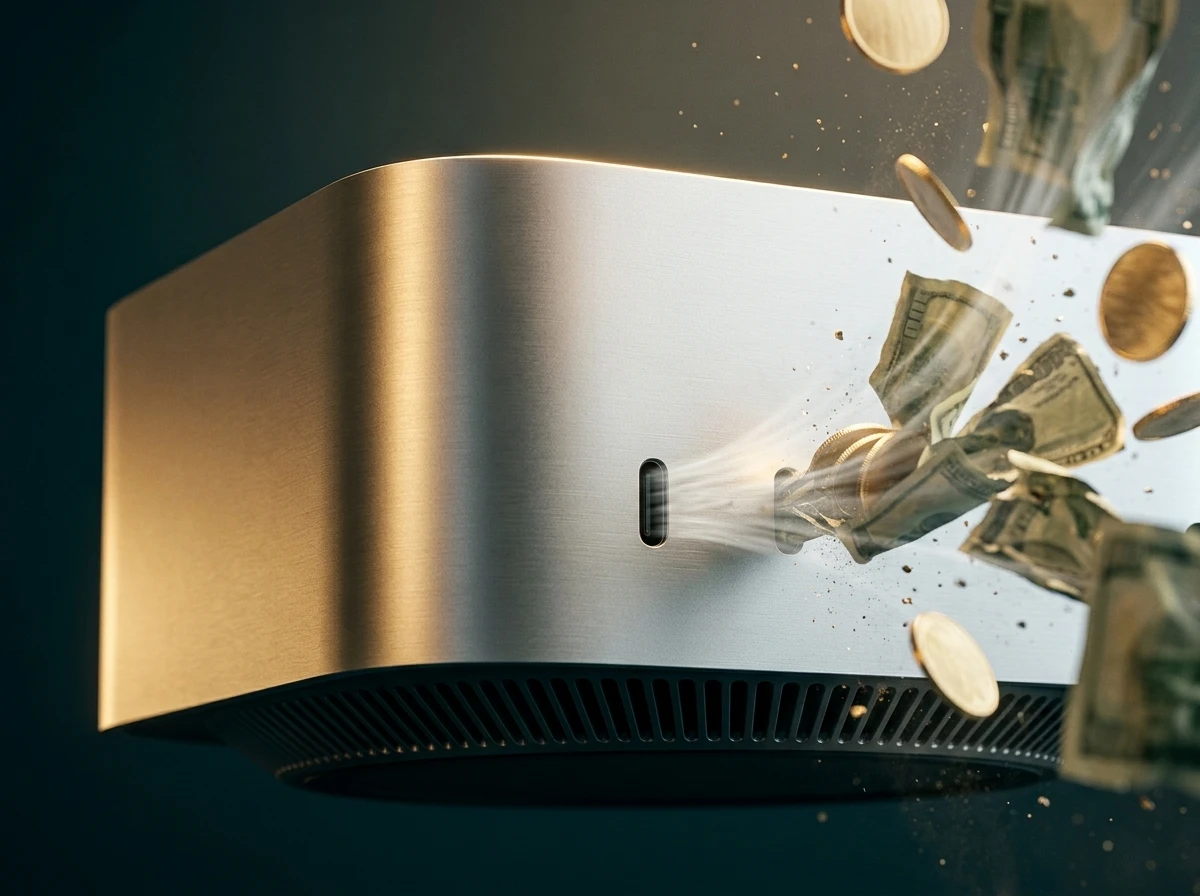
Johny Srouji’s Pitch Is a Desk-Side Agent
Apple’s newsroom headline does not lead with cores. It calls the mini the leading desktop for always-on agentic computing, and it repeats that line for home use, studio work, and enterprise agents.
Mac mini has always been our most versatile Mac. Whether it’s being used as a home computer, powering a professional studio, or as an always-on agentic device, it’s the little Mac that can do it all.
Johny Srouji, Apple’s chief hardware officer, Apple newsroom
The company now sells that cube for always-on, deskside agentic computing in the same aluminum shell. On-device examples in the release include style effects on photos, local models, and agents that automate daily tasks. Thunderbolt 5 on the Pro model is pitched as a way to cluster several minis and keep large models on the hardware.
That is a different buyer than the student who wanted the cheapest Mac that could drive a monitor. The loudest objection after the post went up was the vanished $599 SKU, not the 4x AI slide. A second camp is fine with 16GB because they will run Cursor, Codex, and Claude in the cloud and treat the mini as a fast, quiet client. Apple wrote the first script. A lot of carts will follow the second.
Why the Faster Mini Uses an Older Pro Chip
The M6 is new silicon on a 2nm process. The faster mini in the same lineup uses M5 Pro, a chip that already shipped in MacBook Pro in March. Apple is putting its newest everyday die in the cheap box and its existing Pro die in the expensive one, because M5 Pro is the part that can take 64GB of unified memory and 307GB/s of bandwidth. M6 tops out at 32GB and 170GB/s. Local model size follows memory first, then bandwidth, so the “Pro” badge is doing the heavy AI work even though its generation number looks older.
PCMag noted this is the first time M5 Pro has landed in a desktop. MacStories compared the split to last year’s Mac Studio, which mixed an M4 Max with an M3 Ultra. Sri Santhanam, Apple’s vice president of Silicon Engineering, said M6 is built for everyday users, students, developers, AI hobbyists, and enterprises. The Pro mini is the one Apple describes as quiet enough to leave on for agents and strong enough for ProRes RAW, large 3D scenes, and bigger local models.
Super Cores and a Dual Neural Engine
M6 is Apple’s first 2-nanometer chip, with a 12-core CPU made of 2 super cores, 4 performance cores, and 6 efficiency cores. That is two more CPU cores than M5 and two more than the 10-core M4 in the last mini. The 12-core GPU puts a Neural Accelerator in each core for the first time on Mac mini, and a Dual 16-core Neural Engine is rated up to twice as fast as the last generation.
Apple’s own figures, tested in July 2026, compare the M6 mini with an M4 mini that had 32GB of memory and a 2TB SSD, not with the $599 base unit. Against that loaded M4, Apple claims up to 4x faster AI, 2x faster graphics, 2x faster storage, and 40 percent faster CPU. LM Studio prompt processing is listed at up to 13.5x versus an M1 mini and 4.8x versus M4. Excel is 2.3x versus M1 and 1.5x versus M4. Cyberpunk 2077: Ultimate Edition with ray tracing is up to 2x versus M4. Versus M5, the chip PR claims up to 1.2x multithreaded CPU speed, nearly 30 percent more peak GPU compute for AI, and 10 percent more memory bandwidth.
| Spec | M4 mini (2024 launch) | M6 mini | M5 Pro mini |
|---|---|---|---|
| Starting price (U.S.) | $599 | $899 | $1,699 |
| CPU | 10-core | 12-core (2 super, 4P, 6E) | 15-core, or 18-core for $200 more |
| GPU | 10-core | 12-core with Neural Accelerators | 16-core, or 20-core with the CPU bump |
| Unified memory | 16GB, up to 32GB | 16GB, up to 32GB | 24GB, up to 64GB |
| Memory bandwidth | 120GB/s | 170GB/s | 307GB/s |
| Rear Thunderbolt | Thunderbolt 4 | Thunderbolt 4 (40Gb/s) | Thunderbolt 5 (120Gb/s) |
| Ethernet | 1Gb, 10Gb +$100 | 2.5Gb, 10Gb +$100 | 2.5Gb, 10Gb +$100 |
M5 Pro numbers in the same release use a different baseline, an M2 Pro mini with 32GB and an 8TB SSD. Apple lists LM Studio at up to 8.5x versus that M2 Pro and 4x versus M4 Pro, Blender ray-traced renders at 4.5x and 1.4x, and Affinity image work at 2.1x and 1.5x. The Pro GPU also gets an enhanced shader core and third-generation ray tracing.
The Same 5-Inch Box, With Faster Ethernet
Nothing about the chassis moved. Height is still 2.0 inches (5.0 cm), width and depth 5.0 inches (12.7 cm). The M6 unit weighs 1.5 pounds (0.67 kg); the M5 Pro unit is 1.6 pounds (0.73 kg). Finish is silver only. Front ports stay two USB-C connectors at USB 3 speeds up to 10Gb/s, plus a 3.5 mm headphone jack with high-impedance support. The power button is still on the underside. In the box you still get a 1.8 m power cord and nothing else.
NEW WIRING IN THE OLD SHELL
- Wireless: An Apple N1 chip now handles Wi-Fi 7 (802.11be), Bluetooth 6, and Thread, up from Wi-Fi 6E and Bluetooth 5.3 on the M4 mini.
- Ethernet: The default jack is 100/1000/2500BASE-T. A 10Gb option, still $100, adds Nbase-T rates of 1Gb, 2.5Gb, 5Gb, and 10Gb.
- Displays: Both chips still drive up to three external screens. M6 can run one 8K display at 60Hz plus a second screen; M5 Pro can push three displays from a single Thunderbolt port and uses DisplayPort 2.1 on Thunderbolt 5.
- Genlock: USB-C genlock is new, for locking a display to a camera, including iPhone 17 Pro.
- Clustering: Only the M5 Pro’s Thunderbolt 5 ports are sold as a way to chain minis for large on-device models.
The M6 mini does not get Thunderbolt 5. Anyone who wants 120Gb/s rear I/O, four-display flexibility over one cable, or a mini cluster is on the $1,699 side before memory. Idle noise is listed at 5 dBA at the operator position. Maximum continuous power is 155W. Apple says the mini is made with 50 percent recycled material, including 100 percent recycled aluminum in the enclosure, and that it is ENERGY STAR certified. macOS 27, which Apple calls Golden Gate, is in public beta now and due as a free update this fall, with Siri AI and the next Apple Intelligence features.
A 2TB Drive Costs More Than the Computer
Apple’s store still starts the M6 at 16GB and 256GB. John Gruber’s Daring Fireball table of the configure-to-order menu, which matches the option list on Apple’s spec sheet, puts 24GB at $200 extra and 32GB at $400. Storage is $200 for 512GB, $500 for 1TB, and $1,000 for 2TB. That 2TB add-on costs more than the $899 computer. The M5 Pro starts at 24GB and 512GB. The 18-core CPU and 20-core GPU add $200. 48GB of memory is $600, 64GB is $1,000, a 1TB SSD is $300, 2TB is $800, 4TB is $1,800, and 8TB is $3,800. A 15-core M5 Pro with 64GB and no extra drive is $2,699.
| Add-on | M6 mini | M5 Pro mini |
|---|---|---|
| Next memory step | 24GB, $200 | 48GB, $600 |
| Max memory | 32GB, $400 | 64GB, $1,000 |
| 1TB SSD | $500 | $300 |
| Max SSD | 2TB, $1,000 | 8TB, $3,800 |
| 10Gb Ethernet | $100 | $100 |
That math is why a loaded Pro mini is a weak buy if the only goal is local weights. You spend near $2,700 and still stop at 64GB and 307GB/s; the new Mac Studio with M5 Max starts at $2,499 with a path to much more memory. The M6 ceiling is the sharper limit. 32GB and 170GB/s will run small and mid-size local models, and Apple’s LM Studio claims are real as marketing tests, but they were run against minis stuffed with 32GB and huge SSDs. The $899 box on the product page is not that machine.
Budget buyers who loved the M4 mini at $599 now face a $899 floor for the same 16GB/256GB starting pair, plus $200 if 256GB is a nonstarter. M4 units remain fast enough for office work, and the M6’s everyday gains (about 1.5x in Excel versus M4, 40 percent CPU in Apple’s mixed tests) will not feel like a new class of computer on email and browsers. The people who should pre-order are the ones who want the agent box Apple described, or who need Wi-Fi 7, 2.5Gb Ethernet, and the 2nm CPU in a 5-inch square and will pay the new rent.
Frequently Asked Questions
How Much Does the Education Mac Mini Cost?
College students and educators pay $799 for the M6 model and $1,599 for the M5 Pro model in the United States, $100 off each list price, through Apple’s education store year-round. That discount does not change the 16GB/256GB or 24GB/512GB starting builds, and the Mac mini is not on the Apple Upgrade Program.
How Loud Is the New Mac Mini at Idle?
Apple’s spec sheet lists a sound pressure level of 5 dBA at the operator position when idle, with a maximum continuous power draw of 155W, an operating range of 50° to 95° F (10° to 35° C), and testing up to 16,400 feet (5,000 meters). Those acoustics are why the company keeps calling the Pro model an always-on agent desktop.
Can the M6 Mac Mini Drive an 8K Display?
Yes. The M6 model can run one display up to 8K at 60Hz, 5K at 120Hz, or 4K at 240Hz, plus a second display up to 5K at 60Hz over Thunderbolt or 4K at 60Hz over HDMI, and it can drive two external displays from a single Thunderbolt 4 port. Three-display layouts on M6 use two 6K/4K screens plus a third at up to 5K over Thunderbolt or 4K over HDMI.
What Comes in the Mac Mini Box?
Apple includes the computer and a 1.8 m power cord. There is no keyboard, mouse, HDMI cable, or Ethernet cable in the carton, and Personal Setup sessions plus Today at Apple store classes are the extra help for people who buy direct from Apple.
First customer units and store stock are scheduled for September 22 in 30 countries and regions, including the United States. The cheapest box on that day will still hold 16GB of memory, a 256GB drive, and a 2nm chip Apple now wants sitting on all day.


The 96 Percent Lunar Eclipse California Mostly Missed

Apple TV Hikes Subscriptions to $14.99 and $119

Judge’s 14-Day Hold Freezes USPS Mail Voting Rules

OpenAI Builds the Always-On Codex It Just Warned Against

Meta’s Teen Settlement Puts the Extra Bill on TikTok

Rolex Gifted Drake a Daytona Dealers Already Priced
Meta’s Teen Settlement Puts the Extra Bill on TikTok

Ricky Gervais Bets His Career on Alley Cats Forever
OpenAI Builds the Always-On Codex It Just Warned Against

BMW’s China Strategy Comes Due at €60 a Share
-
 ENTERTAINMENT2 weeks ago
Rolex Gifted Drake a Daytona Dealers Already Priced
-
 NEWS2 days ago
Meta’s Teen Settlement Puts the Extra Bill on TikTok
-
 ENTERTAINMENT2 weeks ago
Ricky Gervais Bets His Career on Alley Cats Forever
-
 NEWS2 days ago
OpenAI Builds the Always-On Codex It Just Warned Against
-
 AUTO2 weeks ago
BMW’s China Strategy Comes Due at €60 a Share
-
 AUTO2 weeks ago
Pateo Offers Yunji a Car-Grade Line for Robots
-

 NEWS3 days ago
Instinct’s $2.5 Billion Round Bets on Total Access
-
 NEWS20 hours ago
The 96 Percent Lunar Eclipse California Mostly Missed
Pingback: Apple TV Price Rises to $14.99 a Month