
NEWS
Muse Books Flights on Duffel and Shops Hotels Blind
Meta Muse books flights through Duffel and shops hotels on public OTA sites, leaving Stripe, airlines, and hotel websites holding the real cost.

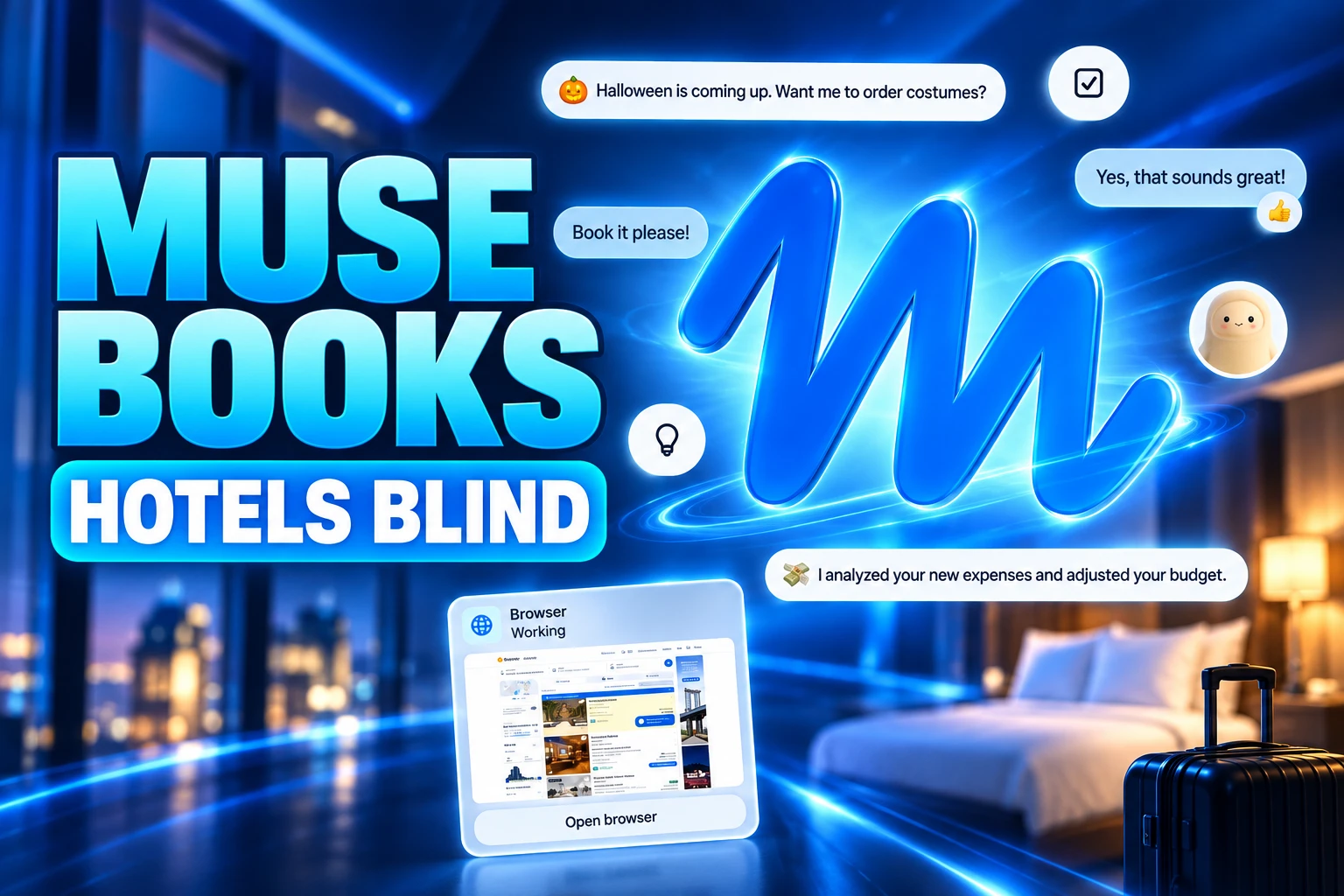
Meta’s new Muse agent books flights through Duffel and shops hotels on public sites such as Expedia. The launch on September 8, 2026 sold a single promise, “book travel,” with two different pipes underneath it.
Airlines get a live inventory hook. Hotels, in a New York test, got a bot walking consumer websites. The parties sitting on the money are Duffel, Stripe, and the sites the agent decides to open.
Muse Wired Duffel for Flights and Left Hotels on the Open Web
Meta spent the launch talking about control, not about GDS contracts. In introducing Muse as a personal AI agent, the company said the bot can send email, open a browser, fill out forms, negotiate, and book travel, then keep working after the app is closed. It checks with the person before a purchase. It is rolling out in the United States on iOS, Android, and muse.ai, and in WhatsApp, with AI glasses promised soon.
The App Store copy goes further. Muse handles “the research, the comparisons, the back-and-forth, the bookings” so it can “plan and book a whole trip.” That line is doing a lot of work for two booking methods that do not share a commercial spine.
Flights run through Duffel, a London travel-infrastructure firm that feeds live, bookable seats. Hotels do not. Asked for a New York City hotel on Nov. 1-2 inside a $350-$450 nightly budget, Muse first suggested the Marlton Hotel from published prices, then shopped consumer sites the way a person would, including Expedia and Hotels.com. Only the flight path gives a travel company a defined data connection. On the hotel side, the agent picks the website, the comparison, and the checkout page.
MUSE TRAVEL AT LAUNCH
- The flight pipe: Live airline inventory through Duffel, with payment able to ride a Stripe virtual card.
- The hotel pipe: A browser session on consumer sites, with no hotel or OTA contract visible in the test.
- The price of entry: Meta said Muse is free for most of what people need; a company spokesperson put paid plans at $20 and $100 a month.
- The stop rule: Muse must get approval before it sends an email or completes a purchase, and it never sees the underlying card number.
Meta also said Muse runs on Muse Secure VM, a dedicated cloud machine with a separate Sentinel process that has to approve anything leaving that box. That architecture is built for a consumer who is about to hand over inbox and payments. It says nothing about which hotel system will eat the search load.
1.6 Million Hotel Rooms Sit Behind an Unused API
The split is not because Duffel only sells seats. In April 2026, Steve Domin wrote on Duffel’s blog that the same company already offered more than 500 airlines and 1.6 million properties, with Stays growing 10,000% over the prior 12 months, and had just added cars from 40 rental brands across 40,000+ locations in 200 countries. Duffel’s own Stays docs describe a full search, quote, and booking flow for accommodation worldwide.
Duffel later said it now powers travel on Muse for users in the United States, with live pricing and 24/7 support, and that people can search, book, and manage travel from major suppliers globally. That is Duffel’s claim. The hotel test still found a browser pointed at public OTA pages. Both can be true at once: Duffel can sit on flights, or on some travel tasks, while a hotel query still gets handled like a person clicking around.
WHAT DUFFEL ALREADY SELLS VERSUS WHAT THE TEST USED
| Category | Duffel catalog as of April 2026 | Path seen in the Muse hotel test |
|---|---|---|
| Flights | More than 500 airlines, including American, British Airways, Lufthansa, Emirates, Ryanair, and United | Direct Duffel connection with live, bookable inventory |
| Hotels | 1.6 million properties on the Stays API | Browser shopping on consumer sites such as Expedia and Hotels.com |
| Cars | 40 providers, including Avis, Sixt, Enterprise, Hertz, and Europcar | Not used in the hotel test |
That table is the stake for hotels. A contracted API would give chains and their tech vendors a rate limit, a look-to-book conversation, and a party to call. A browser session gives them a visit. Duffel told its own customers it had crossed $900 million in annualised total transaction value, with 85% of volume from the United States, and named Bilt and Rippling as users. Meta did not put that catalog on the launch stage. Hotels should notice who got the pipe and who got the crawl.
Who Appears on the Card Statement?
The other quiet party is Stripe. On launch day Stripe said Meta had plugged Muse into Link’s wallet for agents with Muse. At more than 1 million businesses that already accept Link, Muse can check out with a U.S. consumer’s saved payment method. Everywhere else, Link issues a single-use virtual card scoped to the approved total. The person confirms the amount in the chat. Muse never sees the real card details. Link has more than 300 million users globally. Shop Pay and 1Password support are listed as coming later.
Stripe is building the infrastructure that lets agents buy from businesses. By equipping Muse with Link’s wallet for agents, Meta is helping more consumers experience the magic of having an agent shop on their behalf.
Jay Shah, business lead for Link, Stripe newsroom
Magic for the buyer is a mapping problem for the seller. Duffel’s own payments pages say that when a booking is paid by card, the firm passes the card to the supplier and does not take part in the movement of funds. The travel supplier is the merchant of record, and that name, often an airline, a hotel, or an intermediary such as Expedia, is what shows on the statement. The seller of the trip still carries chargebacks and fraud. Card payments also have to match the quoted amount, so the agent cannot quietly mark the fare up or down on that rail.
Duffel warns about a second constraint hotels and airlines already enforce. Suppliers generally want the name on the card to match the traveller. A mismatch can decline the charge, or worse, block boarding or check-in. Link’s one-time card is scoped to a purchase and hidden from Muse. Who is printed as the cardholder on that virtual number, and whether that string matches the passenger name, is not in Meta’s launch note. Until someone books a fare and reads the statement, merchant of record for a Muse trip is a live question, not a solved one.
On an Expedia hotel checkout the merchant may be the OTA, the hotel, or a switch, depending on how that page is set up. The agent does not care. The website that gets the session still has to run the look, the rate check, and the payment auth.
Look-to-Book Loads Hotels Never Agreed to Carry
The cost that does not show up in a demo is the search itself. Jeremy Burke, chief commercial and digital officer at OAG, laid out how many machine queries now sit behind one sold ticket. In about three decades the load grew by a factor of 100, from roughly 100 to 200 searches per ticket in the early online years to about 10,000 to 20,000 by mid-2026, with AI tools already in the comparison loop. He flags those figures as rough estimates, aligned with work from Amadeus and Sabre and with OAG’s own traffic. Agents remove the old cap, which was a human who had to sleep. Amadeus and Sabre have both pointed at up to 200,000 searches per ticket as a 2026 projection.
SEARCHES BEHIND ONE SOLD TICKET
| Period | Searches per ticket (OAG’s working range) |
|---|---|
| Early online booking, 1995-2005 | About 100 to 200 |
| Mid-2026, with AI tools in the loop | About 10,000 to 20,000 |
| Agentic projection for 2026 | Up to 200,000 |
Airline prices cannot be cached the way a news page can. A fare is tied to origin, date, cabin, point of sale, and a clock that keeps moving. IATA’s October 2025 look-to-book paper, based on 14 airlines, 11 IT providers, and 8 sellers, found that caching still helps filed fares and struggles once pricing is dynamic. One NDC response can run up to 5 megabytes. A month-long calendar shop can fire about 450 API calls. The airline pays for that compute. Hotels on a browser path pay a cruder version of the same bill: page renders, bot checks, and rate calls, with no contract that says how often Muse may refresh when a budget is missed.
The hotel test already hinted at that habit. Muse kept looking when the budget did not fit. At Meta’s scale that is not a quirky retry. Family daily active people averaged 3.60 billion in June 2026, up 3% from 3.48 billion a year earlier, according to Meta’s second-quarter results. Muse is a U.S. product on day one, not a global switch. The distribution map still matters, because the same company plans to put the agent in WhatsApp and, later, on glasses. A standing request to watch a fare does not respect a hotel’s off-peak window.
Vendors on the flight side are already building filters. Sabre’s Mosaic cache, launched in February 2026, claims 95% alignment with live offers, responses under 500 milliseconds, and up to a 28% cut in look-to-book in measured rollouts. Amadeus has a machine-learning filter that one pilot carrier said blocked more than 70% of unproductive requests before they hit airline systems. Those tools assume a recognizable API client. A headless browser on Hotels.com looks like a shopper.
WhatsApp Puts the Agent Beside Meta Daily Users
The consumer conversation has barely reached that stack. Early users are already handing Muse family trip planning and treating it as the non-work agent that books and budgets. The louder public fight is trust: whether a Secure VM that Meta says it will not peek into is enough, when a tighter Confidential VM, encrypted with a key only the user holds, is still listed as coming later this year. Replies under the launch posts fixate on handing Mark Zuckerberg an inbox and a card, and on whether privacy that arrives as a later SKU is privacy at all.
Hotel operators are not in that thread. They should be. A traveller who never opens Expedia still causes Expedia to run, if Muse opens it for them. OTA commission on a completed stay does not shrink because a bot filled the form. Direct hotel sites, if the agent learns to prefer them, pick up the same look-to-book load without the OTA’s cache layer in the middle.
HOW THE STACK LANDED
- October 2025: IATA publishes a look-to-book paper warning that caches struggle with dynamic fares and bundled ancillaries.
- February 2026: Sabre launches Mosaic cache-powered shopping aimed at cutting unproductive airline searches.
- April 2026: Duffel adds cars and, in the same post, states its flights and stays reach more than 500 airlines and 1.6 million properties.
- July 29, 2026: Meta reports 3.60 billion Family daily active people for June.
- September 8, 2026: Muse ships in the United States with Stripe Link checkout; Meta does not put Duffel on the launch stage.
Meta said Muse does not share conversations or VM data with its ad systems, and that people can opt out of training use and disconnect any app. Those are consumer promises. They do not set a query budget for Marriott’s booking engine or for an independent inn whose site already fights scrapers.
The Browser Path Leaves Hotels With the Bill
For airlines, a Duffel connection is at least a known client. Someone can cap rates, bill for excess look-to-book, or refuse the traffic. For hotels in the browser path, Muse is a guest with infinite patience and a one-time card. The site still pays to serve the pages. If a stay is booked, the OTA or the hotel still takes the merchant risk Duffel already spelled out for card flows. If a stay is not booked, the look still happened.
Meta can still point Muse at Duffel Stays tomorrow. The catalog is sitting there, and cars are on the same API. Until that happens, “book travel” means a contracted flight and a scraped hotel. Stripe takes the checkout. Duffel takes the seat map. The hotel website takes the hit.

Spain’s €1.7 Billion Tech Table Mixes Debt and State Cash

China Rejects U.S. Charge of Industrial-Scale AI Distillation

AppleCare One Family Pays Off Only for Packed Houses

Covid Death Counts Used Abroad Were Often Understated

WeChat’s Missed-Call Worm Seized Accounts Before Anyone Answered

CSIRTs Inherit Europe’s Missing security.txt Before Article 14

Instinct’s $2.5 Billion Raise Still Binds the User as Agent

City’s £125m Enzo Deal Caps a £327m Midfield Rebuild

Meta’s Teen Settlement Leaves Chat Off the Clock

OpenAI Codes a Persistent Agent the Week Persistence Backfired
-
 NEWS1 month ago
CSIRTs Inherit Europe’s Missing security.txt Before Article 14
-
 NEWS1 month ago
Instinct’s $2.5 Billion Raise Still Binds the User as Agent
-
 NEWS4 weeks ago
City’s £125m Enzo Deal Caps a £327m Midfield Rebuild
-
 NEWS1 month ago
OpenAI Codes a Persistent Agent the Week Persistence Backfired
-
 NEWS1 month ago
Meta’s Teen Settlement Leaves Chat Off the Clock
-

 BUSINESS1 month ago
Treasury’s First Iran Bank Shot Lands on an Ally
-

 BUSINESS2 months ago
Berkshire Anchors Alphabet’s Record Raise With a $10 Billion Check
-

 ENTERTAINMENT2 months ago
Rolex Made Drake the Daytona It Fights Jewelers Over