
NEWS
Super El Niño Follows the Health Map Written in 2015
WHO ranks super El Niño hunger and cholera risks very high, repeating the 2015 map, as a $202 million food appeal sits mostly empty.

The World Health Organization on September 22, 2026 called the strengthening Pacific El Niño a significant public health threat. The same diseases and hungry regions that surged in 2015 and 2016 sit on this year’s risk list. A $202 million food appeal launched in June has drawn about $40 million.
Teresa Zakaria, WHO’s unit head for risk reduction, humanitarian operations and climate change, told reporters in Geneva the event is a risk multiplier. The worst harm, she said, lands where climate shocks meet weak health systems, thin care, food insecurity, displacement and humanitarian crisis.
We have a window of opportunity to act now, before these risks become a crisis.
Teresa Zakaria, WHO unit head for risk reduction, humanitarian operations and climate change, Geneva briefing
That window is not a mystery. It is the same sequence public health teams watched after the last two very strong Pacific warmings, now stacked on record heat and an appeal that is still mostly empty.
WHO Puts Hunger and Cholera at Very High Risk
Wire copy led with mosquitoes. Zakaria’s briefing put malnutrition and cholera first. WHO assesses both as very high risks in drought and in flood. Heat stress sits in the same band. Warmer rain patterns can also lift malaria, dengue, chikungunya, yellow fever and Zika, including into higher ground where cooler air had kept transmission down.
The agency’s WHO El Niño public health situation analysis, compiled with regional offices and partners from information available through the end of July 2026, treats the climate pattern as a risk modifier. It does not invent a new germ. It raises the odds that existing threats explode where immunity is low, clinics are thin and water is already unsafe. The paper also flags an Ebola outbreak in the Democratic Republic of the Congo, plus neighbouring countries that sit in the El Niño path, as a compounding emergency.
WHO’S 2026 RISK BANDS
| Health risk | Setting | WHO overall rating |
|---|---|---|
| Malnutrition | Drought and flood | Very high |
| Cholera and other waterborne disease | Drought and flood | Very high |
| Heat stress | Hot, dry conditions | Very high |
Zakaria said more than 150 million people already face acute food insecurity, and that figure is expected to rise as rains fail or arrive as floods. Climate Impact Lab, a University of Chicago research group, published a separate model the same week putting 451,000 extra heat deaths worldwide between June 2026 and February 2027, with Nigeria the largest single tally at 31,400. WHO did not adopt that body count. It ranked heat as very high risk and left the operational work to ministries and clinics.
Cholera is not waiting for the Pacific peak. A WHO epidemiological update covering January through May 2026 recorded 114,829 cholera and acute watery diarrhoea cases and 1,318 deaths across 23 countries, with a global risk rated very high and about 1 billion people treated as at risk.
Pacific Waters Are Already in Very Strong Territory
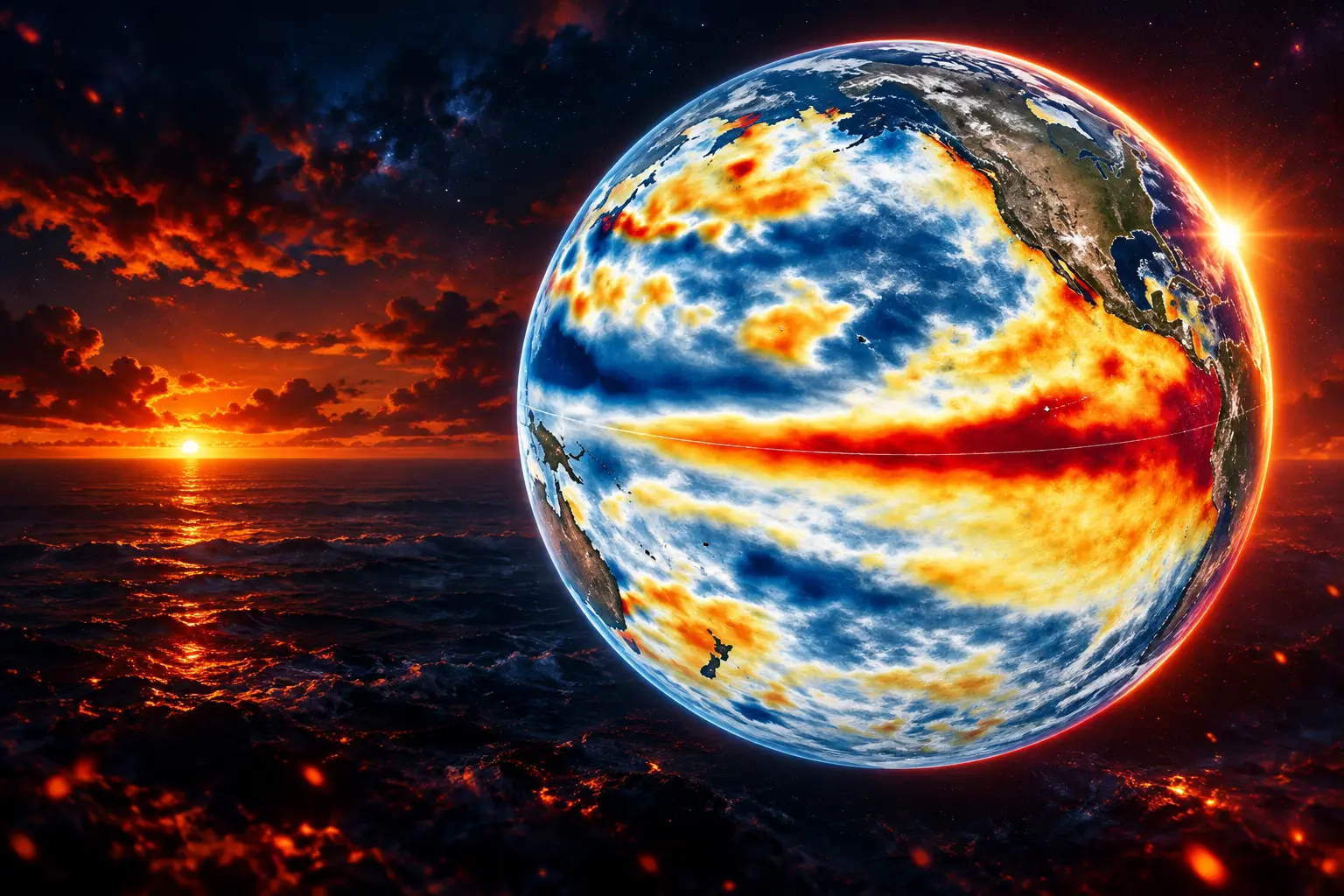
The World Meteorological Organization, in a September 3, 2026 update, said El Niño is firmly established and still strengthening toward a very strong peak late this year. Forecasts from its Global Producing Centres give an exceptionally high, nearly 100 percent chance it lasts into 2027 through February. The agency said it had never issued an El Niño/La Niña update in language that certain.
THE NINO 3.4 READINGS
- May to July 2026: Sea surface temperatures in the central-eastern equatorial Pacific averaged +1.5 °C above normal.
- July 2026: The monthly anomaly reached +2.0 °C.
- Late July to mid-August: Weekly values ran from about +2.2 °C to +2.6 °C.
- Below the surface: Some patches ran more than 8 °C above average in July and early August.
WMO Secretary-General Celeste Saulo said the event can still deliver a heavy blow to communities and economies, and that droughts and floods already under way are expected to worsen as the pattern intensifies. She said that in the organization’s 76-year history it had not launched a mobilization of this scale with national weather services. UN Secretary-General António Guterres called the event “supersized” and said sea surface temperatures keep climbing.
El Niño is a natural Pacific warming, not caused by climate change, and typically arrives every two to seven years. Armel Castellan, extreme heat adviser at the WHO-WMO Climate and Health Joint Programme, said every event is different, and that this one is unique because it is coupled with temperatures that were already breaking records. Knock-on climate effects run well into 2027, including the Southern Hemisphere’s hot season in early 2027.
Tanzania’s Cholera Tail and Brazil’s Dengue Peak
The health map is not a guess. Assaf Anyamba, then a research scientist at NASA’s Goddard Space Flight Center, led a global review of the 2015-16 event, among the top three in strength of the previous 50 years. Changes in rain, land temperature and vegetation lined up with outbreaks far from the equatorial Pacific.
In Tanzania, reported cholera cases in 2015 and 2016 were the second and third highest across an 18-year span from 2000 to 2017. Sewage rode floodwater into untreated drinking sources. Anyamba later said cholera does not flush out quickly, and that the 2015-16 amplification ran on into 2017 and 2018. In Brazil, 2015 dengue reports were the highest from 2000 to 2017. Indonesia and Thailand also logged more dengue than in ENSO-neutral years, as hotter, drier habitat pushed Aedes mosquitoes into towns and water storage jars.
In the American Southwest, plague reports in Colorado and New Mexico peaked in 2015 and hantavirus peaked in 2016, after wetter weather fed rodent hosts. A NASA-linked team had already issued 2015-16 El Niño disease early warnings for Rift Valley fever, cholera and malaria in Africa, dengue in Brazil and Southeast Asia, and plague, West Nile and hantavirus in the Southwest. Many of those alerts verified.
Anyamba put the useful lag at two to three months for mosquito epidemics after the weather shifts. Seasonal forecasts, updated monthly, are enough time to move vaccine, spray, water treatment and clinic stock if the money is there.
In flood-prone cities the pattern is already familiar without a new Pacific index. Heavy rain leaves standing water for Aedes mosquitoes and washes rodent urine into the same streets, which is how dengue and leptospirosis climb after a wet week. A stronger wet season stretches that stretch. A stronger dry season does the opposite harm, pushing families toward stored, unsafe water and skipped meals.
Almost 6 Million Extra Children Went Underweight Last Time
The hunger number from the last very strong event is the one WHO’s 2026 ranking is built to avoid repeating. Jesse K. Anttila-Hughes, Amir S. Jina and Gordon C. McCord, writing in Nature Communications in 2021, combined ENSO intensity from 1986 to 2018 with height and weight from 186 surveys in 51 countries that held 48 percent of the world’s children under five.
Warmer El Niño conditions predicted worse child undernutrition across most of the developing world, and better outcomes only in the few places where the pattern brings extra rain. Weight loss in the event year still showed up later as shorter stature. Their result: almost 6 million additional underweight children during the 2015 El Niño, compared with a neutral Pacific that year.
That is a different population from the 150 million people WHO now counts as already acutely food-insecure, and from the 8.8 million the food agencies asked to cover with early aid. It is the child-level receipt from the last time a very strong event arrived. McCord argued at the time that forecasts already show which places will dry and which will flood months ahead, which is the whole point of spending before harvests fail.
Donors Have Left the 22-Country Food Appeal Almost Empty
On June 18, 2026, the Food and Agriculture Organization and the World Food Programme issued their first joint anticipatory-action appeal, a joint appeal to protect 8.8 million people in 22 high-risk countries, seeking $202 million through March 2027. They said they were already positioned to reach 1.2 million people, and that another $167 million would extend aid to a further 7.6 million.
The package is unglamorous on purpose: cash, drought-tolerant or flood-resistant seed, livestock protection, water storage, flood works, farm advisories and early-warning messages. FAO Deputy Director-General Beth Bechdol said early action is cheaper than rebuilding after a harvest is gone, and that the bottleneck is money before trigger thresholds are crossed.
THE 22 PRIORITY COUNTRIES
- Africa (12): Cameroon, Ethiopia, Kenya, Madagascar, Malawi, Mozambique, Nigeria, Somalia, South Sudan, Sudan, Uganda and Zimbabwe.
- Asia and the Pacific (4): Afghanistan, Pakistan, the Philippines and Timor-Leste.
- Latin America and the Caribbean (6): Colombia, El Salvador, Guatemala, Haiti, Honduras and Venezuela.
Those names overlap the 2015 disease map and the child-undernutrition belt. Kenya, Somalia, Tanzania’s neighbours, the Philippines, Brazil’s Andean and Central American neighbours, and the Horn are the places where a missed planting window becomes a clinic queue.
On September 25, 2026 in Nairobi, Rein Paulsen, FAO’s director of emergencies and resilience, said the agencies had received about $40 million. That is about one-fifth of the $202 million asked for in June, with the Pacific event due to peak between October and December.
We have early warnings. We understand what’s required. Funding is a very real challenge that’s limiting our ability to do what we know can mitigate and minimise the impact of either flooding or droughts.
Rein Paulsen, FAO director of emergencies and resilience, Nairobi
He said the sum is small by international standards, and that spending it now avoids a much more expensive humanitarian response if the full disaster lands. Africa, he said, will be hit hard on top of conflict, displacement and high malnutrition. WHO’s own July analysis had already listed severe humanitarian funding constraints as a reason this event arrives in a more fragile world.
THE WARNING CALENDAR
- June 18, 2026: FAO and WFP open the $202 million appeal for 8.8 million people in 22 countries.
- August 12, 2026: WHO runs an EPI-WIN webinar on El Niño health risks, with Zakaria among the speakers.
- September 3, 2026: WMO says the event will be very strong and is nearly certain to last through February 2027.
- September 5, 2026: WHO posts the global public health situation analysis for El Niño 2026.
- September 22, 2026: Zakaria tells Geneva reporters there is still a window to act.
- September 25, 2026: Paulsen says about $40 million has arrived.
Three months of alerts produced a health ranking, a weather consensus, and a fund that can cover only a slice of the original target. In the 2023-24 El Niño, FAO and WFP said they got early aid to more than three million people before peak impacts. This cycle’s joint appeal was meant to go larger. It has not.
Livestock Vaccines Once Stopped a Rift Valley Fever Wave
The 2015-16 record also includes a success that WHO is, in effect, asking countries to copy. After an alert for Rift Valley fever in East Africa, officials ran a mass livestock vaccination. There is no human vaccine. Field surveys in 2016 found more disease-carrying mosquitoes and no detected human or animal outbreaks. Kenneth Linthicum, a U.S. Department of Agriculture entomology lab director and a co-author of the NASA-led study, said vaccinating livestock likely prevented thousands of human cases and animal deaths.
William Karesh of EcoHealth Alliance called those seasonal forecasts a tool for vaccinations, pest control and clearing stagnant water, and said agriculture ministries in Africa and Asia still treat the forecasts as new. The 2026 playbook WHO is handing governments is the same list: stock oral cholera vaccine and rehydration salts, keep measles campaigns from stalling when roads flood, spray and dump standing water, shade outdoor workers, and keep clinics open when heat and displacement spike.
That is not novel. It failed to travel in 1997-98 and only partly travelled in 2015-16, except where a livestock campaign was funded in time. The Pacific is already in very strong territory. The peak is still ahead. The $202 million appeal is the cheapest version of the lesson, and about $40 million of it is in the door.
Disclaimer: This article is news reporting and analysis of public health and climate statements. It is for information only and is not medical advice, a diagnosis, or a treatment plan for heat illness, cholera, dengue, malaria or any other condition. It is also not a donation appeal or a forecast of any person’s risk. Readers who need care, vaccines, or travel or occupational guidance should speak with a qualified physician or local public health authority. Figures, outbreak counts, funding totals and El Niño intensity readings reflect the agency and research sources cited and can change as the event evolves through 2027.

MLB and the Union Will Not Extend the Labor Deal

Amazon Found PHP2Shell Probes Four Days Before the Patch

Brent Clears $117 After Gulf Crude Already Came Back

Chipmakers Took the Nasdaq Hit After Meta Burned Cash

Netflix Scored Its 2026 Series as Flops Against Home Runs

Rolex Made Drake the Daytona It Fights Jewelers Over

Treasury’s First Iran Bank Shot Lands on an Ally

Instinct’s $2.5 Billion Raise Still Binds the User as Agent

City’s £125m Enzo Deal Caps a £327m Midfield Rebuild

CSIRTs Inherit Europe’s Missing security.txt Before Article 14
-
 ENTERTAINMENT2 months ago
Rolex Made Drake the Daytona It Fights Jewelers Over
-
 BUSINESS2 months ago
Treasury’s First Iran Bank Shot Lands on an Ally
-
 NEWS2 months ago
Instinct’s $2.5 Billion Raise Still Binds the User as Agent
-
 NEWS2 months ago
City’s £125m Enzo Deal Caps a £327m Midfield Rebuild
-
 NEWS2 months ago
CSIRTs Inherit Europe’s Missing security.txt Before Article 14
-

 BUSINESS2 months ago
Berkshire Anchors Alphabet’s Record Raise With a $10 Billion Check
-

 NEWS2 months ago
Meta’s Teen Settlement Leaves Chat Off the Clock
-

 ENTERTAINMENT2 months ago
Ricky Gervais Wants Alley Cats to Run Until He Dies