
NEWS
Bessent Hails a US-China AI Dialogue Built by Trade Hands
Treasury and USTR proposed a US-China AI dialogue after eight hours in New York, while Beijing’s readout skipped AI and chip controls stayed off the table.

Treasury Secretary Scott Bessent called Sunday’s China talks “very successful” and proposed a US-China AI dialogue for the Trump-Xi meeting on September 24.
The session ran about eight hours at JPMorgan Chase headquarters in New York with Vice Premier He Lifeng and US Trade Representative Jamieson Greer. China’s chief trade negotiator, Li Chenggang, joined. Export controls on advanced AI chips stayed off the agenda.
The AI File Sat With Treasury, Not the Labs
The people across the table were the same trio that has carried the trade file from city to city since 2025. Bessent and Greer sat for the United States. He Lifeng, who oversees China’s economy, sat for Beijing. A senior administration official had already described the pairing in blunt terms: Bessent and Greer are “the point guys on China.”
Commerce Secretary Howard Lutnick had led the public AI talk at the G20 gathering in North Carolina. The China channel still ran through Treasury. That is not an accident of scheduling. The White House wanted a deliverable that could travel with soybeans, magnets, and tariffs into a presidential meeting, and it sent the men who already bargain those files.
Bessent posted from New York before the session closed, framing the day as trade work that would “lay the groundwork” for President Donald Trump and “deliver results for the American people.”
In New York City, Vice Premier He Lifeng and I are continuing our discussions on the U.S.-China economic and trade relationship ahead of @POTUS’ historic summit with President Xi in Washington. These talks help lay the groundwork for President Trump to advance America’s economic… pic.twitter.com/phmF11Aoxi
— Treasury Secretary Scott Bessent (@SecScottBessent) September 20, 2026
He has put semiconductors, AI, and critical minerals on the same statecraft list as shipbuilding and drugs. Sunday followed that map. Rare-earth magnets, the November trade pause, and model weights were treated as one negotiation, even when the public line split them into separate rooms.
Rep. Ro Khanna, the ranking Democrat on the House select committee on strategic competition with China, had said an AI deal should be “the first agenda item” when Trump meets Xi Jinping, including a ban on recursive self-improving systems and checks against biological and nuclear misuse. The New York draft was narrower. It was a channel, not a rulebook.
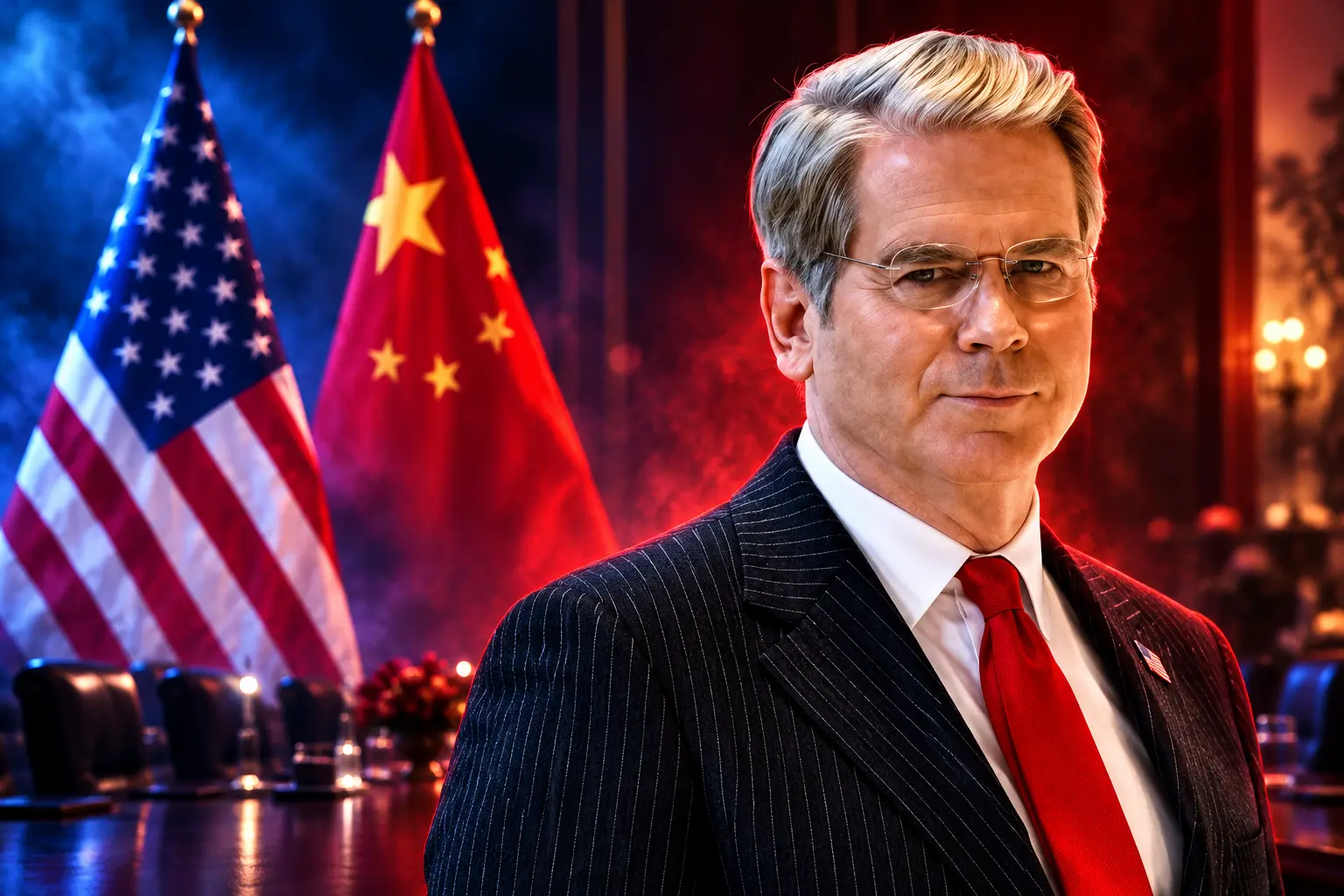
What the Proposed Notification Mechanism Would Cover
Bessent told reporters the United States had proposed a notification system for AI incidents that rise to a national-security level, under a body he said would be called the US-China AI dialogue. The two sides, he said, wanted “a shared vision of common goals and common threats,” and they had agreed to meet again.
THE PROPOSED CHANNEL
- The name: Bessent said the body would be called the US-China AI dialogue.
- The trigger: Alerts would fire when an AI incident reaches national-security level, not on every lab mishap.
- The aim: Move the two largest AI powers from opacity toward a way to talk about shared goals and shared threats.
- The models: Bessent said he expected the talks to cover both open-weight and closed-weight systems.
- The carve-out: Greer said export controls on sophisticated AI chips and semiconductor manufacturing equipment were not on the agenda.
- The next step: Li Chenggang said a working group would continue on Monday, September 21, and Trump and Xi are due to take the file on September 24.
The design copies the logic of a crisis hotline. Each capital would have a number to call when a model incident looks like a security event. It would not set joint tests, shared inspectors, or a pace for training runs. It also would not touch the hardware ban that Chinese labs actually feel.
Trump and Xi first discussed AI consultations during Trump’s state visit to Beijing on May 13-15. That forum was never stood up. Sunday was the attempt to put a name and a task on the idea before the return visit.
Beijing’s Readout Never Named Artificial Intelligence
He’s team left the building without speaking to reporters. The official English account from Xinhua described consultations on economic and trade issues and did not name the AI channel Bessent had just advertised. The dispatch called the exchanges “candid, in-depth and constructive,” guided by prior head-of-state consensus, and stopped there.
That gap is the tell. Washington needed an AI line it could walk into the White House. Beijing needed a day that looked like trade implementation. Both can be true in the same room. Only one side led with model safety when the microphones came on.
We think that, just like with any cross-border activity, that moving from opaque to more transparency between the number one and the number two AI powers in the world is very important.
Scott Bessent, Treasury Secretary, to reporters in New York
China’s foreign ministry had already pushed a different formula, calling for “open and inclusive development of AI for good and for all” and warning against “fear-mongering” after US lab chiefs asked for a slower race. President Trump, on September 14, called claims that AI will destroy humanity a “HOAX” and wrote that “WHOEVER WINS AI, WINS.” A notification channel lets both governments look cooperative without accepting the slowdown either capital has rejected.
Sunday’s Talks Left Chip Controls Untouched
Greer said the AI discussion would not affect US export controls on advanced chips and the tools that make them. That sentence is the floor under the day’s praise. The dialogue can exist because it does not bargain the restriction Beijing most wants lifted.
A senior US official had told reporters on Friday that China’s delivery of rare-earth magnets and other critical minerals “has not been up to par,” and that shortfall would be on the table before the presidents meet. Magnets and chip tools sit in the same physical stack. One side wants rocks and refined metal to move. The other wants high-end silicon to stay put. Sunday’s AI text did not trade one for the other.
Chinese open-weight systems have become cheaper for some US firms than closed US tools from houses such as Anthropic and OpenAI. Even so, Chinese models on public benchmarks can look close to US leaders while Chinese labs still hold only a sliver of global training compute. The visible scoreboard and the hardware stock are different fights. Greer’s carve-out keeps them that way.
Bessent’s own pre-talks line was that the United States “remains the leader in AI” and is open to talks on “avoiding shared risks and avoiding bifurcation of our two systems.” Bifurcation is already the business model for export control. A hotline does not reverse it. It tries to keep the two stacks from colliding in the dark.
November 10 Is the Date That Still Binds Both Sides
The AI proposal is the new label. The clock that can still blow up the relationship is older. A truce struck in Busan, South Korea, on October 30, 2025, after tariffs on both sides had run to triple-digit rates, is set to expire on November 10, 2026. Greer said Sunday’s talks were meant to prepare a “successful summit.” He also said the two sides had turned earlier ideas of a Board of Trade and AI talks into concrete work.
China’s commerce ministry, through spokesperson Huang Ling on September 10, said the teams were negotiating a reciprocal tariff-cut framework covering $30 billion of products from each side. In May, officials described Chinese pledges to lift US farm purchases by $17 billion a year and to buy more than 200 Boeing aircraft. MOFCOM said on July 27 that Washington had committed that replacement additional tariffs on Chinese goods would not exceed 20%. A separate 12.5% duty, restored after the Supreme Court struck down emergency tariffs, now sits on Chinese goods over forced-labor findings.
THE LIVE TRADE FILE
| File | What officials say is in play | Bound to |
|---|---|---|
| Trade truce | Pause on extra tariffs and some control steps | Expires November 10, 2026 |
| Replacement extra tariffs | Political cap, not to exceed 20% | MOFCOM statement, July 27 |
| Forced-labor duty | 12.5% tariff restored after the court ruling | In force |
| Board of Trade | Reciprocal cuts on non-sensitive goods | $30 billion each side |
| Farm purchases | Extra US farm buys pledged in May | $17 billion a year |
| Aircraft | Boeing orders pledged in May | More than 200 planes |
| Critical minerals | Restore magnet and rare-earth flows | US says volumes are short |
| AI dialogue | National-security incident alerts | Proposed for September 24 |
USTR in June asked industry which Chinese imports should get tariff relief under the Board of Trade, with comments due July 10. Older Section 301 tariffs still in force remain on large parts of the goods trade. The Board is the attempted bypass: a managed slice of “non-sensitive” commerce that can be cut without touching chips, aviation electronics, or other red-line goods.
Anna Ashton, a China trade analyst who runs Ashton Intelligence, said before the session that a presidential meeting would probably produce “some show of deliverables” and that “status quo is probably both sides’ general best expectation.” Sunday fit that forecast. An AI name, a Board of Trade that is now said to be in operation, and no signed truce extension.
Open-Weight Models Already Circulate Among US Firms
Bessent said the New York discussion would cover open-weight models, whose core elements can be downloaded and tuned, and closed-weight models, whose internals stay inside the lab. Chinese open-weight systems have been winning some US buyers on price. That is a market fact sitting inside a security talk, and it explains why Treasury, not a standards agency, was in the chair.
If American companies already run Chinese weights, a split between two AI worlds is not a future risk. It is a procurement choice. Bessent’s “avoiding bifurcation” line is an attempt to keep those weights inside a conversation with Beijing rather than treating every download as a hostile act. The notification idea follows. If a model incident hits infrastructure, the two governments would have a path that does not start with a press leak.
Guardrails, as Bessent has described them, are aimed at keeping powerful models away from “malign non-state actors.” That is a terrorism and crime frame, not an arms-control frame. It is also a frame China can accept in principle, because it does not require Beijing to slow its own labs. The harder ask, a joint limit on frontier training, is the one both presidents have already declined in public.
Reports of security breaches involving AI models were on the pre-talks list, alongside the Iran war and investment rules. None of that produced a public annex on Sunday. The only AI product that left the building was the dialogue itself.
A Line the Presidents Can Sign on September 24
Trump is due to host Xi at the White House on September 24, Xi’s first state visit to Washington in more than a decade, with Greer describing summit work across Thursday and Friday. He’s delegation is in the United States from September 19 to 23 and includes Chinese companies, a mirror of the US chief executives who flew to Beijing in May.
THE ROAD TO THE WHITE HOUSE
- October 30, 2025: Trump and Xi strike a one-year trade truce in Busan after tariffs on both sides had reached triple-digit rates.
- May 13-15, 2026: Trump visits Beijing. The two sides discuss AI consultations that are never formalized, agree to a Board of Trade and a Board of Investment, and announce farm and aircraft pledges.
- June 2, 2026: USTR opens a public comment process on which non-sensitive Chinese goods could see tariff cuts under the Board of Trade.
- September 10, 2026: MOFCOM’s Huang Ling says the two sides are negotiating a $30 billion reciprocal cut on each side.
- September 14, 2026: Trump calls claims that AI will destroy humanity a hoax and says whoever wins AI wins.
- September 20, 2026: Bessent, Greer, He, and Li spend about eight hours at JPMorgan’s Manhattan headquarters. Washington proposes the US-China AI dialogue.
- September 24, 2026: Trump hosts Xi in Washington, with the AI channel, the Board of Trade, minerals, and the November 10 truce all still in front of them.
He Lifeng and Li Chenggang left JPMorgan without taking questions. The AI dialogue now sits on the presidents’ table on September 24, beside a trade truce that runs out on November 10.

MLB and the Union Will Not Extend the Labor Deal

Amazon Found PHP2Shell Probes Four Days Before the Patch

Brent Clears $117 After Gulf Crude Already Came Back

Chipmakers Took the Nasdaq Hit After Meta Burned Cash

Netflix Scored Its 2026 Series as Flops Against Home Runs

Rolex Made Drake the Daytona It Fights Jewelers Over

Treasury’s First Iran Bank Shot Lands on an Ally

Instinct’s $2.5 Billion Raise Still Binds the User as Agent

City’s £125m Enzo Deal Caps a £327m Midfield Rebuild

CSIRTs Inherit Europe’s Missing security.txt Before Article 14
-
 ENTERTAINMENT2 months ago
Rolex Made Drake the Daytona It Fights Jewelers Over
-
 BUSINESS2 months ago
Treasury’s First Iran Bank Shot Lands on an Ally
-
 NEWS2 months ago
Instinct’s $2.5 Billion Raise Still Binds the User as Agent
-
 NEWS2 months ago
City’s £125m Enzo Deal Caps a £327m Midfield Rebuild
-
 NEWS2 months ago
CSIRTs Inherit Europe’s Missing security.txt Before Article 14
-

 BUSINESS2 months ago
Berkshire Anchors Alphabet’s Record Raise With a $10 Billion Check
-
 NEWS2 months ago
Meta’s Teen Settlement Leaves Chat Off the Clock
-

 ENTERTAINMENT2 months ago
Ricky Gervais Wants Alley Cats to Run Until He Dies