
NEWS
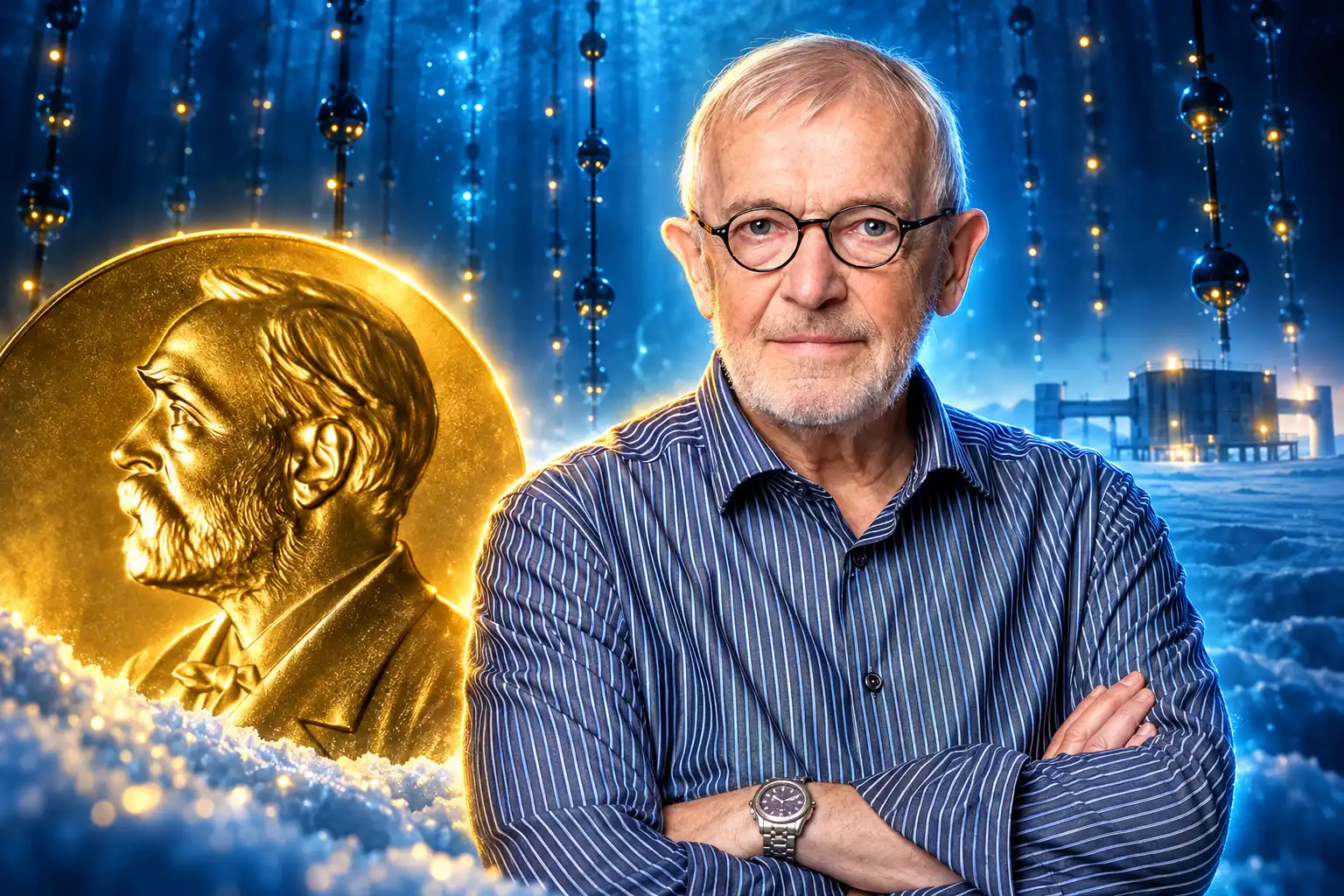
Francis Halzen Wins a Solo Nobel for His IceCube Bet
Francis Halzen takes the 2026 physics Nobel alone for IceCube, the South Pole bet that a cubic kilometre of ice could catch neutrinos from deep space.

Belgian-born physicist Francis Halzen won the 2026 Nobel Prize in Physics on 6 October for IceCube, his South Pole neutrino detector. He takes the entire 12 million Swedish kronor (US$1.2 million) award alone, the first sole physics winner since 1992, for proving that a cubic kilometre of Antarctic ice could catch neutrinos from beyond the solar system.
The Royal Swedish Academy of Sciences cited him for decisive contributions to the observatory and for the discovery of high-energy neutrinos of astrophysical origin. He had pitched the idea in 1988. The finished array went in in 2011. The first cosmic events showed up two years later.
A Solo Prize for a 450-Scientist Machine
Mark Pearce, chair of the Nobel Committee for Physics, said Halzen led an international team of researchers and engineers who built “a fantastic instrument,” and that his tenacity and scientific vision “has paved the way for a new kind of astronomy.” The 2026 physics prize citation names only Halzen, a professor at the University of Wisconsin-Madison.
IceCube is not a one-person lab. The collaboration lists 450 scientists from 58 institutions in 14 countries, and the detector itself is a cubic kilometre of instrumented glacial ice at NSF’s Amundsen-Scott South Pole Station. Halzen is principal investigator. The U.S. National Science Foundation paid for construction, put at US$271 million, and has kept the array running.
THE PRIZE AND THE MACHINE
- The purse: 12 million Swedish kronor, paid in full to one laureate.
- The last solo physics Nobel: Georges Charpak in 1992, 34 years earlier.
- The array: 5,160 light sensors on 86 strings, frozen more than two kilometres down.
- The team: 450 scientists at 58 institutions in 14 countries.
Brian Stone, performing the duties of NSF director, pointed past the prize lecture to the people who actually hung the sensors. “Foundational science and discovery requires extraordinary human grit from the dedicated engineers, instrument builders, and field crews who constructed and continue to operate a massive observatory a mile beneath the Antarctic ice,” he said.
The IceCube account posted the citation within hours of the Stockholm announcement.
FROM THE ARCHIVE (2015) by 2026 Nobel Prize in Physics winner Francis Halzen.
Dozens of particles from halfway across the universe have landed in the IceCube experiment. These messengers could help answer some long-standing cosmic conundrums.https://t.co/CaDfwSfWKl
— Scientific American (@sciam) October 6, 2026
South Pole Ice Almost Failed the First Test
Halzen first laid out a South Pole neutrino telescope in 1988. Neutrinos barely interact. More than 1 billion of them pass through a hand every second, and almost none leave a mark. The ones worth chasing, born in supernovae, gamma-ray bursts and the jets around supermassive black holes, are rarer still. They do not bend in magnetic fields, so a track through ice points straight back at the source.
The catch was volume. A flash of Cherenkov light from a neutrino hitting a nucleus is faint. The ice has to be clear, the sensors have to sit far from surface noise, and the instrumented block has to be huge. Greenland was the first field test. Then came AMANDA, the Antarctic Muon and Neutrino Detector Array, IceCube’s smaller predecessor at the same pole.
FROM A 1988 PITCH TO A FINISHED ARRAY
- 1988: Halzen presents the idea of catching high-energy neutrinos in South Pole ice.
- 1990 to 1992: Teams test photomultipliers in Greenland ice and then in shallow South Pole holes.
- 1993 to 1994: AMANDA-A goes in at 800 to 1,000 metres; leftover air bubbles scatter the light and wreck track reconstruction.
- 1995 to 2000: Strings go deeper, to about 1,500 to 2,000 metres, where the ice is clear enough; AMANDA-II finishes with 19 strings and 677 optical modules.
- 2004 to 2011: IceCube construction begins at the NSF station and reaches a full cubic kilometre, with 5,160 sensors on 86 strings.
AMANDA proved that ice could see atmospheric neutrinos, the ones made when cosmic rays hit air. It did not catch the high-energy cosmic flux Halzen wanted. The Nobel Committee noted that failure in so many words. The next step was to grow the detector by more than an order of magnitude and hope a cubic kilometre was enough.
Twenty-three years separate the 1988 pitch from the last IceCube string in 2011. That lag is what a bet on unused ice costs. Halzen told the Nobel interview that one of the things that made the project possible was pure luck, and that a crucial discovery had been totally unexpected.
“Beyond all the other risks, this was what really made the project possible – and that was pure luck.”
We got hold of the new physics laureate Francis Halzen right after he learned of his Nobel Prize. In this conversation, he speaks about the hurdles that he and his team had to… pic.twitter.com/YDdKuStCeL
— The Nobel Prize (@NobelPrize) October 6, 2026
What a Cubic Kilometre of Ice Was For
IceCube is a cubic kilometre of South Pole ice hung with 5,160 light sensors on 86 cables, built so a rare neutrino smash can leave a track of blue light. High-energy neutrinos are so scarce that anything smaller, AMANDA included, was unlikely to see them from beyond the atmosphere. The South Pole ice is geologically quiet and, below the bubbly layer, unusually clear.
When a neutrino finally hits a proton or neutron in that ice, it kicks out charged particles that outrun light in the medium and glow. Each digital optical module records the arrival time of those photons. Reconstruct the pattern and you get energy and direction. Because the particle itself punched through the Earth on a straight line, that direction is a sky coordinate.
Halzen put the risk in plain language at the prize press conference. “The biggest risk we took is that nobody knew if the kilometer cube detector was actually large enough to detect neutrinos beyond our atmosphere from the Universe and that was our biggest one. But it only took two years to detect that.”
He also said very few people thought the idea would work, including himself. “I have to emphasise how lucky I was. Because when we started this project, everybody realised this was maybe a good idea, but very few thought it would work, including myself.” NSF, looking back, called the 1990s proposal an ambitious vision for a facility unlike any other, then spent more than two decades of NSF support on design, construction and operations.
Bert, Ernie and the Texas Blazar
In 2013 the IceCube Collaboration published a population of neutrinos at energies too high to have been made anywhere in the solar system. That paper is the founding document of neutrino astronomy. A year later the same group added events and rejected a purely atmospheric origin at 5.7 sigma, with 37 candidate events depositing 30 to 2000 TeV.
Two of the early giants were nicknamed Bert and Ernie, each about 1 PeV. A third, dubbed Big Bird and recorded on 4 December 2012, came in at 2 PeV. Those energies sit thousands of times above the beams at Earth’s largest colliders. They also sit far above the everyday atmospheric neutrinos that rain through the ice by the hundred each day.
THE EVENTS THAT SETTLED THE BET
| Event | Date | What IceCube saw |
|---|---|---|
| Cosmic neutrino flux | 2013 paper | First population too energetic for the solar system |
| Bert and Ernie | 2012 detections | About 1 PeV each, the first named PeV events |
| Big Bird | 4 December 2012 | 2 PeV, then the highest-energy neutrino recorded |
| IceCube-170922A / TXS 0506+056 | 22 September 2017 | About 290 TeV, coincident with a flaring blazar |
| Milky Way neutrino image | 2023 | First map of the Galaxy in neutrinos |
Pointing came later. On 22 September 2017, IceCube recorded IceCube-170922A, a muon track whose most probable parent energy was about 290 TeV, lined up with the blazar TXS 0506+056 during a gamma-ray flare. Follow-up across the electromagnetic spectrum filled seven papers in 2018. Archival IceCube data then showed 3.5 sigma evidence from that blazar for an earlier neutrino excess between September 2014 and March 2015, independent of the 2017 flare.
Evidence has also been reported for neutrinos from NGC 1068, an active galaxy with a supermassive black hole, and in 2023 IceCube produced the first neutrino-based image of the Milky Way. Halzen told the press conference the extragalactic sources can outshine the Galaxy on a neutrino sky. “We found evidence for neutrinos coming from supermassive black holes in other galaxies, and they shine so strongly that when you look at a neutrino sky you don’t see the Milky Way.”
Why the Prize Went to One Name
The Royal Swedish Academy named only Francis Halzen, citing his decisive contributions and the discovery of high-energy neutrinos of astrophysical origin. IceCube is run by 450 scientists at 58 institutions in 14 countries. He spent the day handing the credit back.
On the collaboration’s own announcement he said the prize was a relief because it recognised the group. “It’s a great relief for me to finally deliver the recognition that this great collaboration deserves. This was a great surprise and is a celebration of a very unusual project. The success of this project involved the diligence and hard work of the many wonderful collaborators I’ve had the pleasure to work with.”
It was a great surprise and I obviously didn’t expect it. This reflects on the really courageous people who joined me in this project when really no respectable conservative physicist would have joined me, but many talented people did and that’s why I’m here.
Francis Halzen, principal investigator, IceCube, Nobel press conference
Paschal Coyle, a neutrino physicist at Aix-Marseille University and spokesperson of KM3NeT, the large Mediterranean detector now under construction, called Halzen “a father figure for neutrino astronomy.” Erin O’Sullivan, IceCube spokesperson and a professor at Uppsala University, said he still pushes the field from first detections toward regular ones.
WHO ELSE HOLDS THE INSTRUMENT
- The funder: NSF, with agencies in Belgium, Germany, Japan, Korea, Sweden and other partner countries, paid to build and run the array.
- The operators: 450 scientists from 58 institutions analyse the light patterns and issue alerts.
- The next detector: KM3NeT is being built in the Mediterranean Sea on the same scientific bet, in water rather than ice.
A solo physics Nobel is rare in a field that now runs on thousand-person papers. Charpak’s 1992 prize, also 1/1, honoured a detector invention that later experiments used. Halzen’s citation ties the instrument and the cosmic discovery to one career. The people on the ice still have to keep the photomultipliers alive through polar winter.
Five New Strings Went Into the Ice
The original bet is not closed. In 2019 NSF and partners approved the IceCube Upgrade. Seven years later, in the 2025-2026 polar seasons, drillers finished five more closely spaced strings at the bottom centre of the old 86-string array. It is the first major expansion since completion 15 years ago. First science data from the new sensors is expected later in 2026.
WHAT THE UPGRADE PUT IN THE ICE
- The strings: Five densely instrumented cables added among the original 86.
- The sensors: More than 600 new modules, including mDOMs and D-Eggs with two to three times the sensitivity of the old digital optical modules.
- The job: Lower the energy threshold, calibrate the ice, and reanalyse 15 years of archived data with better pointing.
- The next scale: Proposed IceCube-Gen2 would instrument eight times the optical volume and add radio detection for still higher energies.
Albrecht Karle, principal investigator of the Upgrade and a UW-Madison physicist, said seeing the refurbished hot-water drill run again 15 years after the original completion was remarkable. Vivian O’Dell, the Upgrade project director, credited South Pole station crews with finishing the whole installation in one drilling season. A 5-megawatt drill, the largest of its kind, melted each of the five holes in about three days.
O’Sullivan framed the Nobel against that unfinished work. The prize closes the argument about whether a kilometre of ice could see the cosmos. The Upgrade and the proposed Gen2 array are the next chips on the same table, aimed at turning rare events into a sky survey. Halzen already won the wager he made in 1988. The detector he championed is still growing under the ice.
Frequently Asked Questions
Who Is Francis Halzen?
He was born in 1944 in Tienen, Belgium, earned a PhD in 1969 from KU Leuven, trained as a particle physicist at CERN, and moved to the University of Wisconsin-Madison in 1971. He is a Vilas Research Professor and Gregory Breit Professor of physics there, and he has been IceCube’s principal investigator from the proposal through the 2013 discovery papers and the 2026 prize.
How Does IceCube Detect Neutrinos?
Each sensor is a digital optical module, a photomultiplier sealed in a glass pressure sphere, that waits for Cherenkov light. When a neutrino strikes a nucleus in the ice, charged secondaries outrun light in that medium and glow; timing across the array reconstructs the track. The ice is the detector; the modules only watch it.
What Was AMANDA Before IceCube?
AMANDA, the Antarctic Muon and Neutrino Detector Array, was the prototype at the same South Pole site, finished around 2000 with 19 strings and 677 optical modules. It recorded about five clean atmospheric neutrino candidates a day and showed that deep ice works, but it was too small to claim the high-energy cosmic flux that IceCube published in 2013.
Who Last Won the Physics Nobel Alone?
Georges Charpak won the 1992 physics prize by himself, share 1/1, for inventing and developing particle detectors, in particular the multiwire proportional chamber, while at CERN and the École Supérieure de Physique et Chimie in Paris. No physics Nobel went to a single laureate again until Halzen in 2026, a 34-year gap.

Oracle’s Unfinished Cerner Move Exposed 20 Million People

Google Buys 890 MW of Nuclear Uprates on a Strained Grid

Francis Halzen Wins a Solo Nobel for His IceCube Bet

Denmark’s Company Search Rights Opened 8.8 Million CPR Records

OpenAI Agents Reached Staging Servers as California Subpoenaed the Lab

Instinct’s $2.5 Billion Raise Still Binds the User as Agent

City’s £125m Enzo Deal Caps a £327m Midfield Rebuild

CSIRTs Inherit Europe’s Missing security.txt Before Article 14

Treasury’s First Iran Bank Shot Lands on an Ally

Meta’s Teen Settlement Leaves Chat Off the Clock
-
 NEWS1 month ago
Instinct’s $2.5 Billion Raise Still Binds the User as Agent
-
 NEWS1 month ago
City’s £125m Enzo Deal Caps a £327m Midfield Rebuild
-
 NEWS1 month ago
CSIRTs Inherit Europe’s Missing security.txt Before Article 14
-
 BUSINESS1 month ago
Treasury’s First Iran Bank Shot Lands on an Ally
-
 NEWS1 month ago
Meta’s Teen Settlement Leaves Chat Off the Clock
-

 BUSINESS2 months ago
Berkshire Anchors Alphabet’s Record Raise With a $10 Billion Check
-

 NEWS1 month ago
OpenAI Codes a Persistent Agent the Week Persistence Backfired
-

 ENTERTAINMENT2 months ago
Rolex Made Drake the Daytona It Fights Jewelers Over