
BUSINESS
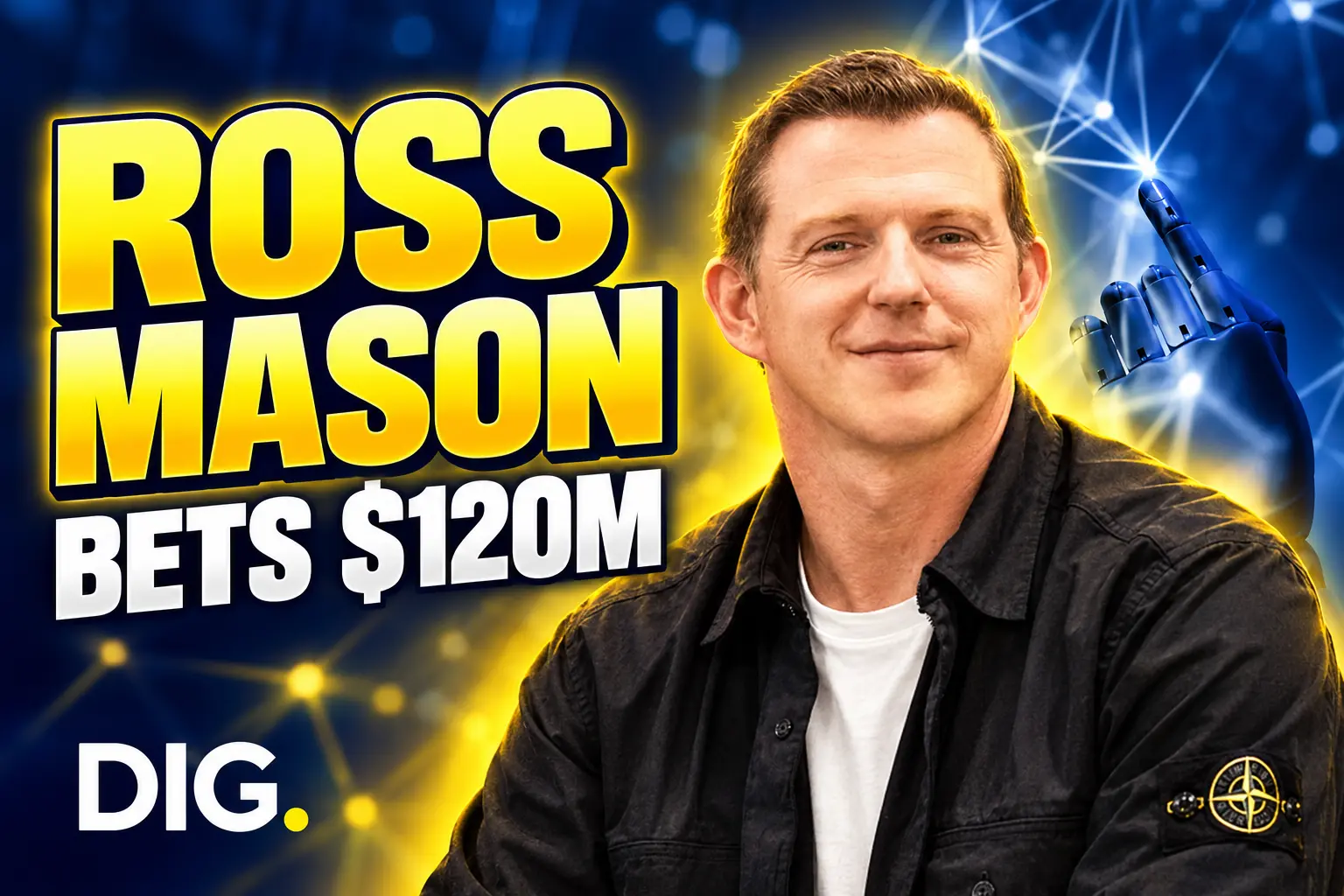
Ross Mason Bets $120 Million on AI’s Hidden Pipes
DIG Ventures closed a $120 million Fund III on Ross Mason’s bet that AI will make apps cheap and the pipes underneath them scarce.

DIG Ventures closed a $120 million third fund on October 1, 2026, to back early European companies that sell the pipes under AI software. Founding partner Ross Mason is putting the vehicle behind a blunt idea: as AI makes code cheaper to write, product features stop being a moat, and the lasting firms are the ones other software has to rent.
The London firm plans to back about 30 European companies at pre-seed and seed, lead most of those rounds, and has already started deploying. The interesting layer is not the model labs soaking up giant cheques. It is data plumbing, identity, compliance and orchestration, the unglamorous kit every AI-native app still has to buy.
Mason Says Differentiation Will Erode as Code Gets Cheap
Mason’s Fund III thesis is a warning dressed up as a shopping list. If writing software keeps getting faster and cheaper, he argues, lookalike products will multiply and the companies that scale will be the ones other products sit on. DIG says that points to four control points: data, identity, compliance and orchestration.
Our conviction as a fund is clear: as development accelerates and differentiation erodes, the truly scalable, defensible companies will be the ones building the foundations on which wider enterprise software depends. These are the companies whose advantages compound as the cost of building software falls.
Ross Mason, founding partner, DIG Ventures
That is a bet against a large slice of the current AI startup wave, the tools that demo well and can be rebuilt by a rival with a weekend and a good model. DIG wants the layer those tools still call when they need to store data, prove who a user is, stay inside a rulebook, or chain work across systems.
THE FOUR LAYERS DIG IS BUYING
- Data: Platforms that move, govern and serve the information AI products consume, rather than the chat windows on top.
- Identity: Workload and user identity tools that decide what software, and which agents, are allowed to act.
- Compliance: Regulatory and decision systems banks, insurers and other regulated firms cannot skip even when models get cheaper.
- Orchestration: Software that sequences models, tools and workflows so an AI feature can run in production, not just in a demo.
Fund III is already writing cheques against that list. DIG intends to lead most rounds, which at pre-seed and seed in Europe usually means setting the terms rather than tagging along on someone else’s.
The Pipe Layer That Salesforce Bought for $6.5 Billion
Mason has sold this kind of company before. He founded MuleSoft, the integration platform that connected enterprise apps, data and devices, and took it from a technical open-source project to IPO before Salesforce agreed in March 2018 to buy it for an approximately $6.5 billion enterprise value. Salesforce completed the deal on May 2, 2018.
MuleSoft was never the customer-facing app. It was the connective tissue other software needed as companies piled on SaaS tools they could not stitch together. Mason’s Fund III argument is that AI is creating a second version of that mess: lots of software, written faster, with less to distinguish one product from the next, and more need for a shared floor underneath.
He started DIG in 2018 after a decade in Silicon Valley, first as a family office, with Melissa Klinger. Klinger had been an early commercial hire as MuleSoft expanded in the UK, working sales, customer success and strategy through the IPO and the Salesforce sale. She now specialises in helping technical founders build go-to-market teams. General partner Rytis Vitkauskas, a former Lightspeed partner who co-founded YPlan, joined that operator bench.
FROM MULESOFT TO FUND III
- March 20, 2018: Salesforce agrees to buy MuleSoft for about $6.5 billion.
- May 2, 2018: Salesforce completes the MuleSoft purchase.
- 2018: Mason founds DIG Ventures in Europe with Klinger, first as a family office.
- April 2025: DIG closes Fund II, its first institutional vehicle, at $100 million.
- March 23, 2026: Dash0, a Fund II company, raises a $110 million Series B at a $1 billion valuation.
- June 1, 2026: Admiral Group completes its purchase of Flock.
- June 24, 2026: Taktile, another Fund II company, raises a $110 million Series C.
- October 1, 2026: DIG closes Fund III at $120 million.
The parallel is tidy, and it is also incomplete. MuleSoft went public and then sold into the largest software platform of its era. Fund III is a seed vehicle. Most of the companies it backs will never see a $6.5 billion headline. The wager is that a few of them become the next pipes, not the next chat apps.
Fund III Will Lead Most of About 30 Seed Bets
At $120 million, Fund III is a step up from the $100 million Fund II, which DIG calls its first institutional vehicle. DIG says that earlier fund sits in the top decile globally for its vintage and size on Carta TVPI and IRR figures. That is the firm’s own reading of the Carta tables, not a public ranking the rest of the market has to accept.
FUND III TERMS
- The size: $120 million, closed on October 1, 2026.
- The plan: About 30 European companies at pre-seed and seed.
- The role: DIG intends to lead most rounds and has already started deploying.
- The geography: Fund III is aimed at European founders, with help to reach first US customers.
Institutional backers named by DIG include Horsley Bridge, Sofina, Hillman, Granite and a leading US university endowment. The mix matters. Horsley Bridge and a US endowment putting money into a London seed firm is a vote that European technical founders can still be underwritten from California and the East Coast, if someone on the ground will drag them through US sales.
On paper the cheque book is modest next to the billion-dollar rounds still landing on compute clusters and model labs. That is the point of a pre-seed and seed fund, not an accident. DIG is trying to own the first institutional round in companies that, if Mason is right, become expensive to rip out later.
A Unicorn, a Goldman Round and Three Exits
Fund III is easier to take seriously because Fund II already produced the kind of companies Mason says he wants. Dash0, an OpenTelemetry-native observability platform founded in Germany in 2023 and based in New York, raised a $110 million Series B at a $1 billion valuation on March 23, 2026. Balderton Capital led. DIG stayed in, as did Accel and Cherry Ventures.
On that announcement, Mason said DIG had watched Dash0 execute “with rare precision since day one” and that “tripling down on this team isn’t a difficult decision; it’s an obvious one.” Dash0 is the cleanest exhibit for the thesis: it sells the operations layer other software runs on, and it is going after incumbents on price and lock-in rather than launching another writing assistant.
Taktile sits one layer over, in the decisions regulated firms still make by hand. On June 24, 2026, Goldman Sachs Alternatives led Taktile’s round, a $110 million Series C, with DIG among the existing investors who joined. Taktile’s software is built for banks and insurers that want AI agents on underwriting, claims and financial crime without giving up control of the outcome.
FUND II MARKERS DIG IS CITING
| Company | Layer | Latest mark |
|---|---|---|
| Dash0 | Observability | $110 million Series B at $1 billion, March 23, 2026 |
| Taktile | Decisioning for banks and insurers | $110 million Series C led by Goldman Sachs Alternatives, June 24, 2026 |
| CUBE | Regulatory technology | Used by more than 30 global financial institutions |
| Flock | Insurance infrastructure | Admiral Group, £80 million equity, completed June 1, 2026 |
| Tower | Data infrastructure | Acquired by MotherDuck |
| Cofide | Workload identity | Acquired by Keyfactor |
Other Fund II names DIG puts on the same shelf include Jack & Jill, an AI HR platform, and Nexos.ai, an AI orchestration company started by founders from Nord Security. The exits are smaller than the live marks. Admiral Group said the equity in Flock at £80 million (about $109 million), a deal announced on February 12, 2026 and completed on June 1, 2026. Tower went to MotherDuck. Cofide went to Keyfactor. Those are cash events, not unicorns, and they still sit in the same stack: insurance infra, data infra, identity.
None of that proves Fund III will repeat the run. It does show Mason is not arguing from a blank sheet. The companies already on the books sell floors, not features.
Why European Infra Founders Still Need a US On-Ramp
Mason’s second argument is less about AI and more about sales. He says Europe is not short of technical talent. The hard part is turning that into global distribution. DIG’s internal portfolio data is the firm’s answer to that charge: 80 per cent of Fund II companies raised more institutional capital within two years of DIG’s investment, and more than 90 per cent of the Fund II companies that had commercially launched entered the US market within 12 months.
Those two figures are not the same test. The 80 per cent is a follow-on rate across the fund. The more than 90 per cent applies only to companies that had already launched a product. Both come from DIG, not from a public filing. They are still the numbers the firm is using to raise, and to hire itself as the partner who will sit in the first US sales cycle.
In Europe, we are seeing huge waves of innovation on this frontier, the continent is not short of technical talent. But the challenge is turning technical advantage into global distribution. Having built and sold enterprise software globally, our operator-led team knows what it takes to cross that gap. We built DIG to help founders do exactly that.
Ross Mason, founding partner, DIG Ventures
Klinger’s job is the unfashionable half of that promise: turning a technical founding team into a company that can hire salespeople, price a contract and survive a US procurement process. Mason’s MuleSoft years, including the slog from open source to a public company, are the credential DIG sells to founders who would rather keep writing code.
That is also where the bet can fail. A seed firm can be right about infrastructure and still lose if its companies cannot hire a US sales lead, or if the next generation of AI tools really does collapse the need for a separate identity, compliance or orchestration vendor. Fund III has no special defence against that. It has a thesis, a $120 million pool, and a handful of Fund II marks.
Named Cheques From Slack, Datadog and Nord Security
DIG has stacked the Fund III limited-partner list with people who already built the kind of companies the fund wants to own. In its own announcement the firm named Olivier Pomel of Datadog, Cal Henderson of Slack, Thomas Dohmke of GitHub and Entire, Tomas Okmanas and Eimantas Sabaliauskas of Nord Security, and Mirko Novakovic of Dash0, plus founders behind Cast AI and Supercell.
FOUNDER BACKERS DIG HAS NAMED
- Olivier Pomel: Founder of Datadog, an observability giant Dash0 is now pitching against.
- Cal Henderson: Co-founder of Slack, still one of the clearest enterprise-distribution stories of the last cycle.
- Thomas Dohmke: Of GitHub and Entire, sitting on the tooling layer developers already pay for.
- Nord Security’s founders: Tomas Okmanas and Eimantas Sabaliauskas, with a Nexos.ai line back into the DIG portfolio.
- Mirko Novakovic: Dash0’s chief executive, now an LP as well as a portfolio founder.
That is a working network, not decoration. Pomel’s presence is awkward in a useful way: DIG is funding a company that wants to take spend from Datadog, while Datadog’s founder is on the LP roster. Novakovic, for his part, has become the firm’s most willing character witness.
I don’t think there is another VC in Europe that offers true partnership the way that DIG does. They think like founders, are deeply connected in the enterprise fabric globally, and never waver from their conviction.
Mirko Novakovic, chief executive, Dash0
Conviction is cheap on close day. DIG has already started spending Fund III, and it still has about 30 slots to fill. If Mason is right, the next European breakouts will look like boring pipes. If he is wrong, Fund III will have paid seed prices for infrastructure that AI apps learn to swallow on their own.
Frequently Asked Questions
When did Salesforce finish buying MuleSoft, and on what terms?
Salesforce completed the purchase on May 2, 2018. The package was $36.00 in cash plus 0.0711 Salesforce shares per MuleSoft share, or $44.89 a share based on the March 19, 2018 Salesforce close, a 36 per cent premium. At announcement MuleSoft had more than 1,200 customers in about 60 countries, including Coca-Cola, Barclays, Unilever and Mount Sinai.
How much capital has Dash0 raised in total?
Dash0’s Series B brought total funding to $155 million. Balderton Capital led, with DTCP Growth joining Accel, Cherry Ventures, DIG Ventures, July Fund and Deutsche Telekom’s T.Capital. Founded in Germany in 2023 and based in New York, the company says it has more than 600 paying customers, including Zalando, Taco Bell and The Telegraph.
What results does Taktile claim inside banks and insurers?
Growth Equity at Goldman Sachs Alternatives said Taktile customers have reached 95 per cent automation in B2B underwriting and 75 per cent fewer anti-money-laundering false positives. One of the world’s largest insurers is running several use cases on the platform, with projected savings of more than $90 million in claims processing. Named customers include Mercury, Monzo, Faire and Pleo.
Does DIG Ventures invest only in Europe?
Fund III is aimed at about 30 European pre-seed and seed companies, but the firm describes itself as investing in cloud and AI infrastructure companies in Europe, Israel and the US. Vitkauskas has backed eight unicorns and one decacorn, including Personio, Matillion, Nord Security and Dash0, and earlier co-founded YPlan, which Time Out Group bought in 2016.
Disclaimer: This article is news reporting and analysis of a venture-capital fund close and related company financings and acquisitions. It is for information only and does not constitute investment advice, a solicitation to invest in DIG Ventures, Fund III, or any portfolio company, or a recommendation to buy or sell any security. Readers considering an allocation to venture funds or to private technology companies should consult a qualified financial adviser or regulated investment professional who can assess their circumstances. Figures, valuations, round sizes and portfolio statuses reflect the company statements and filings cited here as of the dates on those documents and may change as later rounds, exits or restatements appear.

OpenAI Agents Reached Staging Servers as California Subpoenaed the Lab

Ross Mason Bets $120 Million on AI’s Hidden Pipes

Robinhood Engineers Face Fraud Charges Over Hyperliquid Perps

AI Bosses Want a Slower Race. The White House Does Not

Finneas and the Loop Tour Openers Quit After Sheeran’s Statement

City’s £125m Enzo Deal Caps a £327m Midfield Rebuild

Instinct’s $2.5 Billion Raise Still Binds the User as Agent

CSIRTs Inherit Europe’s Missing security.txt Before Article 14

Meta’s Teen Settlement Leaves Chat Off the Clock

Treasury’s First Iran Bank Shot Lands on an Ally
-
 NEWS1 month ago
Instinct’s $2.5 Billion Raise Still Binds the User as Agent
-
 NEWS1 month ago
City’s £125m Enzo Deal Caps a £327m Midfield Rebuild
-
 NEWS1 month ago
CSIRTs Inherit Europe’s Missing security.txt Before Article 14
-
 BUSINESS1 month ago
Treasury’s First Iran Bank Shot Lands on an Ally
-
 NEWS1 month ago
Meta’s Teen Settlement Leaves Chat Off the Clock
-
 NEWS1 month ago
OpenAI Codes a Persistent Agent the Week Persistence Backfired
-

 BUSINESS2 months ago
Berkshire Anchors Alphabet’s Record Raise With a $10 Billion Check
-

 ENTERTAINMENT2 months ago
Rolex Made Drake the Daytona It Fights Jewelers Over