
NEWS
OpenAI Hits Clay’s Forced Navier-Stokes Option, Then Declines
OpenAI proved a forced Navier-Stokes blowup that matches Clay options C and D, then declined the $1 million while unforced flow stays open.

OpenAI said on September 8 that an internal model found a finite-time blowup in the Navier-Stokes equations, matching two official options on a Clay Mathematics Institute Millennium Prize problem. The fluid starts at rest, a smooth force is applied, and energy stays finite while speed grows without bound. The company also said it will not claim the $1 million.
Clay’s public page still lists the problem as unsolved. The unforced equations, the version most working analysts treat as the question, have not been closed.
OpenAI’s Agents Met Clay Statements C and D
The Clay Institute named seven prize problems on May 24, 2000, and set a $1 million purse on each. Poincaré is the only one previously resolved. Charles L. Fefferman of Princeton University wrote the Navier-Stokes statement, and his official Millennium Prize formulation offers four ways to finish the job.
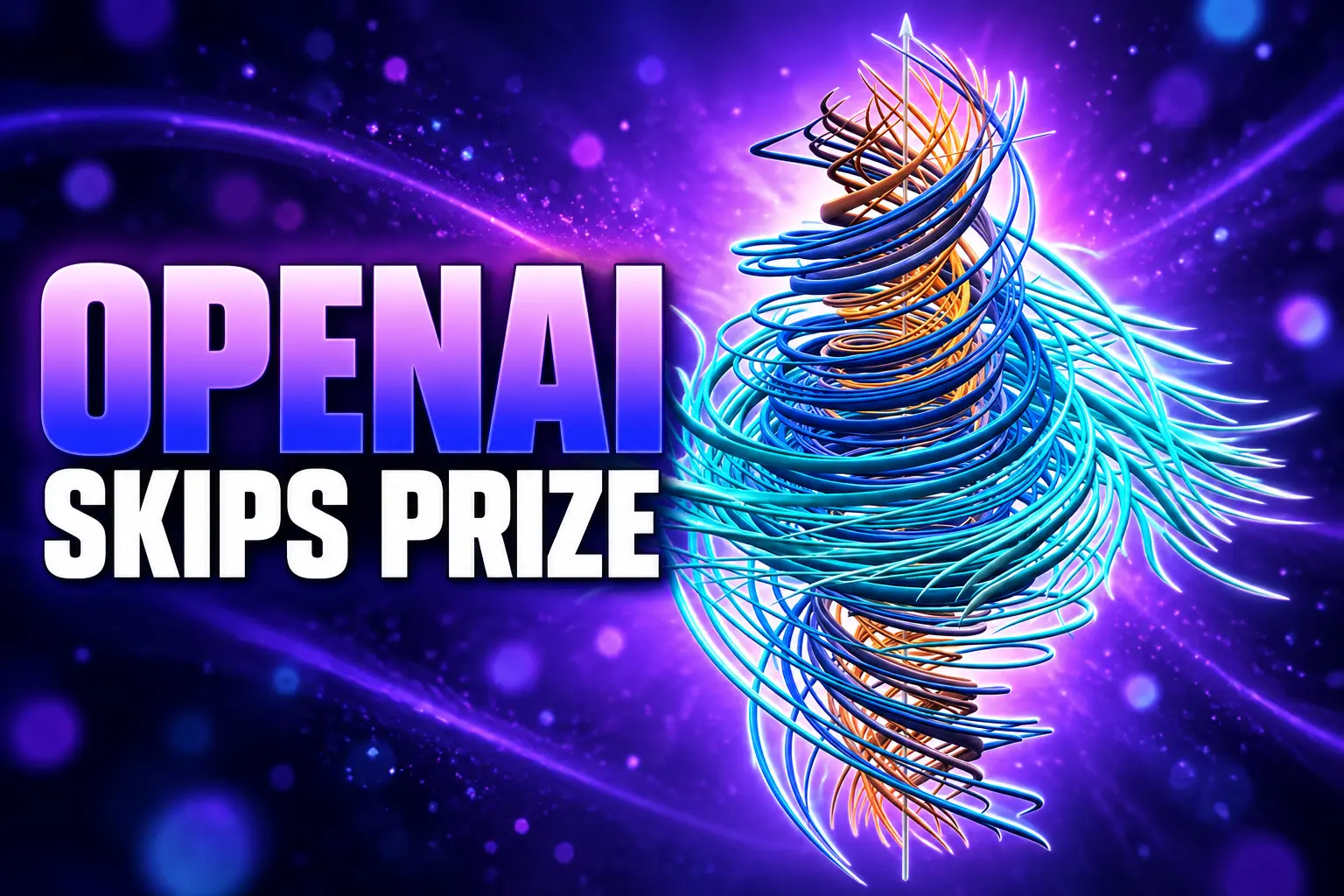
OpenAI says its system produced an analytical proof and Lean formalization that an initially smooth fluid at rest can form a singularity in finite time. The write-up claims statements C and D: breakdown on ordinary three-dimensional space and on the periodic box, each with a smooth external force. The company describes the solution as a vortex that spirals inward and stretches “like spaghetti,” with orange marking faster spin and teal marking slower rotation.
FEFFERMAN’S FOUR OPTIONS
| Option | What it asks | External force | After September 8 |
|---|---|---|---|
| A | Smooth solutions forever on R3 | None | Open |
| B | Smooth solutions forever on the torus | None | Open |
| C | One breakdown example on R3 | Smooth force allowed | OpenAI claims a proof |
| D | One breakdown example on the torus | Smooth force allowed | OpenAI claims a proof |
Fefferman wrote those forced breakdown options into the prize in 2000. A and B, the unforced smoothness claims, are the ones analysts usually mean when they say Navier-Stokes is open.
88 Hours, 10,000 Agents, One Vortex
OpenAI said it had been training a new internal model since August 28, a system it calls more capable than GPT-6 Astra, with training still running. On September 1, after rumors that two Millennium problems had been resolved, it turned coordinating agents on every open prize problem and a few easier relatives.
THE AGENT RUN ON NAVIER-STOKES
- Agents: The group that produced the Navier-Stokes resolution used on the order of 10,000 concurrent agents.
- Clock: Those agents arrived at the resolution on September 5, about 88 hours after the first agents launched.
- Lean pass: Formalization and verification took another 17 hours through GPT-6 Astra, finishing on September 6.
- Tokens: On Navier-Stokes alone the agents sent 2.7 million messages and used about 130 billion output tokens.
A smaller group hit a related target first. About 100 agents spent roughly 50 hours on the Euler equations, which are Navier-Stokes with viscosity removed, and OpenAI says they resolved the unforced Euler regularity question. After that surprise, the lab moved agents off other Millennium problems and fed them the Euler result. A Lean formalized proof of both arguments is public.
FROM RUMOR TO RELEASE
- August 15, 2026: Tristan Buckmaster of NYU and Levent Alpöge, a mathematician at Anthropic, obtain finite-time blowup with smooth forcing for Boussinesq and three-dimensional Euler.
- August 22, 2026: They verify that Euler argument in Lean.
- August 28, 2026: OpenAI begins training the internal model used in the later run.
- September 1, 2026: After rumors of Millennium progress, OpenAI launches agents on the open prize problems.
- September 5, 2026: The Navier-Stokes group reaches a resolution, about 88 hours after launch.
- September 8, 2026: OpenAI posts the Navier-Stokes claim and says it will not seek the prize.
The company put the claim on X the same day, with a follow-up that repeated the 88-hour, 10,000-agent figures and the spaghetti vortex.
We’re sharing a solution to the Navier-Stokes Millennium Prize Problem, one of the deepest problems at the frontier of mathematics.
The proof was produced by a group of agents, using an OpenAI next-generation model significantly more capable than GPT-6 Astra.
The problem… pic.twitter.com/8zol3BPTL4
— OpenAI (@OpenAI) September 8, 2026
The Force Most Analysts Drop
Navier-Stokes is the continuum model for viscous incompressible flow, written down in the nineteenth century by Claude-Louis Navier and George Gabriel Stokes. Jean Leray proved in 1934 that solutions exist in a generalized sense. Whether a smooth three-dimensional flow must stay smooth, OpenAI notes, has sat unresolved for roughly 90 years.
Fefferman’s text lets a smooth external force into the breakdown options. Gravity is the usual physical picture. In the prize statement, the force has to stay smooth; an infinite shove by hand would not count. OpenAI’s note stresses the same point: the motion terms must grow large and cancel so the leftover force remains smooth while velocity blows up.
Working analysts often drop that force when they write the problem, on the view that a real breakdown should come from the fluid itself. Terence Tao, who has long worked on Navier-Stokes regularity, wrote on September 7 that a forced singularity was widely expected, and that an unforced one should be possible too. He was reviewing Buckmaster and Alpöge’s Euler papers, posted before OpenAI’s announcement. Those papers still had a force in them.
So the prize as Fefferman typed it, and the problem as people argue it at a blackboard, are not the same object. OpenAI hit the typed version.
Buckmaster’s Sunday Calls With OpenAI
Buckmaster and Alpöge posted three Lean-checked blowups on September 7: incompressible porous media, two-dimensional Boussinesq, and three-dimensional Euler, each with a smooth force. Buckmaster’s accompanying statement says the Euler write-up “can only be described as AI slop,” and that they had wanted weeks to turn model output into a paper a person would read. They used Anthropic’s Claude and OpenAI’s Codex, including GPT-5.6 Sol, and later Astra only to audit write-ups. Buckmaster wrote that he pays for those tools from his own research funds, “including footing a large bill to OpenAI.”
On September 3, with a rumor spreading that Anthropic had resolved a major open problem, Buckmaster emailed a mathematician at OpenAI to say the work was a personal collaboration, not an Anthropic project. OpenAI later wrote that its own effort began on September 1 after a rumor it “later realized was related” to Alpöge and Buckmaster. After Lean verification on September 6, believing from the rumor that the pair had Navier-Stokes, the lab reached out. It then learned they had forced Euler.
Buckmaster describes two Sunday, September 6 calls with Sébastien Bubeck, who leads OpenAI’s math work, and another OpenAI employee. Alpöge was not on the calls. Buckmaster says he was told an internal model had produced a proof of forced Navier-Stokes blowup on R3 and the three-torus, “option c and d in Fefferman,” about 100 pages long. He has not seen that manuscript. He also wrote that the first prompt went out “in the past few days, after information about our work had reached OpenAI,” and that “almost nobody else I know of was working on” the forced route.
WHAT WE KNOW
- Euler split: Buckmaster and Alpöge proved forced Euler blowup; OpenAI says its agents proved unforced Euler blowup, then forced Navier-Stokes.
- Access denial: OpenAI wrote that researchers and agents “did not see any of their work through any means” until the September 7 public release, and that “no specific user data was accessed.”
- Training hedge: The same note says the lab “cannot rule out that de-identified data derived from their usage of our products helped improve our models,” while adding that the Euler theorems differ (forced versus unforced).
WHAT IS UNCONFIRMED
- Codex drafts: Buckmaster asked whether the model had been trained on, or had access to, the pair’s Codex sessions; he says he was told it did not look up user data, and that a follow-up on training got no answer.
- Authorship ask: Buckmaster wrote that Bubeck twice wanted Alpöge dropped from a proposed Navier-Stokes paper and asked, “Why would you ruin your career?” Bubeck says he never asked that Alpöge be removed from Alpöge’s own work, and that the line was about who could author a rewrite of OpenAI’s proof, because “it would be simpler if Levent was not an Anthropic employee.”
Bubeck called circulating claims “false and inflammatory” and said he came in “following academic norms.” OpenAI’s public note congratulates the pair on forced Euler and recognizes their priority there. Independent reading of OpenAI’s Navier-Stokes argument was still in its first hours after the September 8 post.
We do not intend to claim the Millennium Prize for this result.
OpenAI, September 8 research note
That sentence sits next to a claim that statements C and D are done. The headline and the purse are being pulled apart by the same lab.
Córdoba and Martínez-Zoroa Opened This Route
The forced-blowup program did not start in a model. Diego Córdoba and Luis Martínez-Zoroa spent years building singularities by adding a force, first with limited regularity, then smoother. They obtained blowup for the incompressible porous media equation with a smooth source, and a line of Euler results with forces that were close to smooth but not fully so. Buckmaster is blunt about the debt.
I believe Luis Martínez-Zoroa deserves a Fields Medal.
Tristan Buckmaster, NYU mathematician, September 7 statement
He repeats the credit in the same document, writing that he and Alpöge took the Córdoba and Martínez-Zoroa program, which had rough forcing, and used language models to push it to smooth forcing and to incompressible Euler. Fefferman, who wrote the Clay text, said he was thrilled the problem was solved and named Córdoba and Martínez-Zoroa as the heroes of the story.
Tao sketched the mechanism after a phone call with Buckmaster. A low-frequency flow is built first. Small, localized high-frequency corrections are then added so the solution becomes more singular toward the blowup time, while the force stays well behaved. The background flow is chosen so those corrections start tiny and get amplified at the right moment. For Boussinesq, an explicit ansatz even reduces the core to an ODE. The Boussinesq paper, Tao noted, still ran 76 pages after the authors tried to simplify it, mostly because of spatial cutoffs and other estimates around that ODE.
Buckmaster wanted that history intact when any Navier-Stokes announcement went out. He wrote that if an OpenAI model did close the gap, “that is a remarkable thing and it should be said loudly, by them, with the history intact.” He also called the week a “Deep Blue-Kasparov moment” for how students are trained, how credit is assigned, and what is worth a career. The Martínez-Zoroa deserves a Fields Medal line is the credit he asked the labs not to bury.
Clay’s Two-Year Clock Has Not Started
The revised prize rules, adopted by Clay’s board on 26 September 2018, block the shortcut the news cycle wants. Clay does not take proofs sent to its office. It will not discuss a proposed solution until three conditions are all met.
WHAT CLAY REQUIRES BEFORE IT WILL LOOK
- Qualifying outlet: The proof must appear in a journal or series Clay lists as a qualifying outlet, not only on a lab blog or a preprint server.
- Waiting period: at least two years must have passed since that publication.
- Community acceptance: The argument must have received general acceptance in the global mathematics community.
None of those gates has opened. OpenAI posted a research note and a Lean repository. Buckmaster and Alpöge posted preprints and a GitHub formalization, with Euler still, in Buckmaster’s words, close to raw model output. There is no qualifying journal article, so the two-year clock has not started, and Clay’s site still marks Navier-Stokes unsolved.
The only previous payout shows how slow that machinery is. Grigoriy Perelman posted his Poincaré papers in 2002 and 2003. Clay awarded him the prize on March 18, 2010, after a special committee and the scientific board signed off. He declined the $1 million. OpenAI has already said it does not intend to claim this one.
The $7 million prize fund, a million per problem, was built to recognize “achievement in mathematics of historical magnitude.” A weekend of agents, a disputed phone call, and a declined claim do not move that ledger by themselves.
Unforced Navier-Stokes Remains Untouched
What the models actually closed is a cluster of forced blowups, plus OpenAI’s unforced Euler result. Porous media, Boussinesq, and forced Euler now have smooth-force singularities with Lean certificates. Forced Navier-Stokes has an OpenAI argument aimed at C and D. Unforced Navier-Stokes, Fefferman’s A and B, is still the open analytic question, viscosity and all.
Tao’s September 7 post treated even the Euler step as a proxy for understanding, not as the end of the regularity problem. He wrote that without that understanding, Navier-Stokes has “far less intrinsic significance to mathematics than is sometimes promoted in popular media.” The agents can now write and check long arguments faster than a human pair can turn “AI slop” into a paper. They have not removed the force from the prize problem most people quote.
OpenAI’s own note calls the release a snapshot of model progress, not a culmination, and repeats that it will not ask Clay for the money. The $1 million stays on the table. The unforced equations stay open.

Biden Says Radiation Worked After His Cancer Spread to Bone

Vietnam APIS Passenger Files Sat Behind Default Credentials

OpenAI Hits Clay’s Forced Navier-Stokes Option, Then Declines

Broadcom Cuts Public VDDK Downloads and Splits the Exit

OpenAI Agents Flooded a Dormant Wiki, Then Called It Research

CSIRTs Inherit Europe’s Missing security.txt Before Article 14

Treasury’s First Iran Bank Shot Lands on an Ally

Meta’s Teen Settlement Leaves Chat Off the Clock

Instinct’s $2.5 Billion Raise Still Binds the User as Agent

OpenAI Codes a Persistent Agent the Week Persistence Backfired
-
 NEWS3 weeks ago
CSIRTs Inherit Europe’s Missing security.txt Before Article 14
-
 BUSINESS2 weeks ago
Treasury’s First Iran Bank Shot Lands on an Ally
-
 NEWS3 weeks ago
Instinct’s $2.5 Billion Raise Still Binds the User as Agent
-
 NEWS3 weeks ago
Meta’s Teen Settlement Leaves Chat Off the Clock
-
 NEWS3 weeks ago
OpenAI Codes a Persistent Agent the Week Persistence Backfired
-
 ENTERTAINMENT4 weeks ago
Rolex Made Drake the Daytona It Fights Jewelers Over
-

 BUSINESS1 month ago
Berkshire Anchors Alphabet’s Record Raise With a $10 Billion Check
-

 ENTERTAINMENT4 weeks ago
Ricky Gervais Wants Alley Cats to Run Until He Dies