
BUSINESS
Warsh Turns Jackson Hole Into a September Rate Test
Kevin Warsh repaired his inflation message at Jackson Hole, and the 2-year’s biggest jump since 1996 now boxes him in for September.

Federal Reserve Chairman Kevin Warsh told Jackson Hole on Aug. 28 that inflation is not slowing enough, and traders priced a September rate hike within minutes. The 2-year Treasury yield jumped 0.118 percentage point to 4.348%, the largest one-day rise after a Fed chair’s Jackson Hole speech since Alan Greenspan in 1996.
He had just told the room not to treat his talk as guidance. The front end treated it as a hike warning anyway, while the 30-year barely moved and stocks only slipped. That split is the bill for a summer in which markets could not tell whether Warsh would fight prices or talk around them.
Warsh Draws a Hard Line on Prices
Warsh used the Kansas City Fed’s symposium, on what he called his 100th day as chairman, to put price stability back in front of every other argument. In his prepared Jackson Hole remarks, titled “In Our Time,” he said the 2% goal on the personal consumption expenditures price index is a “firm, fixed target,” and that price stability does not happen on its own.
Here is my standard: We must be confident that underlying inflation is moving to our objective, clearly and at sufficient speed. Otherwise, we have work to do. That’s our job, our mandate, and our charge to keep.
Kevin Warsh, Federal Reserve chairman, Jackson Hole, Aug. 28, 2026
The July PCE price index rose 3.7% from a year earlier, BEA figures released Aug. 26 show, with the core index up 3.3%. Warsh added that the six-month pace was 4.1%, and that 54% of items in the PCE basket rose more than 3% over the past year, against 32% in the two decades before the pandemic. Summer readings that beat forecasts, he said, “do not tell me that underlying trends have meaningfully improved.”
THE SPEECH’S LOAD-BEARING CLAIMS
- The target: The 2% PCE goal is firm and fixed, and the Fed owns 65 months of inflation above it.
- The focus: With the labor market near full employment, “the Fed’s predominant focus right now should be on prices.”
- The tool: Short-term rates are the main instrument; he would not call broad financial conditions tight.
- The method: He wants market signals “as unfiltered as possible” and said not to call his outline forward guidance.
- The AI caveat: A productivity task force is at work, but its findings “have no bearing on decisions we make in the current policy conjuncture.”
He even joked about trail maps and hikes with Don Kohn and Ben Bernanke, then drew a harder line than many in the hall expected from a chair who had spent the summer saying as little as possible. The policy rate remains in a 3.50% to 3.75% band, where it has sat since December. He did not name September. He did not need to.
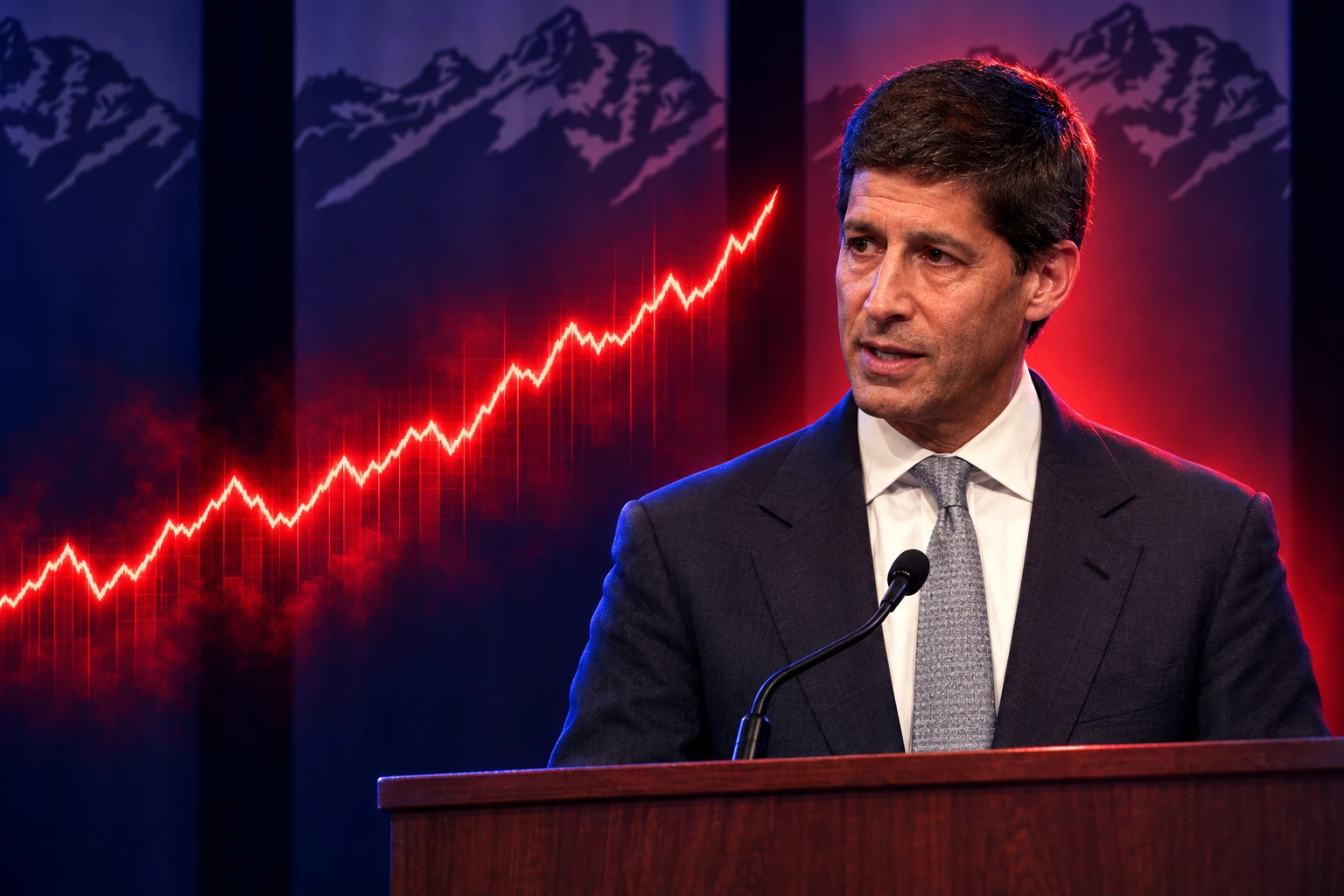
Short Yields Jumped More Than Stocks Fell
The 2-year note, which tracks near-term Fed bets, did the damage. The 10-year yield rose 0.050 percentage point to 4.721%. The 30-year stayed near 5.21%, and the gap between 2-year and 30-year yields tightened to about 87 basis points, the slimmest in a month. Traders bought the idea of a hike. They did not buy a long campaign.
FRIDAY’S REPRICING AFTER THE SPEECH
| Market | Friday close | Friday change |
|---|---|---|
| 2-year Treasury yield | 4.348% | +0.118 pp |
| 10-year Treasury yield | 4.721% | +0.050 pp |
| S&P 500 | 7,711.76 | -0.25% |
| Nasdaq Composite | 26,402.42 | -0.52% |
| Dow Jones Industrial Average | 53,559.99 | -0.02% |
The S&P 500 fell 19.23 points. The Nasdaq lost 138.93 points, and the Russell 2000 dropped 1.4% to 2,972.37, a sharper hit for smaller firms that live on floating-rate credit. Nvidia fell 4.6% after a prior surge, and Marvell Technology sank 10.3% on its own results, so the chip tape had more than Warsh in it. Gold dropped 3.2%. For the week, the S&P 500 still gained 0.49%, the Nasdaq 0.85%, and the Dow 0.53%.
CME FedWatch pricing moved to about a 58% chance of a quarter-point increase at the Sept. 15-16 meeting, from about 35% the day before. By Sept. 2, after oil and fresh Middle East tension piled on, futures implied about two-to-one odds of that hike. Michael Arone, chief investment strategist at State Street Investment Management, said markets read the speech as “a one-way ticket towards higher rates.” The University of Michigan’s final August sentiment index also slipped to 51.7 from 55.2, a sour extra on an already tense tape.
July Left His Inflation Target Sounding Soft
The hawkish turn lands as a repair job. Warsh took the chair in May after President Donald Trump picked him to succeed Jerome Powell, and plenty of investors had boxed him as the man who would deliver cheaper money. Sonal Desai, Franklin Templeton’s fixed income chief, wrote after his first press conference that he might be the most hawkish chair since Volcker, and that the pre-meeting consensus he would simply cut for the White House had been wrong.
At the June 16-17 meeting, nine of 18 officials penciled in higher rates by the end of 2026, a swing from March, when none did. The July meeting left rates unchanged in the 3.50% to 3.75% range, with interest on reserves at 3.65% and the primary credit rate at 3.75%. Then came the July 29 press conference. Warsh’s prepared lines held the 2% target. His answers left room for people to wonder whether the target itself might be reviewed later. Critics at Jackson Hole said he still had not explained how a hold would pull inflation down.
Friday was the cleanup. Don Kohn, the former Fed vice chair who was in Wyoming, put it in one sentence.
He’s changed the presumption to they’ll raise rates unless the data suggests it’s not necessary.
Donald Kohn, former Federal Reserve vice chairman, at the Jackson Hole symposium
WHERE EXPERTS DISAGREE
- Kohn’s camp: The speech flipped the default to a hike unless incoming data blocks it, which is why Barclays and Societe Generale now pencil in increases in both September and December.
- Daco’s camp: Gregory Daco, chief economist at Ernst & Young, called the remarks more direct than anything in three months, then said futures still overstate the odds of a move in two weeks because the speech mostly restated July’s message.
- Clarida’s read: Former Fed vice chair Richard Clarida said bond and futures traders took the talk as a signal that a hike is clearly on the September table.
Priya Misra of JPMorgan Asset Management called Friday a “forceful pushback” to the July mix-up. Matthew Amis of Aberdeen warned that if officials then hold, “credibility will take another bashing.” Warsh still refused a reaction function. He said a Taylor-style rule cannot carry the load, and that 2021-style guidance may have slowed the last inflation fight. The hall-of-mirrors problem, he argued, hurts people without financial assets first.
He banned forward guidance in the same hour markets wrote some for him. That is the trap he built: a quieter Fed that still has to live with a very loud 2-year yield.
Trump Still Wants Cheaper Money
Trump spent years attacking Powell for not cutting. He has mostly spared Warsh by name and blamed other officials instead, including a renewed push against Governor Lisa Cook. After Jackson Hole, the president did not pick a fight with his own chair. In the Oval Office on Aug. 31, asked whether he opposed a possible increase and whether he had called Warsh, Trump said no.
“I have a lot of respect for him, and he’ll do what he has to do,” Trump said. He still argued that “we should have the lowest interest rates in the world.” A hike in mid-September would sit weeks before the midterm elections and put a spotlight on prices that have missed 2% for 65 months. Maurice Obstfeld of the Peterson Institute called it a no-win: raise and clash with the White House, or hold and watch the trust he just rebuilt leak away.
Warsh, for his part, praised an economy he said had strengthened through shocks. “On that score, both Main Street and Wall Street have been remarkably resilient,” he said. He also put the inflation miss on the central bank, not on the president. “The responsibility for 65 months of sustained, elevated inflation sits squarely with the central bank. And that is where it belongs.”
The Long Bond Has Another Buyer
The curve’s split is not only a Fed story. Treasury Secretary Scott Bessent had already moved to support the long end, with an intention to more than double long-end buybacks. ING’s Padhraic Garvey and colleagues wrote on Aug. 31 that Warsh is leaning on front-end rates while Bessent tries to keep long yields from running, and that 10-year break-even inflation even eased a few basis points after the speech. The rise in long rates, they argued, is coming from real yields, issuance, and an AI growth bet, not from a burst in inflation fears.
That is why a 2-year spike and a sleepy 30-year can live in the same session. A September hike would reprice floating-rate credit, credit-card APRs, and small-business lines first. Thirty-year mortgage quotes, tied more to the long bond, barely flinched on Friday. Higher policy rates are not free for farms, ranches, and anyone rolling short-term debt. They also do not, on their own, shrink the deficit that keeps feeding Treasury supply. Warsh said short-term rates are the predominant tool. Fiscal policy is someone else’s.
ING still sees the 10-year yield working into a 4.75% to 5% range if real-rate pressure holds. Bessent can claim a partial win if long swap spreads stay tighter after the buyback step-up. The political split is cleaner: the White House wants cheaper money across the curve, and the chair just made the front end more expensive to hold.
Jobs and CPI Come Before the September Vote
Warsh said a “good majority” of his colleagues judged in July that they wanted more weeks of data “before deciding whether a change in interest rate policy was advisable,” and that they were ready to act. The calendar he created is now short and public.
THE DATES THAT NOW BIND THE CHAIR
- May 2026: Warsh takes over as chairman after Trump’s nomination, with markets still arguing he was hired to cut.
- June 16-17, 2026: First meeting as chair. Officials hold the 3.50% to 3.75% band, and nine of 18 project higher rates by year-end.
- July 28-29, 2026: The committee holds again. The press conference muddies the 2% message he had written down.
- Aug. 26, 2026: BEA publishes July PCE at 3.7% year over year and 3.3% core.
- Aug. 28, 2026: Jackson Hole speech. The 2-year yield’s biggest Jackson Hole jump since 1996.
- Sept. 4, 2026: August jobs report, the first chance for a weak payrolls print to knock hike odds back down.
- Sept. 11, 2026: August consumer-price index, four days before the committee sits.
- Sept. 15-16, 2026: FOMC meeting, with the rate decision and press conference on Sept. 16.
Warsh told the hall the Fed needs contemporaneous data and should not set policy off stale prints or single observations. That principle now cuts against him. A soft August CPI can still stop a hike. A hot one, on top of a 4.1% six-month PCE pace, leaves him explaining a hold he just made harder. He also said AI token sales at the two leading labs are running at more than $100 billion a year, up over 500% from a year earlier, and that this boom is a future policy problem, not a reason to ease now. That closes a door he had left open while seeking the job, when AI was often cast as a disinflationary gift.
A Hold Would Reopen the Trust Fight
Warsh got the bond-market response a new chair wants, which is belief, not a rally. Eric Wallerstein, chief macro strategist at Clocktower Group, said traders wanted commitment after a couple of meetings in which they were not sure how to read him. He supplied it without booking the rate move. The next test is whether the committee follows the presumption Kohn heard, or whether Daco is right and Friday was a restatement that futures over-read.
A quarter-point increase would take the target band to 3.75% to 4.00% and confirm that this Fed will raise into an election season. A hold would send the 2-year back down and reopen every question from July about whether 2% is really fixed. The August CPI report on Sept. 11 is the print that decides which of those meetings he walks into.
Disclaimer: This article is news reporting and analysis of Federal Reserve communications and market prices, and it is for information only. It is not investment advice, a recommendation to buy or sell bonds, stocks, or rate futures, or a forecast you should trade on. Speak with a licensed financial adviser or investment professional who knows your situation before making any portfolio or borrowing decision. Yields, index levels, and hike odds are those published by the cited official and market sources as of the dates given and will change with new data and the Sept. 15-16 meeting.

Oracle’s Unfinished Cerner Move Exposed 20 Million People

Google Buys 890 MW of Nuclear Uprates on a Strained Grid

Francis Halzen Wins a Solo Nobel for His IceCube Bet

Denmark’s Company Search Rights Opened 8.8 Million CPR Records

OpenAI Agents Reached Staging Servers as California Subpoenaed the Lab

Rolex Made Drake the Daytona It Fights Jewelers Over

Treasury’s First Iran Bank Shot Lands on an Ally

Instinct’s $2.5 Billion Raise Still Binds the User as Agent

City’s £125m Enzo Deal Caps a £327m Midfield Rebuild

CSIRTs Inherit Europe’s Missing security.txt Before Article 14
-
 ENTERTAINMENT2 months ago
Rolex Made Drake the Daytona It Fights Jewelers Over
-
 BUSINESS2 months ago
Treasury’s First Iran Bank Shot Lands on an Ally
-
 NEWS2 months ago
Instinct’s $2.5 Billion Raise Still Binds the User as Agent
-
 NEWS2 months ago
City’s £125m Enzo Deal Caps a £327m Midfield Rebuild
-
 NEWS2 months ago
CSIRTs Inherit Europe’s Missing security.txt Before Article 14
-
 BUSINESS2 months ago
Berkshire Anchors Alphabet’s Record Raise With a $10 Billion Check
-
 NEWS2 months ago
Meta’s Teen Settlement Leaves Chat Off the Clock
-

 ENTERTAINMENT2 months ago
Ricky Gervais Wants Alley Cats to Run Until He Dies