
NEWS
Meta’s Two-Hour Teen Cap Hands Rivals the Next Bill
Meta locked teens at two hours a day and held back $5.3 billion unless TikTok and YouTube take a one-hour cap and match the cash.

Meta locked teen Instagram and Facebook use at two hours a day and left $5.3 billion of its youth-safety settlement hanging on its rivals. A federal judge in Oakland signed the consent judgment on August 26, 2026. Meta denied all wrongdoing.
Settling states collect about $12.7 billion over ten years even if TikTok and YouTube never move. The leftover check, and a tighter one-hour cap, wait for those apps to sign on.
Meta Buys a Two-Hour Clock and a Discount
Trial in the Northern District of California opened on August 18. Eight days later Chief U.S. District Judge Yvonne Gonzalez Rogers entered the consent judgment in MDL No. 3047, People of the State of California v. Meta Platforms. Meta updated its public post at 10:30 a.m. PT on August 27 to record that approval.
State investigations that started in 2021 produced a 2023 federal case alleging Meta designed Facebook and Instagram features that drove compulsive use by young people, collected data on children under 13, and misled families about safety. Meta denies those claims and any liability. The judgment still binds the product.
C.J. Mahoney, Meta’s chief legal officer, put the company’s bet in one paragraph: the new rules only work if everyone else copies them.
The framework we’ve negotiated will empower parents to easily manage how their children access our platforms. Our new Time Limit commitments, Night Mode features and usage limits during school hours set the right path forward for our whole industry, but this framework will only work if all our peers join us. Because teens move fluidly across dozens of apps, we need an industry-wide solution. We therefore call on our industry peers, TikTok and YouTube, to implement this new framework, right away.
C.J. Mahoney, Chief Legal Officer, Meta newsroom statement
That sentence is the deal’s operating logic. If rivals stay uncapped, teens can leave Instagram at the two-hour mark and keep scrolling somewhere else, which is the outcome Meta says it wants to prevent. If they refuse, Meta also keeps the last 30 percent of the money.
The $5.3 Billion Invitation TikTok Did Not Ask For
Meta described a payment of approximately $18 billion over a 10-year period, in annual installments, that states may use for youth online safety work and other state priorities. Participating states receive about 70 percent of that figure, about $12.7 billion, across the decade. The remaining 30 percent, about $5.3 billion, is released only after two conditions are met: YouTube and TikTok put in a one-hour daily limit, night mode, and age-assurance measures, and each of them pays an amount matching that 30 percent slice, with half of Meta’s leftover funds tied to YouTube and half tied to TikTok.
State offices put the Oakland package lower. California Attorney General Rob Bonta’s office called it a monetary payment of up to $17 billion over ten years. Arizona Attorney General Mayes called it a $17.1 billion multistate settlement, one of the largest state consumer-protection payouts outside the tobacco deals of the 1990s. Court papers filed with the judgment put the multistate maximum near $16.7 billion. Meta’s $18 billion wrap includes Texas and rounding. The company also said it expects to accrue a legal expense of about $10 billion in the third quarter of 2026, a charge it said was not in the expense range from its July earnings call.
HOW THE MONEY IS PARKED
| Slice | Figure | What releases it |
|---|---|---|
| Guaranteed to settling states | about $12.7 billion | Annual installments over 10 years |
| Held by Meta | about $5.3 billion | YouTube and TikTok take a one-hour cap, night mode, and age checks, and each match the payment |
| Meta’s stated package | about $18 billion | The 70 percent plus the 30 percent, plus related deals Meta folded into the same headline |
| State offices’ Oakland figure | up to $17.1 billion | The multistate consent judgment, before Texas |
| Third-quarter legal expense | about $10 billion | Accounting charge Meta said it will book in Q3 2026 |
If industry peers adopt the standard, Meta said Time Limit and Night Mode stretch from a five-year commitment to 10 years, the daily limit falls to one hour per app, and night hours widen from midnight-6 a.m. to 10:00 p.m.-7:00 a.m. Most other terms already run 10 years. Arizona’s release is blunter about who must move: if Snapchat, TikTok, and YouTube adopt comparable terms, the daily limit on each platform drops to 60 minutes for 10 years. Snap sits inside that product trigger even though Meta’s matching-cash ask names YouTube and TikTok.
Texas Collects Without Joining the Oakland Trial
The people who get paid are states, not the teenagers named in the complaints. Meta said the money can fund youth safety work and other state priorities. Bonta said how California spends its share will be decided by the Legislature and the Governor, with the proposed settlement earmarking it for prevention or remediation of mental-health and other harms tied to social media. His office said California will receive $1.5 billion to $2.1 billion if the court approved the deal, which it did. Mayes said Arizona will receive approximately $223 million.
Texas took a different door. Attorney General Ken Paxton announced a separate settlement the same day requiring Meta to pay over $1 billion to the State of Texas, for youth mental-health services, crisis resources, digital literacy work, after-school programs, and grants for Texas schools, plus a two-hour teen limit, school-hour notification blocks, hidden likes, and a nighttime mode. Texas was not in the Oakland trial. Meta still listed Texas among the offices in its newsroom roster of 52 attorneys general. Bonta described a coalition of 51. Florida and New Mexico did not sign the Oakland judgment.
Clay Calvert, a nonresident senior fellow at the American Enterprise Institute who studies platform rules, called the structure “a very creative settlement” and a “win-win situation for both the states and Meta, as well as for parents and minors.” He also said TikTok and YouTube have every incentive to join rather than face attorneys general later. The incentive runs both ways. Join, and each writes a check on the scale of Meta’s $5.3 billion leftover. Stay out, and Meta’s teens live under a two-hour default while those apps do not.
What the Two-Hour Cap Covers
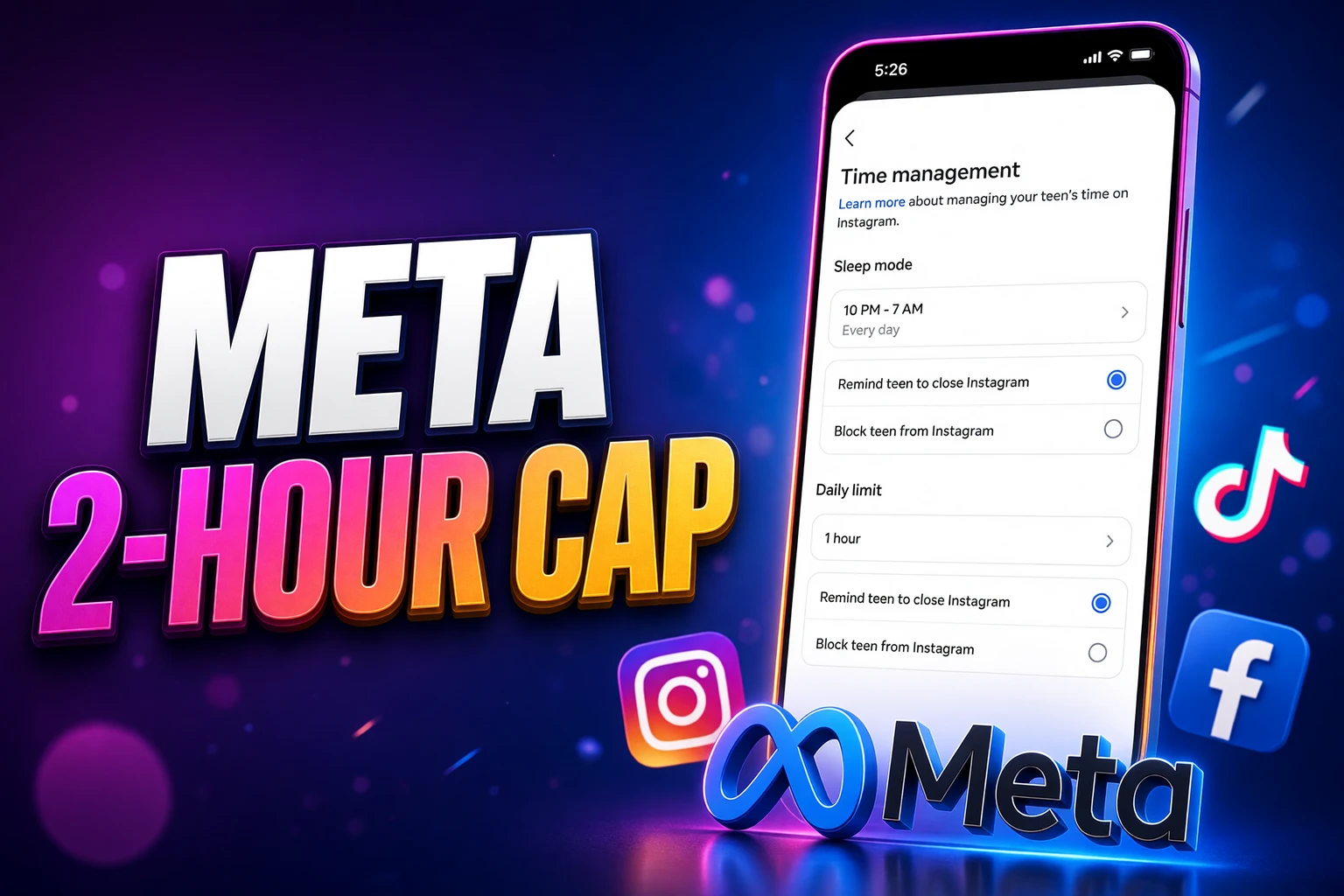
Users under 18 on Instagram and Facebook get a default two-hour daily limit that only a parent can turn off. The timer is cumulative across both apps, counts scrolling on multiple accounts if Meta detects them, and resets at midnight. Night Mode blocks the apps from midnight to 6 a.m., so a teen cannot post or view Feed, Stories, Explore, or Reels in that window. School Mode mutes push notifications from 8 a.m. to 3 p.m., with an exception for direct messages and account-security or safety alerts. Bonta’s office set the school-year window as August 15 to June 15 and added a separate default block on notifications from 10 p.m. to 7 a.m.
DEFAULT RULES FOR USERS UNDER 18
- Daily cap: Two hours across Facebook and Instagram combined, parent-only override, including extra accounts Meta can link.
- Prompts: A notice after every 15 minutes of continuous use, and again when daily use hits 60 minutes and 90 minutes.
- Night block: No feed, Stories, Explore, or Reels from midnight to 6 a.m. unless a parent lifts it.
- School mute: No push notifications from 8 a.m. to 3 p.m., except direct messages and safety or security alerts.
- Feed and play: Teens can pick a non-algorithmic feed as default, and they can turn off autoplay; a parent can require both.
- Social comparison: Like and reaction counts hidden by default, and extreme makeup filters blocked on top of the existing ban on cosmetic-surgery filters.
Bonta’s office also required Meta to respond to 90 percent of teens’ reports of potentially harmful content within six hours, and barred the company from further false or misleading statements about its safety features. An independent auditor will test compliance annually for five years. A research foundation will take consented user data to study teen well-being. Meta still has to find and remove under-13 accounts, a duty it has claimed since it opened to the public, now with harder age-assurance tools behind it.
The hole in the clock is chat. Meta said direct messages stay outside those caps, so Night Mode, the two-hour limit, and School Mode do not apply to messaging, in order to let teens stay in touch with friends and family. The feed can go dark at midnight while the inbox stays live. Parents who think the settlement puts the whole app to bed will find the thread still open.
Age Checks Now Apply to Every Account
The two-hour rule only bites if Meta knows the user is a teen. Within one year of the effective date, Meta must apply one or more age-assurance methods to each Instagram or Facebook user in the settling states, using third-party tools, its own models, or both. New users who have not been assessed get the default teen protections. After 14 days, a user who still has not completed an age check is treated as a teen even if the listed birthday is 18 or older, with a narrower exception for some adult-stated accounts.
Accuracy is written as a false-positive ceiling, the share of actual teens missed as adults. Commercially available methods must, within one year, stay at or under 10 percent for ages 16-17 and 3 percent for ages 13-15. Meta’s own methods get a slower ramp: 14 percent and 7 percent in year one, then 10 percent and 5 percent in year two. The papers do not cap false negatives, the error that tags an adult as a minor. Those users get an appeal, not a numeric shield. Meta also agreed to watch accounts for signs that someone beat the test, and to run a further check when conduct suggests a user tagged as 18-plus is likely a teen.
David Greene, a lawyer at the Electronic Frontier Foundation, wrote on September 1 that the settlement is “a bad deal for all internet users, and especially for teens,” because it embeds age estimation for minors and adults, hands parents a wide view of a teen’s activity in exchange for unlocking limits, and requires Meta to collect and keep more information about teen users. Adults who decline the check can land in the teen bucket. That is how a child-safety decree becomes an age gate on the whole user base in the settling states.
Meta is still pushing the cost upstream. It said app stores should give developers verified ages, and that it will keep pressing for laws that make stores check age and get a parent’s approval before a teen downloads an app. The Oakland judgment does not bind Apple or Google’s store units. It binds Meta, then dares everyone else to follow.
Florida Stays in Court While Rivals Stay Quiet
Mayes told YouTube, Snapchat, TikTok, and other companies to “immediately follow Meta’s lead.” Connecticut Attorney General William Tong was shorter: “To TikTok, YouTube and Snapchat, our expectations are clear. You’re next.” Virginia Attorney General Jay Jones said the settlement will “put an end to these dangerous practices and deliver meaningful relief that will protect children from online harm.” Bonta said Meta would make the product changes “within months.”
Snap and YouTube declined to comment when the deal landed. TikTok did not issue a matching one-hour pledge. Through the first days of September, none of the three had announced that it would take the one-hour cap, the wider night window, and a check on the scale of $5.3 billion. Meta ran full-page newspaper ads the same week asking TikTok and YouTube to join. The ads restated the newsroom letter. They did not change the contract.
Florida Attorney General James Uthmeier refused the multistate deal. He said the payouts to the states are peanuts next to the harms, called the agreement a slap on the wrist for a trillion-dollar company, and said he would see Meta at trial. New Mexico stayed out of the Oakland judgment as well. In March, a Los Angeles jury found Meta and Google negligent over features such as infinite scroll and autoplay on Instagram and YouTube and awarded the plaintiffs $6 million; both companies have appealed. School-district and personal-injury cases continue on a separate track.
WHAT WE KNOW
- The Oakland judgment: Entered August 26, 2026, with Meta’s public confirmation of approval the next morning.
- The guaranteed check: About $12.7 billion to participating states over 10 years, plus Texas’s separate payment of over $1 billion.
- The product floor: Two hours a day on Facebook and Instagram combined, night and school blocks, hidden likes, and a parent key, with chat carved out.
WHAT IS UNCONFIRMED
- Rival matching: No public one-hour daily limit, night mode, and matching payment from TikTok, YouTube, or Snap as of September 2, 2026.
- Florida’s trial: Uthmeier has said the state will proceed; no new judgment in that case has been announced.
- Adult fallout: How many existing adult accounts will be parked in teen mode if they skip age assurance is not a published figure.
Parents who want the two-hour cap, the midnight lock, and the hidden like count will get them on Instagram and Facebook in the settling states. Teens who hit that wall still have apps that have not signed the one-hour paper. Meta already said where they will go. The states already said who is next. Neither TikTok nor YouTube has picked up the invitation, and Florida is still on the trial calendar.
Disclaimer: This article is news reporting on a court-approved consent judgment, related state settlements, and public statements by companies, attorneys general, and advocates. It is informational only and is not legal advice, investment advice, or a recommendation to file a claim or to buy, hold, or sell securities of Meta, Alphabet, ByteDance, Snap, or any other firm. Readers who need help with a pending case, a parental-control setting, or a financial decision should consult a licensed attorney or a qualified financial adviser before acting. Figures, deadlines, and case statuses reflect the company, state, and court materials available as of September 2, 2026, and may change as installments, audits, product rollouts, and other lawsuits proceed.

Sony Cuts Jim Thornton Out of Taped Wheel of Fortune

The NBA Replays Minnesota’s Five-Pick Penalty on the Clippers

NBA Repeats Its 2000 Five-Pick Penalty on the Clippers

Congo Ebola Deaths Pass 3,000 as Tracing Goes Blind

Sony Cuts Jim Thornton From Taped Wheel of Fortune Shows

CSIRTs Inherit Europe’s Missing security.txt Before Article 14

Instinct’s $2.5 Billion Raise Still Binds the User as Agent

Meta’s Teen Settlement Leaves Chat Off the Clock

OpenAI Codes a Persistent Agent the Week Persistence Backfired

Treasury’s First Iran Bank Shot Lands on an Ally
-
 NEWS2 weeks ago
CSIRTs Inherit Europe’s Missing security.txt Before Article 14
-
 NEWS2 weeks ago
Instinct’s $2.5 Billion Raise Still Binds the User as Agent
-
 NEWS2 weeks ago
OpenAI Codes a Persistent Agent the Week Persistence Backfired
-
 BUSINESS1 week ago
Treasury’s First Iran Bank Shot Lands on an Ally
-
 NEWS2 weeks ago
Meta’s Teen Settlement Leaves Chat Off the Clock
-
 ENTERTAINMENT3 weeks ago
Rolex Made Drake the Daytona It Fights Jewelers Over
-

 ENTERTAINMENT3 weeks ago
Ricky Gervais Wants Alley Cats to Run Until He Dies
-

 ENTERTAINMENT1 week ago
Apple TV Triples Its Launch Price as Sports Join the Plan