
NEWS
Congo Ebola Deaths Pass 3,000 as Tracing Goes Blind
WHO chief Tedros asked for $1.3 billion to break Congo’s Ebola chains after most new cases arose off contact lists and red-zone schools reopened.

Congo’s Ebola outbreak has killed 3,007 people among 6,186 confirmed cases, government figures showed on 2 September. WHO director-general Tedros Adhanom Ghebreyesus told reporters in Geneva that most of those deaths were still among people who had never been listed as contacts.
He said every chain of spread has to be found and broken. The United States CDC’s latest field note, built from Congo’s own daily reports, shows that work running far behind the levels that stopped earlier epidemics, while pupils in the red zone went back to class on 1 September.
Deaths Pass 3,000 in Congo’s Fastest Ebola Outbreak
The Democratic Republic of the Congo’s health ministry declared the outbreak on 15 May, two days before CDC stood up its emergency operations, and the virus was already moving through Ituri. The strain is Bundibugyo virus, a species that had caused only two small outbreaks before this year. This is Congo’s 17th Ebola epidemic, and on raw counts it has already passed the country’s previous worst.
From 1 August 2018 to 25 June 2020, the North Kivu epidemic produced 3,470 cases over 23 months, including 3,317 confirmed and 153 probable infections, and 2,287 deaths. It touched 29 health zones and registered more than 250,000 contacts. The 2014 to 2016 West Africa epidemic infected more than 28,600 people and killed more than 11,000 in Guinea, Liberia and Sierra Leone, still the largest on record.
Congo’s 2026 count reached 1,000 cases within 40 days of the response starting. The 2018 epidemic needed about 235 days to cross the same line. CDC’s comparison chart, using ministry and WHO reports through 30 August, puts this outbreak at 5,458 cases by day 100, against 759 at the same mark in West Africa in 2014 and 323 in Congo in 2018.
HOW THIS OUTBREAK COMPARES
| Epidemic | Confirmed or total cases | Deaths | Time to 1,000 cases |
|---|---|---|---|
| DRC Bundibugyo, 2026 | 6,186 confirmed (2 Sept) | 3,007 | About 40 days |
| DRC North Kivu, 2018 to 2020 | 3,470 (3,317 confirmed) | 2,287 | About 235 days |
| West Africa, 2014 to 2016 | More than 28,600 | More than 11,000 | Past day 100, still under 800 |
Tedros said on 2 September that the epidemic now covers 60 health zones across six provinces. As of 21 August, CDC listed Bas-Uélé, Haut-Uélé, Ituri, North Kivu, South Kivu and Tshopo, with Ituri still holding 84 percent of reported cases. South Kivu has reported no confirmed case since 29 May. Uganda recorded 21 confirmed and probable cases and 3 deaths, with the last confirmation on 21 June.
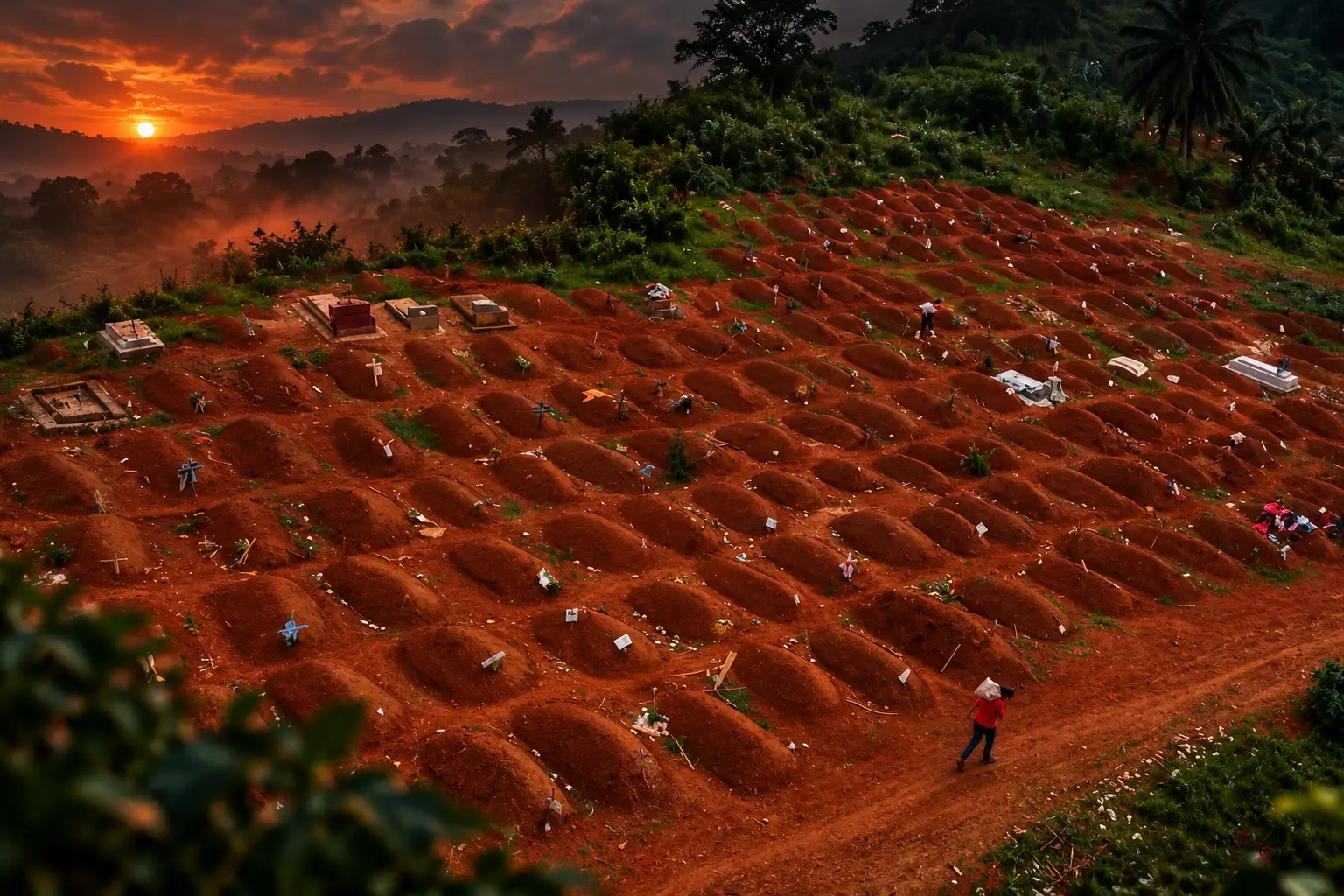
Nearly half of Congo’s confirmed patients have died. CDC recorded a 48 percent confirmed-death share on 21 August, when the tally stood at 2,606 deaths among 5,458 cases. The 2 September government figures imply the same brutal ratio. In 2018 to 2020, 33 percent of patients died outside treatment centres. That share is now much higher.
Four in Five New Cases Were Never on a List
Tedros put the hole in plain language. “That means there are chains of transmission we don’t know about,” he said, adding that many of the dead were still being buried in ways that spread the virus. CDC, reading Congo’s situation reports, had already measured the same gap.
A 1 September MMWR field note found the five outbreak-control targets still unmet that past epidemics needed to stop. For the three weeks from 31 July to 21 August, teams listed an average of 10.6 contacts per confirmed case, against a target of 20 or more. Daily tracing completeness sat at 82 percent, against a target above 95 percent. The share of new confirmed cases who had already been listed as contacts, last published on 12 July, was 15 to 20 percent, against a target above 90 percent.
THE CDC SCORECARD AS OF 21 AUGUST
| Measure | Target | Latest status |
|---|---|---|
| Contacts listed per confirmed case | 20 or more | 10.6 |
| Daily contact follow-up | Above 95% | 82% |
| New cases already on a contact list | Above 90% | 15 to 20% (as of 12 July) |
| Alerts investigated within 24 hours | Above 90% | 83% (as of 5 Aug) |
| Validated alerts sent for laboratory testing | Above 90% | 72% |
| Share of tests that come back positive | 0% | 24% |
| Deaths outside an Ebola treatment unit | 0% | 59% |
| Affected health zones with a safe-burial team | 100% | 49% |
National treatment-unit occupancy averaged 64 percent, inside the target of staying below 80 percent, but some facilities were at 140 percent and could not isolate every infected patient. 59 percent of confirmed deaths happened outside a treatment unit. Only 49 percent of affected health zones had a trained safe-and-dignified burial team. CDC said those gaps, plus missing data on how fast patients are isolated, point to uncontrolled expansion.
Follow-up of the people who do get listed can look almost adequate. The list itself is not. If four in five new patients were never named as contacts, the teams are monitoring a network that is not producing the infections. Armed conflict, displacement and weak clinics in the east make that worse, and CDC notes violence against health workers and shortages of protective gear.
Why the Licensed Ebola Shot Stays in Trials
The 2018 to 2020 response had a tool this one does not. Ervebo, the only licensed Ebola vaccine, is approved for Ebola virus disease caused by the Zaire species. Bundibugyo is a different virus. There is still no approved vaccine or specific drug for it.
WHO’s Strategic Advisory Group of Experts on Immunization met in an extraordinary session and, on 31 August, issued updated emergency guidance. The group reviewed new animal, immune-system and observational studies that hint at some cross-protection, then concluded that the evidence is still too weak to say the shot protects people against Bundibugyo in a clinically meaningful way. The guidance keeps the licensed shot only inside research protocols.
On 2 September the WHO account repeated the rule: Ervebo should be used against Bundibugyo only in a research protocol, not as a mass campaign. A ring randomised trial is supposed to generate the missing efficacy data. Separate Bundibugyo-specific candidates, including an Oxford chimpanzee-adenovirus construct that entered a small adult safety study in July, remain months from a field answer. Supportive care is still the standard, while a platform trial in Ituri tests remdesivir and the antibody cocktail MBP-134 against that standard.
Ring vaccination was how Guinea, and later North Kivu, got ahead of Zaire Ebola. The same gesture now, with a mismatched product, would spend scarce doses on a question the trial has not answered. Tedros still argues the epidemic can be stopped with the older package of tracing, isolation, testing and safe burials.
Until every chain is found and broken, the epidemic will continue and will continue to pose a threat to DRC, its neighbors and the region as a whole.
Tedros Adhanom Ghebreyesus, WHO director-general, Geneva briefing, 2 September 2026
CDC has kept the risk to the American public low and reports no U.S. cases tied to this outbreak. Travelers who have been in Congo within 21 days are barred from boarding commercial flights to the United States.
Classrooms Reopened in the Red Zone Anyway
The 2026 to 2027 school year opened nationwide on Tuesday, 1 September. On 19 August, the Ministry of National Education and New Citizenship had published a three-colour scheme for Ebola-affected provinces and listed about 2,890 schools classed as high risk across 18 education subdivisions.
THE THREE-ZONE SCHOOL PLAN
- Green zones: No confirmed case, ordinary in-person classes with prevention messages.
- Orange zones: Confirmed cases nearby, in-person classes with tighter hygiene and screening.
- Red zones: Active spread, ordinary classes to be replaced by light distance learning for four-week blocks, using worksheets every 15 days plus radio and, where possible, television, with no internet required.
Red-zone schools were still supposed to open as pickup points, on staggered hours, so families could collect the sheets without crowding. That was the plan on paper. An education ministry official said on 2 September that schools in Ituri, the epicentre, opened as usual after provincial authorities argued that pupils in the red zone would otherwise fall behind the national curriculum. “At the first sign of a case, we will close and implement distance learning, but for now, that’s not the case,” the official said, speaking without being named because they were not authorised to brief the press.
Education minister Raissa Malu, opening the year in Kinshasa, said some parts of the country face conflict and others face Ebola, and that “our duty remains the same, to make schools work wherever possible and to preserve the right to education.” The teachers’ union in Ituri had asked for a delay. Classes also restarted in parts of North Kivu and South Kivu held by the Rwanda-backed AFC/M23 alliance.
A contact-tracing system that already misses most new infections now shares the morning with packed classrooms, handwashing stations and temperature checks. The ministry said the colour map would be reviewed as the epidemic moved. The first review, in Ituri, went toward keeping children in the room.
Unpaid Staff and Phantom Names Slow the Work
The people who would have to list those contacts, isolate patients and bury the dead have been walking off the job since July. At the Elikya treatment centre in Bunia, doctors, nurses and security staff stopped work over two months of unpaid performance bonuses. About a hundred protested outside the gates. Staff at Rwampara General Hospital, including investigators, drivers and gravediggers, blocked the road and shut the site.
Dr. Biensi Kano, on Ituri’s epidemiological surveillance committee, said in early July that the demand had been the same since the outbreak was declared. “Since the Ebola virus disease outbreak was declared, we’ve been demanding payment for our work,” he said. Martin Bolombi, a hygiene worker at Elikya, said in August he had been on the job since May and had been paid only for June. Edouige Makosi, during a later protest at the Ituri governor’s office, said Ebola would not end in the province “with this way of managing things.”
Health minister Roger Kamba, visiting Ituri in July, said the government was checking response payrolls because unrelated names had been added. “We must ensure that these payments reach the right people,” he said. Communications minister Patrick Muyaya Katembwe later said delayed pay had triggered protests at several treatment centres and that outstanding amounts were being processed. In Haut-Uélé, checkpoints stopped filing reports during an August walkout over unpaid workers, and some posts were still silent almost two weeks later.
The virus is not the only thing thinning the line. Ghost names on payment lists slow money to people who are actually in the yellow suits. Strikes that last only a few days still interrupt admissions, decontamination and screening, which is exactly the work CDC says is already below target.
The $1.3 Billion Plan Cannot Buy a Proven Shot
Tedros asked member states on 2 September to increase and accelerate funding for the Congolese government-led plan, which seeks $1.3 billion for the next six months. “We know that we are making this request at a time when financing for humanitarian assistance has contracted, and when there are many other competing priorities. But as we know from previous Ebola outbreaks, we can control this epidemic if we choose to,” he said.
His own post the same day set the scale in public: more than 6,000 reported cases, almost 3,000 deaths, 60 health zones, six provinces, and a warning that most deaths still happen in communities rather than treatment centres.
The #Ebola epidemic in the #DRC is already the second-largest on record, and the fastest-moving we have ever seen.
Today we passed 6000 reported cases and almost 3000 deaths. The epidemic now affects 60 health zones across six provinces, making this an extremely complex… pic.twitter.com/IhpfaR1ZQi
— Tedros Adhanom Ghebreyesus (@DrTedros) September 2, 2026
Earlier continental planning had already been overtaken by the case curve. A joint WHO and Africa CDC preparedness plan launched in June was costed at $518 million through November. Congo’s own national envelope moved from a three-month figure near $240 million toward about $940 million by late August, before the six-month $1.3 billion ask. U.S. commitments for the response and regional preparedness were raised in August. Pledges have repeatedly outrun cash that actually reached teams in Ituri.
Money can buy beds, tests, burial teams and wages. It cannot, on present evidence, buy a Bundibugyo vaccine that regulators will let campaign teams use. The plan Tedros is selling is the 2018 package, run hotter and more expensive, against a virus that package was not built for, in a tracing system that cannot see most of the next patients.
What Village Screening Looks Like When Lists Fail
In the hottest pockets, responders have already stopped pretending a name list is the unit of control. Dr. Kyeng Mercy, who leads epidemic intelligence at Africa CDC, said that when the virus moves fast through a community, tracing individual contacts may no longer be enough. Teams now treat a whole high-risk locality as exposed, going door to door for temperatures and symptoms. That is a village-centred response, she said, meeting people where they are.
The shift is an admission dressed as a tactic. If 10.6 contacts are named where 20 are needed, and if only 15 to 20 percent of new cases were on the previous list, door-to-door screening of entire neighbourhoods is what is left. It is also slower, dearer and more dependent on the same unpaid workers who have already struck. Africa CDC scheduled a continental briefing for 3 September on the DRC response and regional coordination.
Tedros ended his 2 September note with the only forecast that still fits the scorecard. The epidemic will end, he wrote. The question is how fast, and how many lives will be lost before it does. In Ituri this week, that question is being answered at school gates, with a thermometer and a chlorine bucket, while the contact lists run on behind.
Disclaimer: This article is news reporting and analysis of an ongoing outbreak and is for information only. It is not medical advice, a diagnosis, a treatment recommendation or a travel instruction, and it does not tell any reader whether to seek care, take an investigational drug or vaccine, or change school or work plans. Anyone who may have been exposed to Ebola, or who has fever or other symptoms after time in an affected area, should contact a qualified physician or local public health authority at once and follow official guidance. Case counts, deaths, funding figures, school rules and vaccine recommendations reflect the government, WHO, CDC and ministry sources cited, dated through 2 September 2026, and they can change as new reports are issued.

Oracle’s Unfinished Cerner Move Exposed 20 Million People

Google Buys 890 MW of Nuclear Uprates on a Strained Grid

Francis Halzen Wins a Solo Nobel for His IceCube Bet

Denmark’s Company Search Rights Opened 8.8 Million CPR Records

OpenAI Agents Reached Staging Servers as California Subpoenaed the Lab

Rolex Made Drake the Daytona It Fights Jewelers Over

Treasury’s First Iran Bank Shot Lands on an Ally

Instinct’s $2.5 Billion Raise Still Binds the User as Agent

City’s £125m Enzo Deal Caps a £327m Midfield Rebuild

CSIRTs Inherit Europe’s Missing security.txt Before Article 14
-
 ENTERTAINMENT2 months ago
Rolex Made Drake the Daytona It Fights Jewelers Over
-
 BUSINESS2 months ago
Treasury’s First Iran Bank Shot Lands on an Ally
-
 NEWS2 months ago
Instinct’s $2.5 Billion Raise Still Binds the User as Agent
-
 NEWS2 months ago
City’s £125m Enzo Deal Caps a £327m Midfield Rebuild
-
 NEWS2 months ago
CSIRTs Inherit Europe’s Missing security.txt Before Article 14
-

 BUSINESS2 months ago
Berkshire Anchors Alphabet’s Record Raise With a $10 Billion Check
-

 NEWS2 months ago
Meta’s Teen Settlement Leaves Chat Off the Clock
-

 ENTERTAINMENT2 months ago
Ricky Gervais Wants Alley Cats to Run Until He Dies